
The Future of Taiwan's Drone Industry: Five Outcomes and What to Watch

November 10, 2026
Where is Taiwan's drone industry headed? There are two answers, depending on who you ask. In Taipei, officials describe a manufacturing hub. Opening the Global UAV Academy on October 30, Vice President Hsiao Bi-khim said the goal is for Taiwan to become Asia's top drone exporter to fellow democracies, built on fully non-Chinese supply chains. The economics ministry aims for production capacity of about 100,000 drones a month by 2030, up from about 15,000 now, and at the same event a former Czech parliamentary speaker spoke of setting up assembly lines on the island. The trade data describes something narrower: an industry selling batteries, motors, cameras and other parts, mostly into Europe and Ukraine, with a fast-growing but still small business in finished aircraft.
This article tests those descriptions against the export data, the rules in Taiwan's main markets, the record of Taiwan's own procurement and the investments its suppliers have made. It then sets out five outcomes, estimates how likely each is by the end of 2028, lists the indicators that will show which way the industry is going, and suggests what Taipei could do to change the odds.
Where the industry stands
Taiwan exported US$277.8 million of complete drones in the first eight months of 2026, about three times its total for 2025, according to customs data in the Taiwan Drones Export Tracker. About three quarters went to the Czech Republic and Poland, much of it understood to end up in Ukraine. Output reached NT$12.9 billion in 2025, 2.5 times the year before.
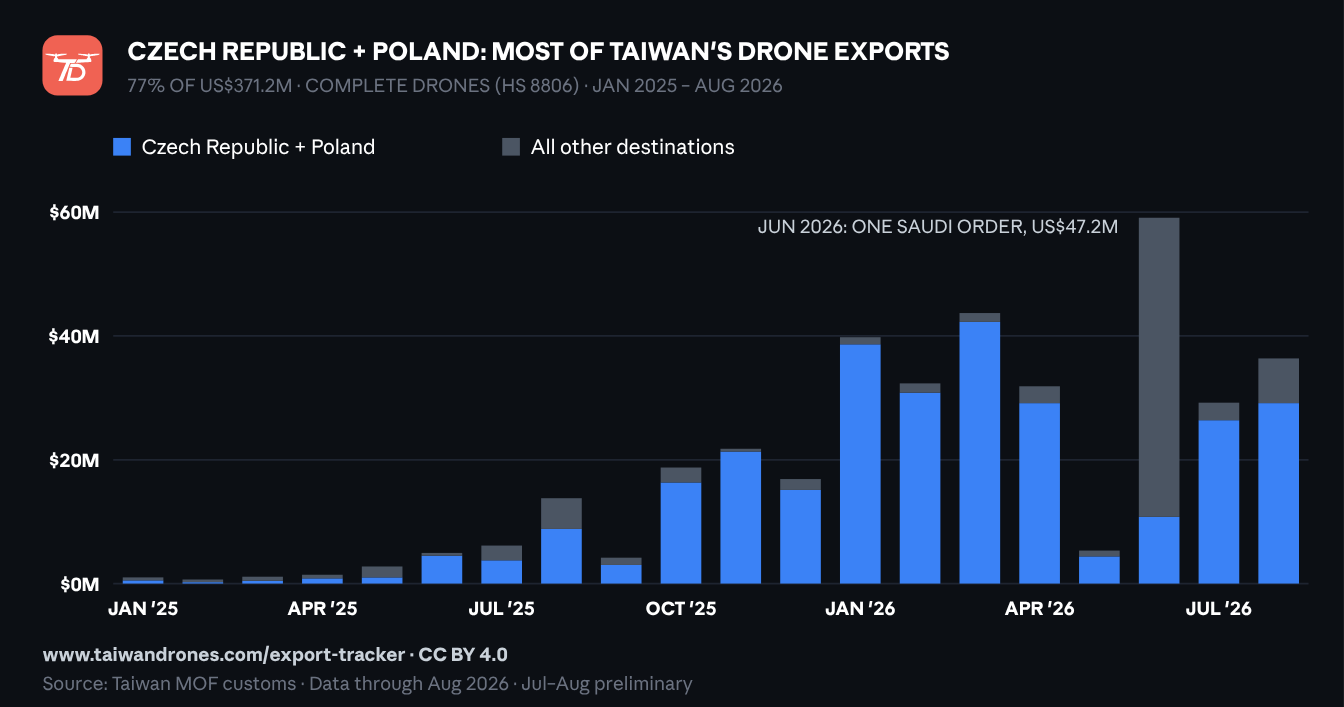
The customs figures cover finished aircraft only. Motors, cells, cameras and flight controllers ship under other headings, so the chart understates the component trade this article is about, and the destination is the declared importer, not the end user.
- Scale. About 274 companies are in the official supply chain. Fewer can serve a foreign buyer, and Taiwan's 2025 output was about one hundredth of China's.
- Price. Many foreign buyers expect Taiwanese components to cost more than their Chinese equivalents. For example, one buyer put a Taiwanese EO/IR gimbal at 1.4 to 2.2 times the Chinese price. A battery pack made from non-Chinese materials can cost about 2.5 times as much.
- Strengths and gaps. The supply base is deepest in propulsion, structures, cells and GNSS and thinnest in datalinks, thermal cores, magnets and battery materials.
- Demand outside Ukraine. Saudi Arabia bought US$47.2 million of complete drones in June. Japan's ACSL, which won a roughly ¥1 billion defense order in March, uses Taiwan-made batteries. Utilities and public-safety buyers replacing DJI form a smaller commercial market.
- United States. US$14.8 million of complete drones from January to August. The component trade is larger: American defense firm AeroVironment alone has bought more than US$20 million of Taiwanese parts over three years.
- Engineers. Drone makers compete for staff with chip firms, which recruited about 47,000 people a month in the first half of 2026.
What the markets reward
Each major market now draws the same line, through its rules or its buyers: a Taiwanese component can qualify, and a finished Taiwanese aircraft mostly cannot.
- United States. Since December 22, 2025, drones and critical components made outside the US cannot get new FCC authorization unless they are on a Blue UAS list or hold a Conditional Approval, which requires a US manufacturing plan. Components reach the Blue UAS Framework through a US Recognized Assessor, and in August MIRDC signed an MOU with one, Edgesource. Complete aircraft can go through ITRI's Green UAS evaluation, which DIU recognized as a pathway to the Cleared List. Drone makers in the Pentagon's Drone Dominance program can use Taiwanese parts now, but the program requires US final assembly from February 2027. Section 232 tariffs of 25% or 100% have applied since September 3; Taiwan's 15% cap depends on the importer certifying allied origin of critical components, and US Customs has not activated it yet.
- Europe. Most Taiwanese trade with the Czech Republic and Poland is paid for with private or national money and faces no content rule. Where EU funds pay, a Taiwanese part can sit inside the 35% allowed from third countries; a complete Taiwanese aircraft generally cannot. The bigger factor is not a rule at all. Ukraine has the capacity to build up to 10 million drones a year and integrates them close to the front, where designs change in weeks. What its makers need from abroad is parts, not finished aircraft.
- India. Imported drones are banned, and imported components are allowed.
- Taiwan. Military tenders require local production or assembly and ban Chinese parts.
The trade already follows these rules. One Taiwanese manufacturer ships 5 million to 7 million battery cells a month into Ukraine's market, and RFE/RL reported that Ukrainian makers use Taiwanese flight controllers, batteries, motors and cameras. About 16% of the hardware materials in Shield AI's V-BAT come from Taiwan, with a target of 25%. Of the 27 drone R&D projects the economics ministry approved in October, 21 were key-technology projects rather than complete aircraft.
The counter-evidence is real but narrow. Saudi Arabia's large June purchase was complete aircraft, and Thunder Tiger's Overkill FPV drone is on the Blue UAS Cleared List. Finished aircraft still sell to buyers without origin rules, or through a listing, one order at a time. The structural pull however runs toward components.
What decides how big the parts business gets
Demand from Ukraine and Europe
Ukraine's demand is driven by attrition. Estimates run from about 2.5 million drones in the first half of 2026 to the defense ministry's figure of capacity for up to 10 million a year. DSET ranks Taiwan the second-largest drone import source in the Czech Republic and fourth in Poland, behind China in both, and seven of 61 Ukrainian makers it surveyed buy from Taiwan. A ceasefire would cut attrition, and Ukrainian firms are making more of their own motors and flight controllers. Against that, Poland has announced a drone armada built with Ukrainian expertise, and European rearmament could absorb volume a ceasefire releases, subject to price and EU content rules.
Chinese content inside the parts
Taiwan's origin claims are strongest at assembly and weakest in materials. China processes about 90% of sintered rare-earth magnets, and Taiwanese motor makers cannot offer non-Chinese magnets for new orders until late 2026 or early 2027. DSET found the Chinese share of cells in Taiwan-made drones fell from about 70% to 50%, but the materials inside a cell, about 70% of its cost, still come mostly from China.
Beijing is tightening the same inputs. Export licenses for heavy drone motors, speed controllers and carbon propellers take effect November 18, and the suspension of China's October 2025 rare-earth controls ends on November 10 or January 10, depending on which text applies. A part with Chinese magnets inside passes fewer of the rules above, and those rules tighten through 2027.
Origin fraud
The same gap creates an incentive to hide Chinese content, and Taiwan's enforcement record cuts both ways. In August, prosecutors detained the head of Hang Jian Technology over training drones for the army's 8th Corps that allegedly used Chinese flight-control boards with the labels covered and false certificates of origin. The parts were reportedly bought on Taobao, and the company had won the contract with a bid of NT$2.95 million against an estimate above NT$4 million. In October, prosecutors detained two executives of Jiin Ming Industry, a listed company, over alleged Chinese chips and lenses in drones for military contracts. Neither of these cases has gone to trial.
The cases show that the army's inspections can catch fraud. They also show that it reaches listed companies as well as small firms, that lowest-price tenders reward it, and that it was caught by a customer with acceptance inspections on the island and prosecutors behind it. A foreign buyer ordering small lots from abroad, often through a distributor, has neither, and even Taiwan's army has only now extended teardown inspection to small purchases. Each case weakens the "non-red" label for every Taiwanese supplier, including honest ones. We have heard from people in foreign drone circles who already suspect that Taiwanese non-red claims cannot be taken at face value, and industry insiders have told AFP they doubt official claims that most exports are free of Chinese parts. Taiwan's origin advantage is worth only as much as buyers believe it, and for now they have reason to check.
Fit with what buyers already use
Much of the drone industry is built around parts China made standard: motor sizes and mounting patterns, stacked four-in-one speed controllers, open firmware and control protocols such as AM32, BLHeli and DShot, and ExpressLRS radio links. An integrator replacing a Chinese part ideally wants one that fits the same holes and runs the same firmware. Taiwan rarely offers that. In our own sourcing work, Taiwan-made high-voltage speed controllers that run DShot firmware were close to nonexistent, and the non-Chinese options available off the shelf were Australian and American.
Part of the explanation is volume, and part is the pull of Taiwan's military specifications, which reward custom designs. Additionally, many Taiwanese suppliers do not track what foreign integrators actually design around. Serious buyers will pay for non-recurring engineering (NRE) to adapt a part to their design. But when every request needs NRE, Taiwanese suppliers lose the routine orders where a Chinese equivalent ships from stock, and those orders make up much of the volume. A part that requires a redesign to adopt is a harder sell than one that drops in, whatever its origin.
Competition
Taiwan is one of several non-Chinese sources. Unusual Machines makes about 15,000 motors a month, the Army's Tobyhanna depot has lines rated at up to 500,000 a year with an initial target of 200,000, and Performance Drone Works has a conditional loan commitment of up to US$820 million. South Korea plans to buy 60,000 training drones built only with domestic core components, and Vietnam's Gremsy has three payloads on the Blue UAS list through Gremsy USA. US programs want a non-Chinese supplier; few require a Taiwanese one, and the Drone Dominance framework's stated end goal is a wholly domestic supply chain.
Cross-strait risk
Buyers treat a single-site supplier within range of China as a second source, and most Taiwanese drone SMEs run one site on the island. The obvious objection is that the world depends on TSMC despite the same geography. That is the point. TSMC is the dependence the US, Europe and Japan have spent the past five years subsidizing chip plants to reduce, and they are writing drone policy so as not to repeat it. The Drone Dominance framework's stated end goal is a wholly domestic supply chain, and EU-funded programs require 65% of component value from Europe or Ukraine.
Drones also lack what protects TSMC. There is no second source for leading-edge chips, so buyers accept the risk. Drone motors and cells can be made elsewhere at some extra cost, so buyers can afford to cap Taiwan's share. DSET advises buyers to hold six months of upstream inventory.
Where production happens
Political announcements often describe Taiwan as a place where foreign companies will assemble drones. On October 30, former Czech Chamber of Deputies president Markéta Pekarová Adamová, who now works in the defense industry, said Czech manufacturers are interested in setting up drone assembly lines in Taiwan.
For export production, that runs against everything above. Assembly is the lowest-value step, the Czech companies' customers are about 9,000 km away, their designs change in close contact with frontline users, and Taiwan is the most exposed site in a blockade. Wages are not the obstacle: average manufacturing earnings were about CZK 50,400 a month in the Czech Republic and NT$80,300 in Taiwan, broadly similar in US dollars. Trade runs the other way: many of the Czech Republic's 16 drone companies rely on Taiwanese suppliers.
The domestic exception
Building foreign designs in Taiwan makes sense when Taiwan's own forces are the customer. A blockade would cut off imported drones and spares, so local production is the point, and a foreign firm can supply the design while a Taiwanese partner builds it. The clearest case involves Anduril's Altius-600M, delivered without chargers because the original units contained Chinese parts. In September, legislator Wang Ting-yu said a Taiwanese company had received technology transfer and begun producing the batteries; the army, Anduril and the manufacturer have not confirmed it. Kratos and NCSIST aim to mass-produce the Mighty Hornet IV in Taiwan, and AeroVironment signed an exploratory MOU with Thunder Tiger on joint production in Taiwan. Local assembly protects supply in a blockade only if the imported inputs are stockpiled.
This market depends on a buyer that has struggled to buy. The legislature removed domestic drone procurement from the May special budget, then passed a KMT-written law providing NT$240 billion over six years, still subject to annual appropriation. The economics ministry, which must administer it, said its committee structure invites gridlock; the KMT argued for tighter budget oversight. Tenders have also failed for reasons money alone will not fix. The army terminated Tron Future's NT$987.8 million counter-drone contract after three failed acceptance tests and penalized the company NT$140.3 million. The Coast Guard's NT$1.2 billion surveillance-drone tender failed in June when most qualified firms declined to bid on near-military specifications. Lowest-price awards, as in the Hang Jian case, favor suppliers who cut corners on origin.
Production abroad
The other half of the pattern is Taiwanese suppliers building near foreign customers. A few have committed; most of the industry has not, and most entries below are announcements rather than completed investments.
| Company | Location | Form | Status |
|---|---|---|---|
| Thunder Tiger | Ohio, US | Motor production joint venture | Announced; 60,000 to 120,000 motors a year planned |
| UAVER | Texas, US | Assembly plant with ASC Global | Announced August 2025 |
| Ahamani | India | NBC Bearings taking a 30% stake in Ahamani India | Agreed January 2026 |
| AVIX | India | Joint venture with Optiemus | Announced |
| Ahamani | Poland | Drone and component production with Farada | Agreed in principle; no plant confirmed |
| Unnamed group of Taiwanese makers | Poland | Production line with a local aircraft builder | Scouting sites as of July |
The rules push this way: FCC Conditional Approvals require a US manufacturing plan, Drone Dominance requires US assembly from 2027, Section 232 lets an approved US plant import duty-free during construction, India requires local production, and SAFE requires contractors established in the EU. What holds suppliers back is scale and demand. Taiwan's largest 2025 production runs were in the low thousands of units, few suppliers have an anchor customer abroad, and Thunder Tiger's chief executive has asked for predictable policy rather than subsidies.
Government support points inward. Taipei is financing a Texas park of up to NT$129.8 billion for chip and AI suppliers that does not name drone makers, and a comparable park would cost about 10 times the drone industry's 2025 output. The ministry's drone money goes to domestic clusters and to its goal to remove reliance on China for drone parts by 2027.
That leaves a conflict. Taiwan's defense planning needs capacity on the island, its export markets want production in their own countries, and few firms have the capital or engineers for both. Revenue from abroad can fund R&D at home, and US co-production could build stocks for Taiwan before a crisis, but current announcements do not describe plants that would serve Taiwan. The division that fits both needs keeps design, key components and domestic-defense production in Taiwan and moves final assembly for foreign customers abroad, usually through a joint venture or license in which the foreign partner owns the plant. We have found no government policy that sets this out.
Five outcomes, and how likely each is
Each outcome below has a definition that can be checked, the main evidence on each side, and our estimate of the probability that it holds by the end of 2028. The estimates are judgments built from the evidence in this article, not model output. The outcomes are not exclusive, so the probabilities do not sum to 100%.
1. Parts supplier
Definition: by the end of 2028, components outsell complete drones in Taiwan's drone exports, and several Taiwanese components are on the Blue UAS Framework.
For: every major market's rules admit Taiwanese parts more readily than Taiwanese aircraft, and the trade already follows: battery cells into Ukraine, about 16% of V-BAT's hardware, US$20 million of parts to AeroVironment, 21 of 27 ministry R&D projects in components. More than 20 firms have requested pre-assessments from ITRI, and MIRDC's link with Edgesource gives components a route to the Framework.
Against: no Taiwanese component is listed yet. US motor capacity is growing fast, Drone Dominance aims for a wholly domestic supply chain, and buyers expect Taiwanese parts to cost more than Chinese ones.
Estimate: 70 to 80%.
2. Electronics supplier
Definition: by the end of 2028, a Taiwanese-designed flight-control, video or radio chip is in volume production in foreign drones.
For: the economics ministry's first drone-chip round funded seven projects with NT$326 million, led by Coretronic and iCatch's 6-nanometer image-chip platform. A second round announced in November, led by Elan Microelectronics, budgets NT$1 billion for 11 chips, including a radio chip for software-defined datalinks and an AI processor. An Elan subsidiary already ships a drone image processor to five customers. Low-cost drones rely on Chinese video chips such as SigmaStar's and Artosyn's, and a chip designed, made and packaged in Taiwan settles the origin question in one step.
Against: no funded vendor has published a unit price, and price depends on volume that no buyer has committed. The four flight-control projects together received less than the single image-chip project, although flight control and communications are the gaps the government itself names. Lowest-price tenders work against compliant chips.
Estimate: 25 to 35%.
3. Domestic defense production
Definition: by the end of 2028, the NT$240 billion law has been funded in each annual budget, and the army's counter-drone re-tender and the 48,750-drone procurement have been awarded and are delivering.
For: the law was written by the opposition KMT, which gives it backing across both main parties, and the Cabinet has asked for a further NT$55.9 billion for coastal attack drones and uncrewed boats. Licensed production of foreign designs has started to appear.
Against: the May cut to zero, the Tron termination, the failed Coast Guard tender and two origin prosecutions all date from the past six months. Each year's money still needs a vote, and the army plans to pay more per system rather than change how it specifies and awards contracts.
Estimate: 40 to 50%.
4. Post-ceasefire contraction
Definition: before the end of 2028, complete-drone exports to the Czech Republic and Poland fall by more than half from their 2026 monthly average for at least two consecutive quarters, and no other market replaces them.
For: those two countries took about 80% of complete-drone exports in August. Shipments fell 85% in a single month in May. DSET has warned that European demand may not outlast the war, Ukrainian makers are localizing motors and flight controllers, and an EU-backed carve-out lets Ukraine buy Chinese components where others cannot deliver.
Against: shipments recovered in July and August, Poland and the EU are building drone forces of their own, and Ukraine's demand runs to millions of drones a year. This outcome is mostly a bet on a ceasefire, which no trade data can forecast.
Estimate: 25 to 35%.
5. Final assembler on Chinese inputs
Definition: at the end of 2027, when the US magnet and assembly rules tighten, most Taiwanese drone motors and battery packs sold on new orders still contain Chinese magnets or cell materials.
For: China processes about 90% of sintered magnets, Taiwanese motor makers cannot offer non-Chinese magnets for new orders before late 2026 or early 2027, and cell materials still come mostly from China. ITRI's rare-earth refining pilot line is about three years away, and this publication has put the chance of a cost-competitive China-free cathode and anode supply by 2027 at 20 to 30%.
Against: the Chinese share of cells fell from about 70% to 50% in a year. The DFARS magnet rule creates paying demand for clean motors, and some buyers are already willing to supply their own magnets to Taiwanese motor makers.
Estimate: 50 to 60%.
Where the data leans
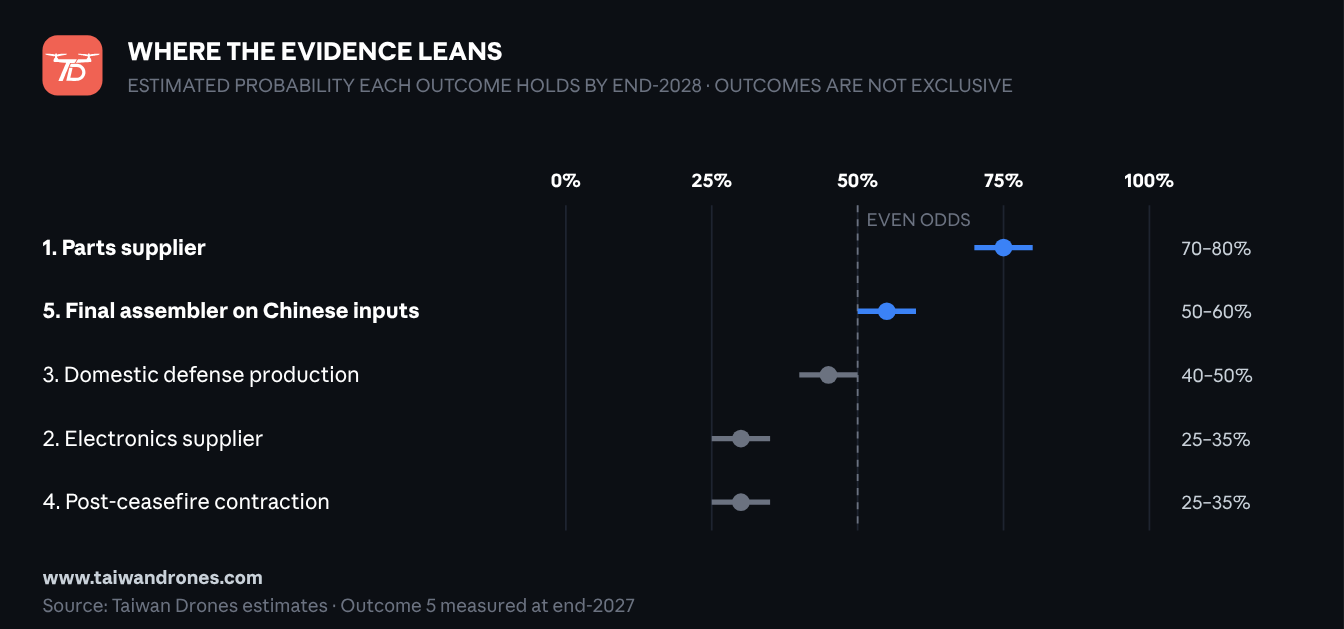
Put together, the evidence leans toward a parts business that is still tied to Chinese materials. Outcome 1 is the most likely, because the rules in every major market point that way and the trade already follows them. Outcome 5 is close behind, because the magnet and cell-material gaps are unlikely to close before US rules tighten in 2027. Both can hold at once. If they do, Taiwan sells more parts but stays out of the strictest US programs, which is where the margins are.
The other three are less likely. Domestic production depends on Taipei fixing how it buys as well as how much it spends. The electronics upside has the most new activity but no published prices or volumes. A post-ceasefire contraction is the largest outside risk and the hardest to forecast.
The data also argues against the description of Taiwan as a hub where foreign firms assemble drones for export. That outcome has no support in the evidence. What the evidence shows is Taiwanese parts and licenses going out and assembly moving toward customers, except for drones built for Taiwan's own forces.
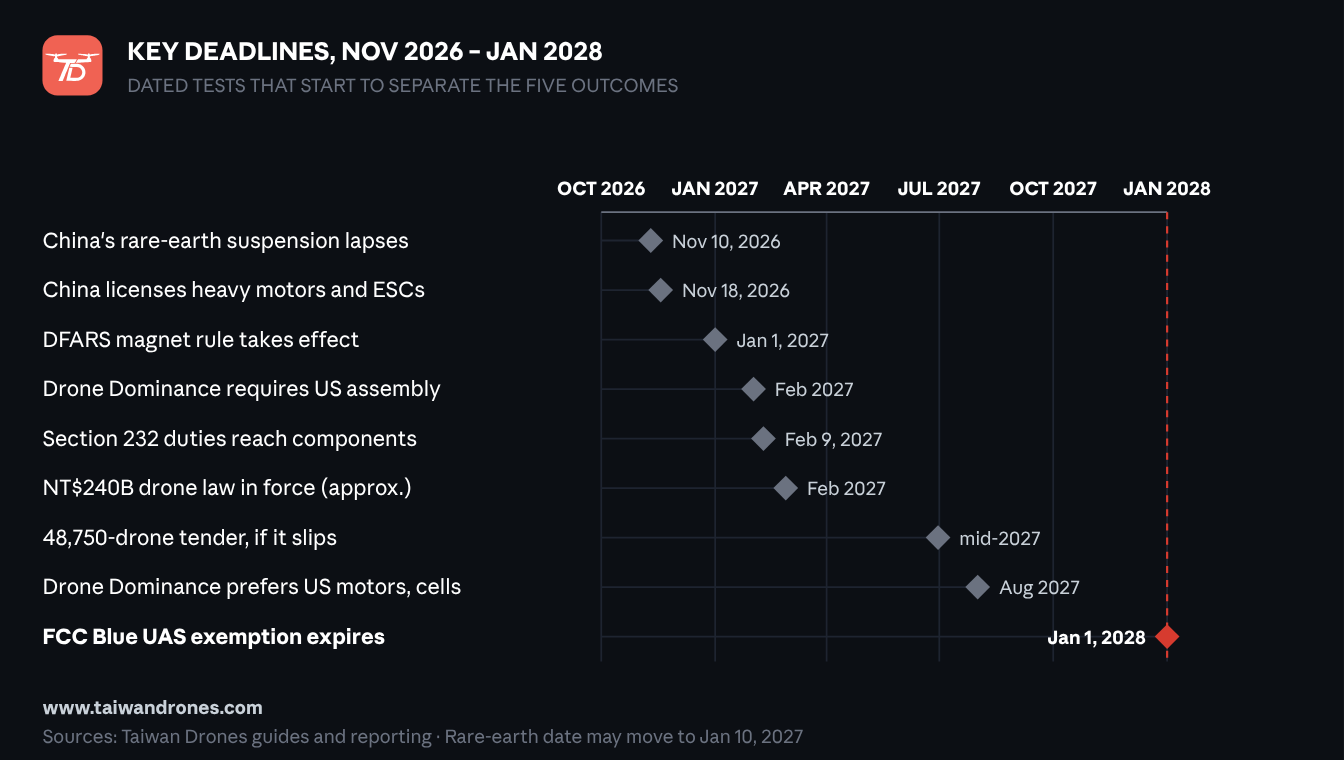
China's controls arrive first, the US rules bunch up in early 2027, and the FCC exemption for Blue UAS listings ends in January 2028.
Indicators to watch
- Blue UAS Framework: the first Taiwanese component listed (outcome 1).
- Magnet origin: whether Taiwanese motor makers can offer non-Chinese magnets on new orders in 2027 (outcome 5).
- Chip prices: a published unit price and annual capacity from any ministry-funded drone-chip vendor, and Elan's mass-production date (outcome 2).
- Taipei's procurement: the first year's money under the NT$240 billion law in the 2027 budget, and whether the army's counter-drone re-tender is awarded and delivered (outcome 3).
- The corridor: the monthly share of complete-drone exports going to the Czech Republic and Poland, and SAFE-funded orders reaching Taiwanese suppliers (outcome 4).
- Production abroad: equity investments, as distinct from MOUs, by Taiwanese suppliers in the US, India or Europe.
- US tariffs: activation of the 15% allied rate under Section 232.
What would change this assessment
- A complete Taiwanese aircraft winning a large US or EU-funded program would weaken the case for outcome 1.
- Component exports falling as Ukraine localizes, without European orders to replace them, would raise outcome 4.
- A delivered counter-drone re-tender and a funded first year under the new law would raise outcome 3.
- Non-Chinese magnets available in volume for new motor orders would cut outcome 5 sharply.
What Taipei could do differently
If the government wants Taiwan to be a trusted source of drone hardware, the evidence above points to seven changes. Each targets a specific outcome. Taipei already funds R&D grants, domestic clusters, ITRI's Green UAS evaluations and a rare-earth refining pilot; the gaps are elsewhere.
- Pay for origin proof down to materials (outcomes 1 and 5). The binding constraint is not assembly but magnets and cell materials, and the rules that pay for clean parts tighten in 2027. Offtake guarantees for non-Chinese magnets and cathode materials, and a funded six-month input stockpile for defense suppliers, would do more for Taiwan's position than further assembly subsidies. So would co-funding per-product Blue UAS and Green UAS assessments for small suppliers, who are waiting for orders before they pay.
- Buy on value, not lowest price (outcome 3). The Tron and Coast Guard failures came from specifications the budget did not pay for, and the Hang Jian case from a lowest-price award. Budgets set from current market prices, specifications based on proven products, multi-year framework contracts and lot-level teardown inspection would give domestic suppliers volume and reward compliance.
- Be the first customer for Taiwanese chips (outcome 2). The chip programs fund design but not demand, and unit prices depend on volume. Writing Taiwan-designed and Taiwan-packaged flight-control, radio and video chips into defense and coast-guard specifications would give vendors an anchor order to price against. The current split, with flight control receiving less than a single image-chip project, runs opposite to the government's own list of gaps.
- Back production abroad that also serves Taiwan (outcomes 1 and 3). Drone makers are not named in the US supplier parks, and few can build abroad alone. Including them, or financing joint ventures in the US, India and Poland, would help them meet local-content rules. Making support conditional on reserved capacity or stock for Taiwan's forces would turn the conflict between export markets and domestic defense into an arrangement that serves both.
- Work on rule access, not only branding (outcomes 1 and 4). Taiwan cannot join the EU's partner list, but it can seek access to third-party assessment under the coming EU Trusted Drone label, support passage of the Blue Skies for Taiwan Act, and seek Recognized Assessor status for a Taiwanese body so components need not route every assessment through US firms.
- Measure drone diplomacy by orders (all outcomes). MOUs, delegations and talk of foreign assembly lines in Taiwan generate headlines without trade. Reporting what each agreement produced (contracts, shipments, listings) would focus effort on the parts business that is actually growing.
- Help suppliers sell, not just exhibit (outcomes 1 and 2). Foreign buyers describe the same problems again and again: slow replies, quotes without English datasheets, no clear answer on export permits, and evaluation orders declined as too small. The comparison buyers make is with Chinese suppliers, which tend to answer quickly, quote readily, follow up, and market themselves with English-language websites and advertising. Government support centers on trade-show delegations and MOUs. A program aimed at individual suppliers would do more: funded English technical documentation, websites and international marketing, market intelligence on the standard parts foreign integrators design around, help with export permits for strategic high-tech goods, co-funding for small evaluation runs, response-time expectations for firms that join government delegations, and technical support based in Europe and the US. Chinese suppliers set the standard of service buyers expect, and competitors in Poland, Ukraine and the US sit closer to the buyer. Taiwanese suppliers have to close both gaps. Disclosure: TaiwanDrones.com runs a sourcing service that introduces foreign buyers to Taiwanese suppliers, so it has an interest in this recommendation.
What it means for buyers and suppliers
Buyers should treat Taiwan as a second source with real strength in propulsion, structures, cells and GNSS. Ask for origin documents at the materials level for motors and batteries, ask which Blue UAS route a supplier is on, check whether a program uses EU funds before applying the 35% cap, and write lot traceability, change notification and inventory buffers into contracts.
Suppliers should expect the margin to sit in parts and, increasingly, in documentation. Those targeting the US should start a Blue UAS route now: components go through a US Recognized Assessor, and the FCC exemption runs to January 1, 2028. Capacity should not be sized on war volume. India's open market for components and Japan's smaller, higher-margin market are worth a look, and buyers will increasingly ask where else a supplier can produce.
Sourcing drones or components from Taiwan?
Tell us what you need — we match it to verified Taiwan-based manufacturers and make the introduction. There's no charge to submit a request.
Source these components from Taiwan →The hardest parts to make non-PRC: a drone component risk map
Oct 26, 2026
Seven components carry most of the Chinese content in drones built outside China...
Could Taiwan's US Supplier Parks One Day Include Drone Makers?
Oct 19, 2026
Taiwan plans industrial parks in the US to help the smaller suppliers of its chi...
Non-Red Is a Requirement, Not a Label: Why TaiwanDrones.com Is Asking Suppliers for Documents Instead of Declarations
Oct 9, 2026
We planned to launch a China-Free verification program with our supplier directo...