The Drone Dominance Program Supply Chain Framework, Decoded — and What Changed on July 23

July 28, 2026
Most of what gets written about U.S. drone supply-chain policy works from press releases and secondhand summaries. The underlying document is public, and it is more precise than any summary of it. The Drone Dominance Program (DDP) — a $1.1 billion advanced market commitment to buy more than 200,000 Group 1 one-way-attack small drones — publishes a Supply Chain Framework that spells out, for every major component, exactly what sourcing will be required and when. For a supplier trying to understand where it fits, the framework is the map. This is a decode of it.
Two notes before the detail. First, the framework is program policy, not statute. It applies to DDP purchases and, in several places, deliberately runs ahead of what the law currently requires. Second, it was revised on July 23, and the changes are meaningful.
What changed on July 23
The framework's first version was dated April 27, 2026. Version two, published July 23, is not a cosmetic update. Three changes matter.
The destination hardened from "non-Chinese" to "wholly domestic." Version one set out to purchase drones "without any components, subcomponents or raw materials sourced from covered countries — principally China — at every tier." Version two keeps that language and adds a sentence that changes the horizon: the ultimate goal is now a "wholly domestic" small-drone supply chain, to be reached "as soon as is practicable." That is a different and more demanding end-state — not merely the removal of Chinese content, but a preference for American production, which over a long enough horizon points past allied suppliers too.
Two new component areas were added to the top of the table — and they are the two hardest. Version one's migration table began with the flight controller. Version two prepends two new tracked line items: final assembly (where the drone is physically built) and active components — the semiconductors: processors, systems-on-chip, memory, RF and programmable chips. Adding these is significant precisely because they are the parts the program's own leadership has called the toughest to source domestically. The July revision reached simultaneously further up the chain (assembly location) and further down it (chip fabrication).
A new longest-horizon preference tier was added. Version one's schedule topped out at a Phase 4 minimum. Version two adds a Phase 4 preferred column — the most aggressive, most domestic tier in the document, describing U.S. and Western-Hemisphere sourcing for nearly every component. The program didn't just tighten the near-term floor; it extended the ceiling further toward fully domestic.
All three edits move in one direction: harder, and more domestic.
How to read the framework
The framework rests on three ideas.
Three sourcing tiers. Every requirement is written in terms of where a thing is made, on a ladder of three rungs:
- NCC — non-covered-country. Sourced outside China, Russia, North Korea, and Iran. This is the allied tier. Taiwan is NCC. A Taiwanese motor, datalink, or flight controller satisfies an NCC requirement.
- Nearshored. Defined specifically as the Western Hemisphere — the Americas. Taiwan is not nearshored.
- U.S. Made in the United States.
This distinction is the single most important thing in the document for a Taiwanese supplier, and we return to it below.
Four phases, tightening over time. Requirements escalate on a calendar: Phase 1 (the NDAA baseline, already in effect), Phase 2 (August 2026), Phase 3 (February 2027), Phase 4 (August 2027). Each phase has a minimum (the disqualifying floor — miss it and you cannot compete) and a preferred tier (attributes that earn extra scoring weight and signal where the program is heading). A useful rule the framework states directly: each phase's preferred becomes the next phase's minimum. In other words, today's bonus is tomorrow's requirement.
Direction of travel. Read left to right, nearly every row follows the same arc: NCC assembly at the Phase 2 minimum → NCC deepening into PCBs and subcomponents through Phase 3 → U.S. or nearshored production preferred by Phase 4. The program is walking suppliers from "not Chinese" toward "American," one phase at a time.
The table, component by component
| Component | Phase 2 MinimumAug 2026 · floor | Phase 2 PreferredAug 2026 | Phase 3 MinimumFeb 2027 | Phase 4 PreferredAug 2027 · most domestic |
|---|---|---|---|---|
| Motorsmagnets, rare-earth feedstock, stator | NCC motor assembly; specialty metals US/qualifying-country melted. No statute requires this — DDP-only. | NCC assembly; DFARS-compliant magnet sourcing plan | NCC assembly, magnet production & winding; disclosed feedstock origin | US/nearshored assembly & winding; NCC magnets & feedstock |
| Batteries & BMScells, pack, BMS electronics | NCC pack assembly; no CATL / listed Chinese entities | + NCC BMS assembly & PCB; firmware repo off covered-country hosting | NCC cells (FY26 NDAA §842); NCC BMS components | US pack assembly & US-manufactured cells |
| Comms & Data Linkradio, VTX/VRX, RF, encryption | NCC assembly; no Sec 889 parts; ASDA-compliant | + NCC PCB; firmware repo off covered-country hosting | NCC RF chips & PCB; NCC encryption module; firmware repo US-controlled, auditable | US/nearshored assembly, RF semiconductors & PCB |
| Flight Controllerprocessor, IMU, sensors, FC PCB | NCC assembly; no Sec 889 parts; ASDA-compliant | + NCC PCB; firmware repo off covered-country hosting | NCC PCB; firmware repo US-hosted & controlled, auditable | US assembly; US/nearshored PCB; NCC passives |
| Ground ControlGCS hardware, software, controller | NCC assembly; no Sec 889 parts | + NCC PCB; software repo off covered-country hosting | NCC PCB; all GCS software repos US-controlled, auditable | US hardware assembly; US/nearshored PCB; subcomponent place-of-manufacture disclosure |
| Final Assembly new in v2 (July 23) | NCC final assembly | US final assembly | US final assembly | US final assembly |
| Active Components logic-bearing ICs / semiconductors — new in v2 | — | NCC wafer fab & packaging (exc. signal/voltage conditioning ICs) | NCC wafer fab & packaging | US/nearshored wafer fab & packaging |
How to read this: Each phase's preferred tier generally becomes the next phase's minimum — today's bonus is tomorrow's floor. Phase 2 minimum is disqualifying: miss it and a system cannot compete. NCC (non-covered-country) is the allied tier, and Taiwan qualifies for it; nearshored means the Western Hemisphere, which Taiwan does not. The arc of nearly every row runs allied → domestic. Selected component areas shown; the full framework covers 15. Verified against framework v2 (July 23, 2026); requirements are program policy and subject to revision — confirm against the current version before any commercial decision.
What follows are the component areas most relevant to Taiwan's manufacturers, with the practical requirement at each stage. Where the framework runs ahead of statute, that is noted, because it tells you where the program is applying pressure beyond what the law compels.
Motors. The Phase 2 minimum (August 2026) is NCC motor assembly, with specialty metals melted in the U.S. or a qualifying country. The framework flags that this is a program requirement with no current statute mandating non-Chinese motors for this class of drone — the DDP is out ahead of the law here. Phase 2 preferred adds a DFARS-compliant magnet sourcing plan; Phase 3 pushes into NCC magnet production and winding with disclosed rare-earth feedstock origin; Phase 4 preferred moves assembly and winding to U.S. or nearshored, with NCC magnets and feedstock. For a Taiwanese motor maker, the near-term bar (NCC assembly) is reachable now; the magnet and rare-earth chain is where the difficulty escalates.
Batteries and BMS. Phase 2 minimum requires NCC pack assembly and bars cells from specific listed Chinese entities including CATL. Phase 2 preferred adds NCC battery-management-system assembly and PCB. Phase 3 goes further — NCC cells compliant with the relevant FY26 NDAA provision, plus NCC BMS components. Phase 4 preferred requires U.S. pack assembly and U.S.-manufactured cells. This is the row that most exposes the depth of the problem: as covered in our earlier reporting, the dependency runs upstream into cell materials, and the framework's later phases reach for exactly that.
Communications and data links. Phase 2 minimum: NCC assembly, no Section 889 components, ASDA-compliant, parts from original manufacturers or authorized distributors. Phase 2 preferred adds NCC PCB and a requirement that firmware source-code repositories not be hosted in or administered from a covered country. Phase 3 tightens to NCC RF chips and PCB, NCC-sourced encryption module if applicable, and firmware repos hosted and controlled by a U.S. entity, auditable on request. Phase 4 preferred moves to U.S. or nearshored assembly, RF semiconductors, and PCB. Note how much this row is about software control, not just hardware origin — where the code lives becomes a sourcing requirement.
Flight controllers. The same arc: Phase 2 minimum is NCC assembly with no Section 889 parts and ASDA compliance; preferred adds NCC PCB and the firmware-repo-location rule. By Phase 3, the firmware repository must be hosted and controlled by a U.S. entity and auditable. Phase 4 preferred requires U.S. assembly and U.S./nearshored PCB. For the most safety-critical component on the aircraft, the program moves fastest toward U.S. control of the software layer.
Imaging and optics, GNSS, ESCs, companion computers, ground control. Each follows the pattern — NCC assembly and parts at the Phase 2 floor, NCC PCB and firmware-repo-location preferred, U.S.-entity firmware control by Phase 3, and U.S./nearshored production preferred by Phase 4. The ground control system row adds progressively stricter software-repository control and, by Phase 4, "place of manufacture" disclosure down to subcomponents.
Final assembly and active components (the two new rows). Final assembly starts at NCC and moves to U.S. as the preferred tier from Phase 2 onward — the program wants the aircraft physically built domestically, sooner rather than later. Active components — the semiconductors — is where the framework is most candid about difficulty: it holds NCC wafer fabrication and packaging as a preferred target through the middle phases and only reaches for U.S./nearshored fabrication at Phase 4 preferred, acknowledging the long qualification cycles chips require. These are the two areas the program added in July, and their placement tells you where it now believes the hardest work lies.
What the framework means for Taiwan
Read as a whole, the document says two things at once, and both matter.
Near term, it is an invitation. For Phase 2 and much of Phase 3, the operative requirement is NCC — allied sourcing. Taiwan is NCC. A Taiwanese manufacturer that can meet the assembly and PCB requirements, keep firmware repositories out of covered countries, and document its sourcing is not a fallback option; it is precisely what the minimum calls for. The near-term deadlines are close — Phase 2 is August 2026 — and the components most in question, motors and batteries and datalinks, are ones Taiwan already builds. This is the opening.
Long term, it points past allies. The preferred tiers that will become future minimums move steadily toward "U.S. or nearshored." Nearshored is the Western Hemisphere. Taiwan is neither U.S. nor Western Hemisphere. A supplier that reads only the Phase 2 column sees an open door; a supplier that reads the Phase 4 column sees that the door is scheduled to narrow. The best non-covered-country credentials in the world do not, on their own, reach the tier the program is ultimately steering orders toward. Only production in the United States or the Americas does.
That is not a contradiction in the framework; it is the framework's design. It is built to pull a supply chain from Chinese-dependent, through allied, to domestic, on a schedule. Taiwan's suppliers occupy the middle rung — genuinely wanted there now, and genuinely being moved through it. What a Taiwanese firm does with that position — treat it as a durable export market, or as a runway toward a U.S. production presence that stays on the right side of the domestic-content line — is the strategic question the framework poses. We will take up that question, and the case for U.S. co-production, in an upcoming analysis later this week.
Sourcing note: this decode is drawn directly from the DDP Supply Chain Framework, versions one (April 27, 2026) and two (July 23, 2026), read against each other. The framework is program policy and subject to revision; specific phase requirements should be verified against the current version before any commercial decision.
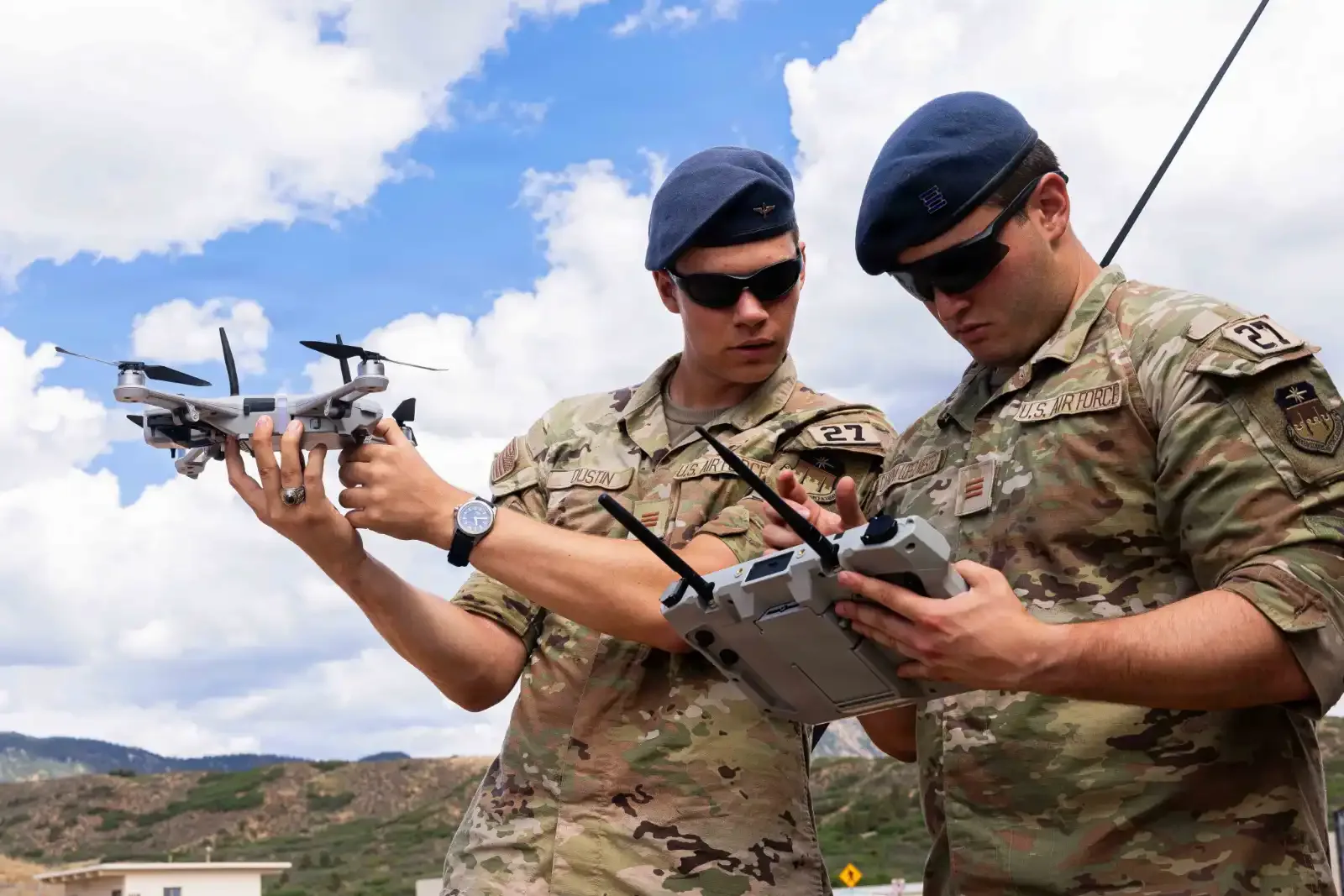
Photo credit: Department of War — Trevor Cokley, U.S. Air Force
Sourcing drones or components from Taiwan?
Tell us what you need — we match it to verified Taiwan-based manufacturers and make the introduction. There's no charge to submit a request.
Source these components from Taiwan →Taiwan Drone Components vs. China: What the Battery Supply Chain Data Shows
Jul 24, 2026
Taiwan is now Ukraine's third-largest drone battery supplier, but new DSET resea...
Taiwan's Drone Cluster Is Forming. Can Its Own Party's Bill Undo It?
Jul 10, 2026
Taichung Mayor Lu Shiow-yen wants central funding for a drone corridor built on...
Taiwan's MOEA Drone Subsidy Program: What the 2026 R&D Grant Means for Non-Red Supply Chain Suppliers
Jun 22, 2026
Taiwan's Ministry of Economic Affairs has opened applications for its Drone Adva...