
China Just Put Drone Motors Under License. Can Taiwan Move From Second Source to First Choice?

October 29, 2026
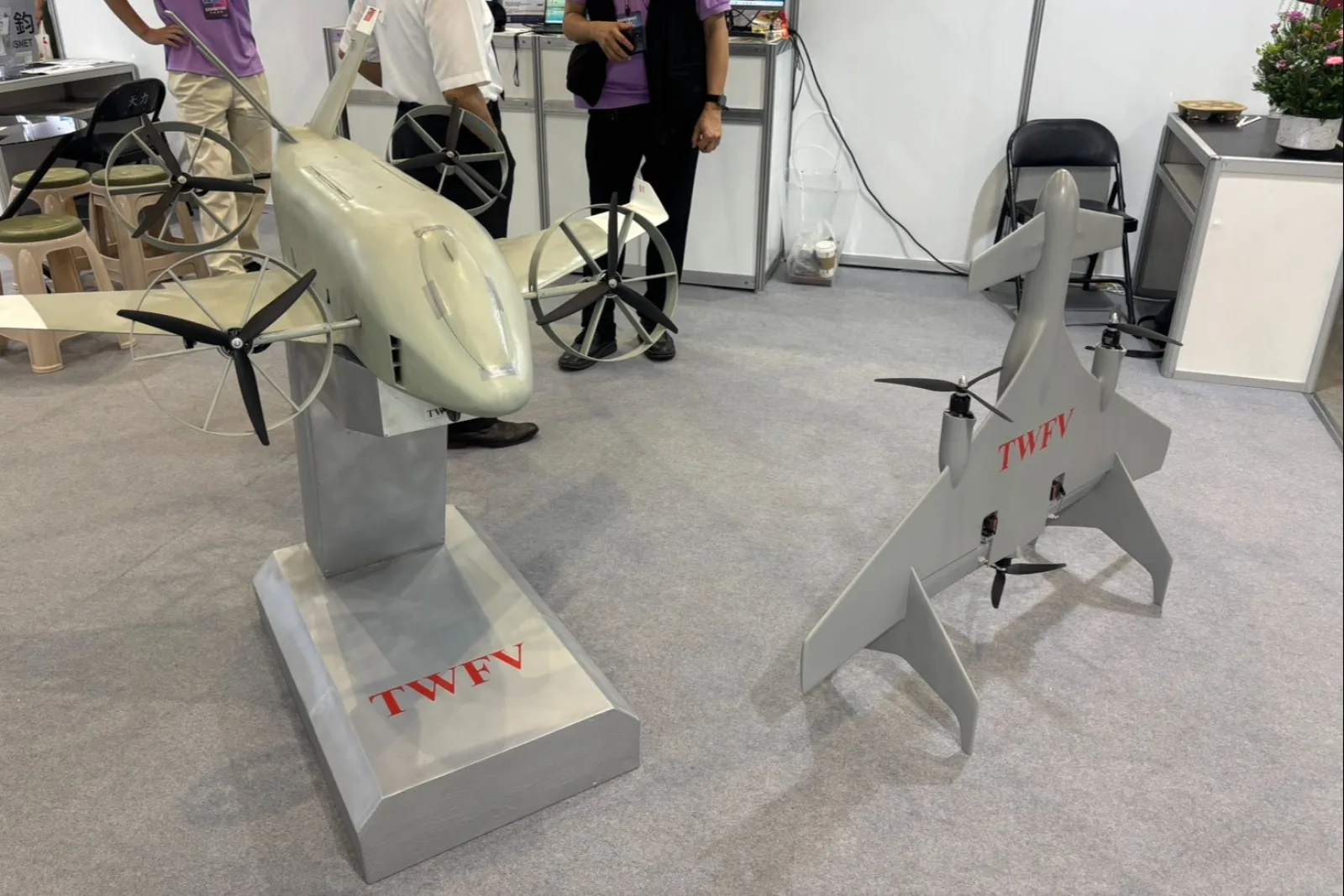
On October 19, China's Ministry of Commerce, the General Administration of Customs and the Central Military Commission's Equipment Development Department published a revised drone export-control regime that takes effect on November 18. It eases licensing for consumer drones and puts high-power brushless motors, speed controllers, carbon-fiber propellers, multi-drone radios and flight-control and navigation technology under license. A license is not a ban, but it adds paperwork, lead time and the risk of refusal to the parts that cheap, expendable military drones use up fastest, just as Washington and Europe's five largest military powers ask industry for those drones in volume.
For most of the past three years, "second source" in the drone industry meant a hedge: keep buying from China, qualify someone else in case a restriction arrives. We made that case for Taiwanese components on October 5. This year China has changed the premise twice. In April and July it put named European defense suppliers on its export control list, and for those companies Chinese dual-use supply now depends on special approval, so a second source carries most of the load. From November 18, buyers anywhere who need the larger motors and controllers will need their Chinese supplier to hold an export license. Licensed exports will continue; what changes is how long they take and how certain they are.
Three caveats belong at the top. First, the October 19 announcement is reported here from Chinese press coverage of the official text, and buyers should check the parameters against the Ministry of Commerce original before acting on them. Second, the demand signals are early. The US program described below has a shortlist, not a contract, and Europe's joint initiative has so far placed only small national development awards. Third, nothing here suggests Taiwan can replace China across a drone's bill of materials in the near term. The question is narrower: for which components can Taiwan become a dependable alternative while Chinese supply grows less predictable.
Beijing has controlled drone parts by type and by buyer
China's earlier drone controls worked by item. Beijing began restricting dual-use drones and components in 2023, extended controls to specific parts in 2024, and on August 5 this year put drone-related exports to the United States under case-by-case review with no license facilitation.
October 19: the item list got longer. The new rules relax civilian thresholds, raising the endurance trigger for an individual license from one hour to three and letting drones with 0.5 to 3 hours of endurance ship after registration, according to China Times. The same report lists the new controls: brushless motors rated at 48 volts or more, 3 kilowatts or more and a power density of at least 3 kW/kg at no more than 3,000 rpm; speed controllers at 48 volts and 3 kilowatts; carbon-fiber propellers by size and variable pitch; radios that control more than 10 drones from one station; and flight-control and navigation technology including swarm control, terrain-matching and anti-jamming satellite navigation. Exporters with a working internal compliance program and established end users can also apply for general licenses, according to 21st Century Business Herald. Chinese commentators summarized the package as freeing civilian drones and locking down military ones.
The thresholds matter. A typical FPV motor falls well below 3 kilowatts. The new controls reach the heavy-lift and long-range class: the propulsion for interceptors, one-way attack drones of the Shahed type and multi-rotor cargo drones. That is the class both Western programs below are trying to buy in quantity.
April 24 and July 24: named buyers. Two earlier listings worked by entity. In April the ministry banned dual-use exports to Germany's Hensoldt, Belgium's FN Herstal and FN Browning, and four Czech companies, Excalibur Army, Omnipol, VZLU and SpaceKnow, citing "arms sales to or collusion with Taiwan," as The Diplomat reported. In July, answering the EU's 21st Russia package and its 14 Chinese and Hong Kong listings, Beijing named 14 more, including Italian motor maker Lafert, motion-control supplier Garnet, Rheinmetall, French drone developer Cavok UAS, Czech truck maker Tatra, Dutch shipbuilder IHC, Lithuanian laser maker Ekspla, and two Polish entities, Wrocław University of Science and Technology and Vigo Photonics. Warsaw's Centre for Eastern Studies concluded that the targets appeared to be chosen for their weight in European defense supply chains.
The EU's next test is close. On October 12 the Council adopted a record 1,569 listings of Russian component suppliers and their executives, and Brussels says it aims to pass a full 22nd package before the end of the year. We could find no Chinese response to the October listings. We assess it as roughly 65 to 80 percent likely that MOFCOM adds further European defense or drone-related entities within 12 months. The reasons: two listings in three months, EU packages that keep naming Chinese suppliers, and Beijing's demonstrated habit of answering within a day. It stays below certainty because Beijing also has reasons to avoid a wider rupture with Brussels.
Buyers want volume they can afford to lose
The supply squeeze is arriving just as the demand side changes shape. Across the US and European programs, the requirement has moved from a small number of costly aircraft that cannot be lost to large numbers of cheaper ones that are expected to be.
Washington wants a cheaper Reaper. The US lost nearly 30 MQ-9 Reapers in the war with Iran, roughly $1 billion of aircraft and about a fifth of the prewar inventory, according to Bloomberg. On July 7 the Defense Innovation Unit asked industry for a Massed Modular Aircraft, stating that reliance on aircraft costing more than $30 million is unsustainable against cheap layered air defenses, as Ars Technica reported. The solicitation calls for a combat radius of at least 2,300 nautical miles, and Breaking Defense noted that one-third of prototype costs must come from non-federal funds. Initial operating capability, 20 mission-ready aircraft, is targeted for fiscal 2031, per National Defense. The Air Force and DIU have since shortlisted seven companies. MMA is a cheaper Reaper, not a cheap drone: DIU named no target price, and an aircraft with that range sits far above the component classes discussed below. Its significance is the doctrine it writes down, that losses are planned for.
Europe wants cheap interceptors within a year. On February 20 in Kraków, the UK, France, Germany, Italy and Poland launched the Low-Cost Effectors and Autonomous Platforms initiative, or LEAP. German Defense Minister Boris Pistorius said the goal was to develop counter-drone systems quickly and cheaply and then mass-produce them just as fast, and UK minister Luke Pollard set a 12-month target to begin production, as United Daily News reported. The first contracts came from London on July 13: £3.16 million to Frankenburg Technologies, Greenjets and Cambridge Aerospace.
The small end is where the volume is. The Pentagon's Drone Dominance program shows what a cheap-and-many requirement looks like in numbers. After Gauntlet II it pays $4,500 for a long-range strike drone and $3,500 for a close-quarters drone, plus $3,250 per warhead, and its plan cuts the average to $3,000 from February 2027 and $2,300 from August 2027, as we detailed in our Drone Dominance analysis. Phase I ordered 22,320 drones from 11 vendors. By September 10 the program's tracker showed 57% accepted, and the delay was traced to a shortage of compliant motors, batteries, speed controllers and radios. Ukraine, the benchmark everyone cites, says it builds 10 million drones a year.
Volume turns cost into a component problem. At a fixed sale price of a few thousand dollars, the airframe maker's margin is decided by what it pays for motors, cells and controllers. A quadcopter needs four motors and four speed-controller channels, so a 20,000-drone order is roughly 80,000 motors; if most of Ukraine's output is multirotor, its annual motor demand runs to tens of millions. Against those numbers, a buyer comparing a Chinese motor with a non-Chinese one is no longer comparing one part. It is comparing the cost of a production line.
These programs differ in scale, but they share one premise: losses are expected, so each unit has to be cheap enough to replace in bulk. From November 18, the high-power motors and controllers for the interceptor and one-way-attack end of that fleet need a Chinese export license, which makes delivery dates and approvals harder to plan around. For a European integrator already on Beijing's list, Chinese supply is available only by special application, which in practice means planning without it.
Taiwan is already inside Europe's drone supply line
Taiwan did not need these programs to find European demand. Its exports of complete drones to Europe rose from 2,574 units in 2024 to 107,433 in 2025, concentrated in Poland and Czechia with likely onward shipment to Ukraine, according to DSET. Component inquiries followed. CommonWealth Magazine reported last year that European drone makers were coming to Taiwan for motors, batteries and optics as Europe debated a "drone wall." Monthly volumes are in our Export Tracker.
The Diplomat reads the April listing as aimed at that Taiwan-Europe link; four of the seven targets were Czech. Beijing has not said so, and we do not treat it as established. The numbers also limit how much weight Taiwan can carry. DSET found that even in Poland and Czechia, Taiwan ranked only fourth and second as an import source by value, behind China in both. Taiwan is a real second source for European drone buyers. It is not yet a primary one.
That is how most defense supply relationships start. A second source that passes qualification and is designed into an airframe tends to stay for the life of the program, and in a market where Chinese supply of these parts has become less predictable, the incumbent of 2028 is being chosen in this year's evaluations. That will happen component by component. Taiwan can win specific slots on a bill of materials; it is not positioned to replace Chinese supply across the whole of one soon.
Buyers are asking for volume. Whether Taiwan can ship it is another story
The inquiries reaching our sourcing service bear out the demand side. Foreign buyers are not only asking for one or two evaluation units. Several have put production quantities on the table alongside the evaluation request, and one program described to us runs to hundreds of thousands of boards, as we reported in September. The volume is real. Whether Taiwanese suppliers can take it on is a separate question, and in our experience the answer depends heavily on the component.
Some categories already ship at volume. At least one Taiwanese manufacturer ships 5 million to 7 million battery cells a month into Ukraine's market, according to DSET, and Taiwan's contract manufacturers run board assembly at server-industry scale. Thunder Tiger delivered all 1,520 drones of its first Drone Dominance order, as we reported on October 18, and its Taichung motor line produces 20,000 to 40,000 units a month.
Others do not, yet. A line producing 20,000 to 40,000 motors a month covers roughly 5,000 to 10,000 quadcopters. That puts Thunder Tiger in the same range as the US capacity now being financed, with Unusual Machines reporting about 15,000 motors a month in Orlando and the Army's Tobyhanna depot rated at up to 500,000 a year, as we covered in our Drone Dominance analysis. It is also two to four months of output for the motors in Drone Dominance's Phase I order alone, and a small fraction of Ukraine's demand. Thunder Tiger is the exception rather than the pattern: most Taiwanese drone suppliers are small and mid-sized firms for which drones are one product line among several. In our sourcing work, some have deferred or declined inquiries citing capacity, and the number ready to engage foreign buyers is well below the 274 companies in the official supply-chain count.
Non-Chinese at volume is the hardest part. Buyers asking for motors with non-Chinese magnets have so far been told no for new orders, by capable suppliers as well as weaker ones. Taiwanese motor makers we deal with say non-Chinese magnets may become available to them at the end of this year or early next year at the earliest, and they are careful to add that even that is uncertain. For a buyer, that is not yet a date to plan a program around, and it falls after both November deadlines. A part that is a stocked catalog item in China is often a custom build in Taiwan, with engineering charges and a minimum order. Scale explains much of it: Taiwan's drone output in 2025 was roughly one hundredth of China's.
The premium hurts more as volume rises. One buyer's own estimate, which we have not verified, put Taiwanese parts at 1.4 to 2.2 times the Chinese price. A battery pack built entirely on non-Chinese materials costs about 2.5 times a Chinese-sourced one, its Taiwanese maker told us. A buyer can absorb that premium on an evaluation lot. On a 100,000-unit order at a fixed program price, it decides whether the program works.
Suppliers have their own reason for caution. Building capacity for a foreign buyer means betting on a customer that may be a venture-backed startup, under a program whose order sizes are projections, while Taiwan's own domestic drone contracts have slipped. The supplier that declines a volume quote is sometimes reading the risk correctly. The cost is that the buyer qualifies someone else.
What counts as a second source now
The April and July announcements share a second measure. Chinese exporters may not ship dual-use items to the listed entities, and foreign organizations and individuals may not transfer or provide China-origin dual-use items to them either. That sentence reaches past Chinese companies.
Consider a Taiwanese motor wound in Taichung around Chinese magnets, sold to a listed European integrator. Is the motor, or the magnet inside it, a "China-origin dual-use item"? MOFCOM has not said, and the answer probably turns on classification. Press coverage of the October 19 rules reports no comparable transfer clause, but a Taiwanese maker of a 3-kilowatt motor that imports Chinese stators, magnets or controller boards should check whether those inputs now need a Chinese license themselves.
Then there is November 10. China's extraterritorial rare-earth controls, which reach foreign-made products containing Chinese material, were suspended only until that date. On September 28 the Ministry of Commerce said its trade arrangements with the United States had been extended to January 10, 2027. As of October 29, Beijing has not said whether the rare-earth suspension rolls over with them.
For a listed buyer, and increasingly for any buyer of heavy-lift propulsion, a "pink" Taiwanese part with Chinese material inside offers less protection than its label implies. The part that fully insulates a buyer from Chinese licensing is one that is clean down to the material level, which is a narrower set of products than the "non-red" label suggests. Taiwan's origin prosecutions this month show the state is policing false origin claims; they also show why buyers will ask for documents.
Beijing lists Taiwanese companies too. GEOSAT was placed on a Chinese control list in July 2025 and no longer exists as a standalone company, as we covered in our ownership-risk analysis.
What we're tracking
November 10. If the rare-earth suspension lapses, Chinese magnets inside Taiwanese motors stop being a theoretical problem for every buyer, listed or not.
November 18. Watch whether European and US integrators report license delays on Chinese motors and controllers above the new thresholds, and whether inquiries to Taiwanese makers of 3-kilowatt-class motors rise in December. We will report what reaches our sourcing desk.
The 22nd package. If it names Chinese suppliers, a MOFCOM counter-list is likely within days. Watch for any European integrator known to buy from Taiwan.
Capacity commitments in Taiwan. Watch which suppliers quote production volumes rather than evaluation lots, and whether any add lines against a signed foreign order. Few also screen buyers against Chinese control lists or classify their own inputs against China's dual-use list. The suppliers that do both will be the ones a European prime can actually use.
→ Subscribe to Taiwan Drone Weekly for ongoing coverage: www.taiwandrones.com/subscribe
→ Suppliers: contact us at info@taiwandrones.com
This analysis draws on reporting from Reuters, The Diplomat, Ars Technica, Bloomberg, Breaking Defense, National Defense, Air & Space Forces Magazine, United Daily News, China Times, 21st Century Business Herald, CommonWealth Magazine and RFE/RL; on China's Ministry of Commerce announcements of April 24, July 24 and October 19, 2026; on the Defense Innovation Unit's Massed Modular Aircraft solicitation, UK government statements on LEAP and Council of the EU sanctions releases; on research by DSET and the Centre for Eastern Studies (OSW); and on TaiwanDrones' prior reporting. Technical parameters of the October 19 controls are taken from Chinese press coverage and should be confirmed against the official text. Whether Chinese export-control measures apply to third-country products containing Chinese-origin material is an open legal question; nothing here interprets Chinese law. The probability estimate represents analytical judgment, not a forecast of specific policy outcomes. Sourcing observations are drawn from TaiwanDrones.com inquiries in aggregate; no buyer, component or volume from any individual inquiry is identified. This piece reflects public information as of October 29, 2026 and does not constitute legal, export-control or investment advice. Consult qualified export-control counsel for your specific situation.
Sourcing drones or components from Taiwan?
Tell us what you need — we match it to verified Taiwan-based manufacturers and make the introduction. There's no charge to submit a request.
Source these components from Taiwan →Taiwan's Drone Talent Gap Is a Global Problem With Local Causes
Oct 7, 2026
The US Army has the drones but not enough operators, and Ukraine and Europe lack...
Taiwan Has No Rare Earth Reserves. Can It Still Build a Magnet Supply Chain?
Aug 24, 2026
ITRI plans to transfer neodymium and dysprosium refining technology to private i...
Taiwan's Government Says a 15% Drone Tariff Is a Competitive Edge. But Are Suppliers Ready to Claim It?
Aug 18, 2026
Days after Washington signed the Section 232 drone tariffs, the first Taiwanese...