
Foreign Buyers Are Asking Taiwan for Drone Parts. Too Often the Answer Is No.

September 23, 2026
Foreign inquiries reaching Taiwanese component makers through this platform's sourcing service in recent months have come from buyers in Asia, Europe and North America, at scales from single evaluation units to volume programs. The pattern is consistent: a non-Chinese origin requirement, a written specification, evaluation quantities first, production tied to the result.
Supplier responses fell into two groups. Some replied within a day with a clear statement of their capabilities and which parts of their supply chain were and were not Chinese. Others could not commit time to new requests, or were unable to say which components of a product marketed as NDAA-compliant were made in China. More than one declined repeated introductions.
There was also a third outcome. In some cases the supplier engaged fully, answered every question, and the answer was still no: the completely non-Chinese version of the part the buyer wanted does not yet exist in Taiwan. In others, the part was a catalog item in China and would have been a development project in Taiwan.
These problems are worth examining, because they are surfacing at the moment when domestic demand — the foundation of Taiwan's drone strategy — has stalled.
The domestic order book, 2026
Taiwan's drone policy since 2022 has rested on the premise that large, predictable government procurement would support an industrial base that would then export. In January 2026 the government raised its military drone target to 200,000 units; the Armaments Bureau's 48,750-unit order for 2026–27 was to be the first tranche.
The funding has not kept pace. The special defense budget passed in May 2026 with domestic drone procurement removed. The Executive Yuan's NT$210 billion drone special budget, introduced in June, met competing opposition bills that route funding through the general budget under a new oversight committee. The annual budget was passed on August 14, 266 days late. The Diplomat's analysis suggests contract awards for the 48,750-unit procurement may slip to mid-2027, and that 2026 could close without a new large-scale contract for domestically built combat drones.
Some of the money is returning through slower channels. On August 27 the legislature passed its own act routing up to NT$240 billion for unmanned systems through six annual budgets, and on September 3 the Executive Yuan's supplementary budget re-entered NT$55.9 billion for littoral drone and boat programs. Neither is yet a contract.
The Ministry of Economic Affairs has cautioned that unstable orders raise financial pressure on the 274 companies in the supply chain, many of which invested in capacity in line with policy. The ministry is a party to the budget dispute, and its warning supports its own case. KMT legislator Huang Chien-hao has argued the ministry favors a few large manufacturers over the SMEs that would form a genuine supply chain. Both observations point to the same structural fact: the domestic market is small, slow and concentrated relative to the number of firms depending on it.
Export demand, by contrast, has grown without a special budget. Taiwan shipped 139,091 drones in the first quarter of 2026 — more than in all of 2025 — largely to Ukraine via Poland and Czechia, according to DSET data. Annual production rose from roughly 10,000 units in 2024 to an estimated 123,000 in 2025. Monthly customs figures are tracked in our Export Tracker.
Domestic and export demand also do not ask for the same things. The Global Taiwan Institute analysis cited above argues that what Taiwan builds and exports in volume is small, short-range systems, while defending the Strait calls for long-range maritime strike drones and low-cost counter-drone defenses that the industry barely produces. Its author warns that investment in the FPV export business may come at the expense of those.
That is one analyst's view, and it concerns complete systems more than the motors, controllers and datalinks that most inbound inquiries ask for. A motor, speed controller or datalink qualified for a foreign buyer is not capacity taken from a long-range strike program; a component maker that meets a foreign defense buyer's standard is better placed to supply a domestic program as well. The tension is nonetheless real inside a single company. A supplier with a small engineering team may be asked, in the same year, to develop for a domestic program with one set of requirements and to qualify a product for a foreign buyer with another, and it cannot always do both.
Volume orders start with evaluation orders
Today's inbound buyers are rarely the primes that Taiwanese suppliers and policymakers expect. They are a mixed group: engineers at mid-sized OEMs and integrators, venture-backed defense startups, university-linked research programs, and independent sourcing agents working on behalf of buyers who prefer not to appear directly. What they share is a non-Chinese origin requirement — sometimes imposed by rule (India's draft drone security framework, EU content thresholds, the US NDAA), sometimes a commercial preference adopted ahead of any rule, because the buyer expects its own customers to ask — and a way of working: send a specification, ask for one or two evaluation units, tie production quantities to the result.
The US case illustrates why the prime is not the customer to wait for. As the Pentagon pushes to shorten acquisition cycles — through the Drone Dominance program, the DAWG budget line, and a broader preference for commercial-first buying in uncrewed systems — a rapidly growing group of defense-technology companies has emerged to compete for that demand. Even the largest of them, the Anduril- and Skydio-class firms, are small next to a traditional prime, and behind them are dozens of smaller UAS startups with a few dozen engineers, limited venture funding, and a need to qualify non-Chinese components in months rather than years. Lockheed Martin does not send a delegation to Taichung to source a motor. A startup's lead propulsion engineer sends an email. In the UAS segment specifically, that engineer is now the typical first contact with an American buyer — and the same pattern, at smaller scale, is visible in Europe and India.
From the supplier's side, this is a small first order with substantial paperwork: a country-of-origin declaration, a component-level bill of materials, possibly a Taiwanese strategic-goods export permit, and where a US-origin sensor is involved, a US re-export authorization. Against a first order in the low hundreds of thousands of NT dollars, weighing the effort is a legitimate management decision. Where no stocked Taiwanese equivalent exists and the part would have to be developed, the first order is a development project, and the calculation changes again, as described below.
It is also the decision that determines whether the large order ever arrives. Defense and dual-use procurement does not begin with a volume purchase order; it begins with qualification. A buyer tests samples, integrates them, flies them, checks the paperwork, and only then writes the component into a program. The volume programs now approaching Taiwanese suppliers — including one in the hundreds of thousands of boards — went through exactly this sequence somewhere, with someone. A supplier that declines the evaluation stage is not postponing the relationship; it is withdrawing from consideration at the only stage when the buyer is choosing suppliers.
The same process favors suppliers that do engage. A component that passes evaluation and is designed into an airframe — to meet a 65% EU-content threshold, or to replace a Chinese part under Indian or US rules — tends to stay for the life of the program. Switching costs after integration are high, which is why the incumbent in most defense supply chains is whoever answered the engineer during qualification. Multi-million-dollar orders in this industry are almost never a customer's first order. They are the second or third order from a customer whose first was a two-unit evaluation.
Two kinds of supplier
Within Taiwan, the difference in approach is visible. One motor maker publishes full thrust tables — current, RPM, efficiency at each throttle step — for every UAV motor it sells. Another propulsion supplier states on its own website which parts of its supply chain are non-Chinese. Neither is large. Both are the small and mid-sized specialists that policy documents describe as the target of SME support, and both operate as exporters already: transparent about origin, specific about performance, responsive to technical questions.
Other suppliers, some with stronger trade-show presence and more polished catalogs, have deferred or declined foreign inquiries, citing capacity. The reasons behind that answer vary by company and are not visible from outside; deferring an inquiry may be a rational allocation rather than a lack of interest in exporting.
The difficulty is timing. The policy channels that would bring larger foreign customers — the Blue Skies for Taiwan Act, ITRI's Green UAS evaluation partnership with AUVSI, the FY2026 NDAA's mandate for US–Taiwan co-production — are real but slow. The Blue Skies bill, if enacted, produces a working group and a report, not list entries. Individual Taiwanese firms can already seek assessment for the US approved list at their own cost, without waiting for legislation. A listing makes a product eligible for US government purchase; it does not guarantee orders. Europe's content rules place Taiwan in the same third-country category as the United States and Turkey. The foreign customers reachable in 2026 and 2027 are the ones sending specifications now.
The image and the supply base
Taiwan is marketing itself, with some justification, as the non-Chinese drone industrial base that democratic buyers have been looking for. Government showcases, trade delegations and the "non-red supply chain" label present a sector of more than 270 companies ready to serve global markets. The export figures support that image.
But 274 is a supply-chain count. It includes chip designers, materials firms, software houses and service providers alongside component makers, and it says nothing about how many companies are prepared to receive a foreign engineer's specification, answer questions about origin, and ship an evaluation unit with the paperwork a defense buyer needs. On the evidence of the inquiries handled through this platform, that number is considerably smaller than 274, and some of the companies that appear in the showcases are, for now, not responding to foreign inquiries.
The risk is reputational, and it belongs to the country rather than to any single company. A buyer who has been told Taiwan is ready to export, and who then meets a supplier that cannot say what is inside its own product or engage before the end of the year, does not conclude that one company was busy. The buyer concludes that the promotion overstated what Taiwan can supply, and the sourcing agents who broker these relationships repeat that conclusion to their other clients.
Taiwan's non-red positioning is genuinely differentiated — few other places can offer it — and that is exactly why it is worth protecting. The gap is not in the policy or the promotion. It is in the number of suppliers ready to handle a foreign buyer's inquiry.
An MOU is not a purchase order
Much of Taiwan's promotion of its drone industry takes a particular form. Signing ceremonies, ribbon-cuttings and visiting delegations have become a regular feature of the sector's news coverage, each witnessed by an official and reported as a step into a foreign market. One signed this month in Chiayi between a Taiwanese drone maker and a North American Taiwanese business association is representative. According to local coverage, it provides for introductions to North American government, industry, integrators and investors, the sharing of public regulatory and certification information, joint promotion of non-red supply chains, and training. The host facility counts more than 60 resident organizations and visitors from 36 countries.
This activity has value, and it would be wrong to dismiss it. It builds the awareness that brings foreign buyers to Taiwan in the first place; some of the inquiries described in this article probably exist because of it. Relationships formed at such events do sometimes lead to sales.
But it should be described accurately. A memorandum of understanding commits no one to buy anything. It contains no specification, no quantity and no counterparty with a budget. It does not address the requirements a Taiwanese product must meet to win a foreign order: the buyer's acceptance test, the origin documentation, the export permit, and whatever certification or approved-list status the end customer requires. Nor are delegations usually made up of the people who place component orders. The engineer who needs a motor with non-Chinese magnets, or a gimbal whose sensor core has a documented origin, does not travel with a delegation. That engineer sends an email.
A simple test separates the two kinds of activity. Some months after the ceremony, is there a named customer, a sample shipped, a certification application filed, or a line in the customs data? Promotion generates interest. Orders come from substantively answering the requests that the interest eventually produces.
The risk arises where promotion claims more than can be delivered. A buyer who arrives expecting the supply base described at these events, and meets an unanswered email or a bill of materials that does not match the marketing, leaves unsure what Taiwan actually offers. That confusion does more damage than a smaller claim that proves accurate.
This platform has an obvious interest in the argument, since sourcing is its business, and readers should weigh it accordingly. The argument does not depend on who makes it.
Marketed as non-red, pink in the bill of materials
A further gap concerns the products themselves, and it affects suppliers that respond well as much as those that do not. Taiwan promotes a non-red drone supply chain. Much of what it can ship today is better described by the word the industry uses in private: pink. The product is designed and assembled in Taiwan, the firmware is Taiwanese, and somewhere upstream a material or sub-component still comes from China.
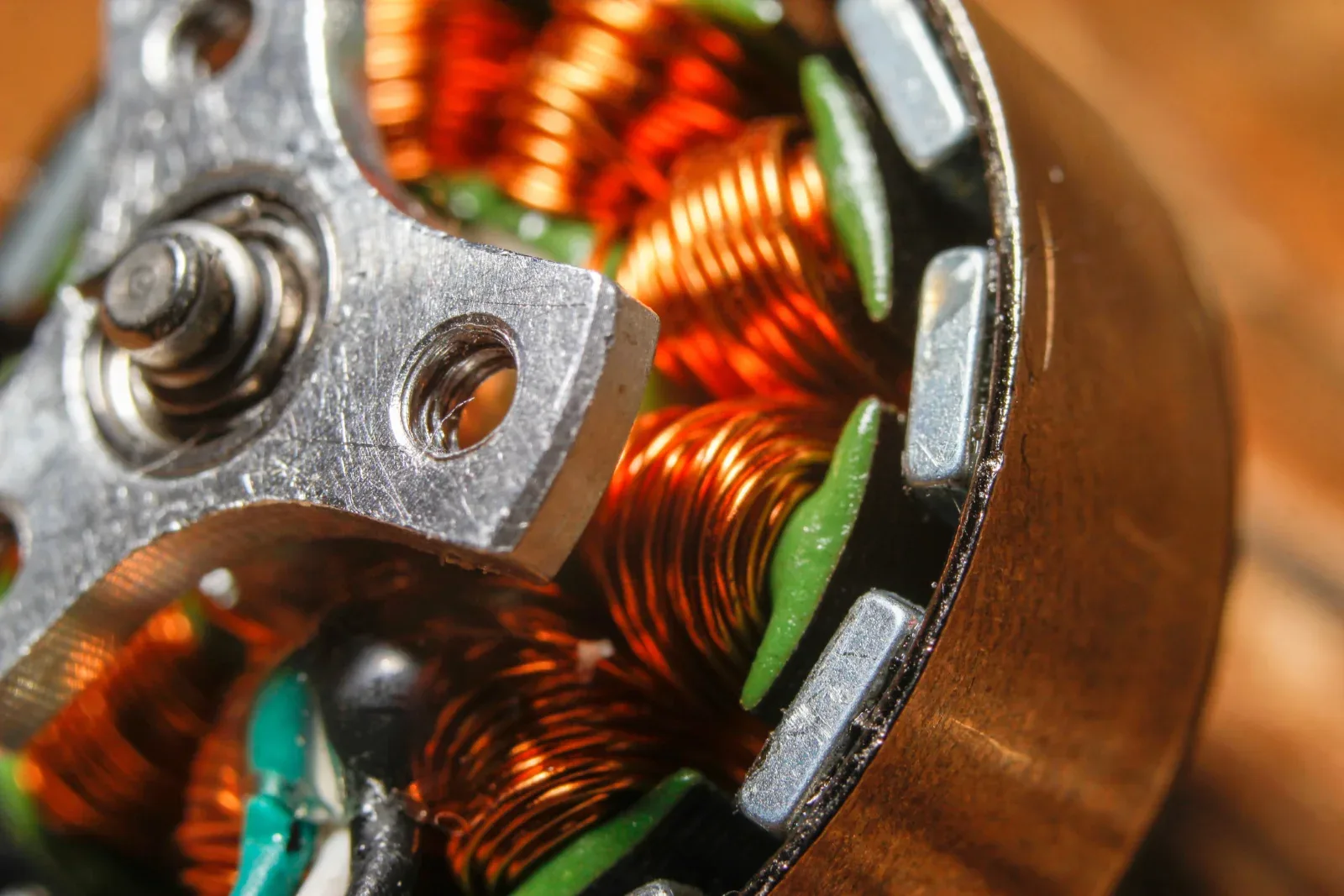
Buyers are now arriving who will not accept that. One of the clearest and most interesting cases we have seen of this is propulsion. Buyers ask for motors with non-Chinese permanent magnets, and Taiwanese motor makers, large and small, including capable ones that answer every other question well, have not been able to supply them for a new order. This is not evasion. China accounts for roughly 90 percent of rare earth processing, and the sintered-magnet capacity that exists outside China, much of it in Japan, is largely committed to automotive customers on long contracts. Motor makers we have spoken with describe non-Chinese supply as available in principle and very hard to obtain in practice for a drone-scale order.
Public statements suggest progress. Fukuta, one of Taiwan's largest motor manufacturers, has said it has stopped using Chinese rare earth material and secured Japanese magnet supply, and is developing rare-earth-free motors with China Steel. Announcements of this kind are encouraging, but they describe a company's own production programs. Non-Chinese magnet supply is typically contracted against specific customers and volumes, and a secured source for existing programs is not the same as magnets available for a new buyer's evaluation order. What a foreign engineer needs to know is narrower than what a press release says: can this motor, in this quantity, be built with non-Chinese magnets for me. For now, across the makers we have dealt with, the answer to that question has been no.
It is worth being exact about what the rules require, because buyers are asking for more than that. Section 848 of the FY2020 NDAA, the US provision that governs drone components, names flight controllers, radios, data transmission devices, cameras, gimbals, ground control systems and operating software. It does not name motors, and a buyer applying the statute strictly has no basis to reject a Taiwanese motor over its magnets.
But buyers are asking anyway. US procurement practice has in places run broader than the statute, a prime may flow origin requirements down to parts the law does not list, and the magnet restriction described below applies to defense purchases whatever Section 848 names. We have seen the same request from another foreign market whose own import rules do not require non-Chinese magnets: the buyer had its own reasons for wanting them anyway. A supplier that reads the rules and concludes motors are exempt is reading the rules correctly and drawing the wrong commercial conclusion.
The requirement is also tightening. "Non-Chinese magnet" can mean a magnet sintered outside China from Chinese feedstock, which satisfies many buyers today. Even that looser version is in limited supply: the shortage described above is a shortage of sintering capacity outside China, whatever the origin of the material going into it. And the looser version will not satisfy the US Department of Defense for long: from January 1, 2027, the DFARS magnet restriction extends from where a magnet is melted and produced to the entire chain from mine to finished magnet, and it flows down to subcontractors. Separately, China's extraterritorial rare earth controls, which reach foreign-made products containing Chinese-origin material, are suspended only until November 10, 2026. A pink motor could become unacceptable to the buyer and unshippable for the supplier within the same few months.
Suppliers are working on this, and the effort is real. Based on our conversations with them, we expect non-Chinese magnet supply to Taiwanese motor makers to improve in 2027. The difficulty is sequencing. The buyers are here in 2026, and "we expect to have a non-Chinese magnet source" is not something a procurement engineer can write into a program. Each time the honest answer is "not yet," the buyer looks at Japan, Korea, Europe or the United States for that part, and whoever qualifies there becomes the incumbent described above.
None of this argues for saying less. A supplier that tells a buyer exactly which parts of its product are pink, and what its plan and timetable are for changing that, remains a candidate. A supplier that markets non-red and discovers the gap during the buyer's due diligence does not.
This is also likely to divide suppliers. Some of the motor makers we have dealt with are working hard to line up non-Chinese magnet sources. It is slow and expensive, and it produces no revenue this year. We expect it to leave them in a strong and distinctive position, because when compliant supply does open up they will already have the designs, the test data and the paperwork, and few competitors anywhere will. Others are proceeding as if the market for drones with pink motors will continue indefinitely. The dates above suggest otherwise, and the buyers asking for non-Chinese magnets today are an early indication of what the rest will ask for.
Standard in China, custom in Taiwan
A further kind of "no" has nothing to do with origin or responsiveness. Several buyers have asked for parts that are standard catalog items in China, in a common size, rating or interface, and found that a Taiwanese equivalent would have to be developed for them.
The likely explanation is scale and business model. China's civil drone industry recorded output of 176.1 billion yuan, about US$26 billion, in 2025, according to industry data reported by Chinese state media, with consumer drones alone accounting for 50.2 billion yuan. Taiwan's drone output that year was roughly US$250 million, about one hundredth of that. A market of China's size supports suppliers that stock hundreds of variants, because each one sells. Most Taiwanese suppliers build to a customer's specification or for a single program, not to stock. The common sizes, connectors and firmware targets in small drones were also set largely by Chinese products, so a buyer's specification is often written around a Chinese part even when it names none.
For the buyer, a drop-in replacement then becomes a development project, with engineering charges, a minimum order and a validation cycle. That is hard to justify for two evaluation units, and for the supplier the "small order" is not small. Declining it can be the correct decision. The problem is not unique to Taiwan: catalogs of non-Chinese drone components are narrow everywhere, and in at least one case the standard part a buyer wanted was available from stock in Australia and the United States and not in Taiwan. Nor is Taiwan's catalog empty. A few firms sell standard drone electronics from stock, and Taiwanese battery cells are a catalog product sold in volume.
What helps the buyer is a fast, specific answer: which parts are available from stock, which would be custom, and what custom work costs and requires. The gap is also an opening. A supplier that builds stocked, non-Chinese equivalents of the standard parts buyers ask for most often would meet demand that currently has no Taiwanese supplier.
Why suppliers hesitate, and what would help
Three reasons for caution are legitimate.
Compliance risk is asymmetric. A country-of-origin declaration carries liability; Indian procurement rules, for example, now provide for debarment on misrepresentation. A supplier whose bill of materials does not record origin is right not to sign one. The remedy is an origin-documented BOM, which takes real work to produce.
Some products are marketed before they are ready to sell. In one case a product shown on a manufacturer's website was, when a buyer asked for it, still being completed. Declining the inquiry was the right answer. Listing the product was the problem: a buyer who finds a product on a manufacturer's website has reason to expect it can be bought.
Capacity is finite. A firm whose one domestic program or a different, larger market occupies its engineers may be correct to protect it, particularly where domestic and foreign requirements differ. The open questions are what replaces that program when it ends, or whether it makes sense to promote drone capacity at all if the drone business is never large enough to compete with the supplier's work in other markets.
Each of these, like the magnet problem, points to the same set of capabilities: export-compliance staffing, supply-chain documentation that records what is and is not Chinese, and products finished to a foreign buyer's standard. They are modest investments relative to a production line, and they are the ones that convert an evaluation order into a program.
Outlook
With domestic awards likely deferred into 2027 and funding returning only through slower annual and supplementary budgets, the sector's firms face a period in which foreign evaluation orders may be the most reliable drone demand available. Few of these firms depend on drones. Most are motor, electronics, machining or composites companies for which drones are one product line among several, so the likelier result of a stalled order book is not failure but withdrawal: engineers and capital move to the product lines that are paying. The firms best positioned to keep a drone business through that period are not necessarily the largest or the best connected in Taipei; they are those that treated the pilot as the beginning of a program and have a foreign reference customer, an export-paperwork record, and the habit of answering an engineer's questions in the week they are asked.
The volume orders that policy has promised will be placed by buyers who have already decided whom they trust. That decision is being made now, in evaluations. Suppliers who are not in those evaluations will, with limited exceptions, likely not be considered for the larger orders that follow.
Sources: The Diplomat (May, August and September 2026); Taipei Times (August and September 2026); Focus Taiwan/CNA and Liberty Times (September 2026); Global Taiwan Institute (September 2026); DSET production and export data; Economic Daily News (July 2026); Global Times (June 2026); DFARS 225.7018; TaiwanDrones.com sourcing inquiries, June–September 2026. Supplier interactions described are drawn from the platform's own inquiry handling in aggregate; no buyer, application, component or volume from any individual inquiry is identified.
Sourcing drones or components from Taiwan?
Tell us what you need — we match it to verified Taiwan-based manufacturers and make the introduction. There's no charge to submit a request.
Source these components from Taiwan →Non-Red Is a Capability, Not a Market
Sep 17, 2026
On drones alone, going non-red rarely pays: a small market, custom lots, and a r...
Taiwan's Anduril ALTIUS-600M Drones Arrived Without a Charger. The Original Was Made in China.
Sep 15, 2026
Taiwan's Army took delivery of 291 Anduril ALTIUS-600M loitering munitions and t...
Beyond Ukraine and the US: Where Taiwan's Drone Demand Comes From Next
Sep 9, 2026
Taiwan exported more drones in the first half of 2026 than in all of 2025, but D...