
The Ukraine Corridor Came Back and US Buyers Beat the Tariff Deadline: Taiwan Drone Exports, August 2026

September 12, 2026
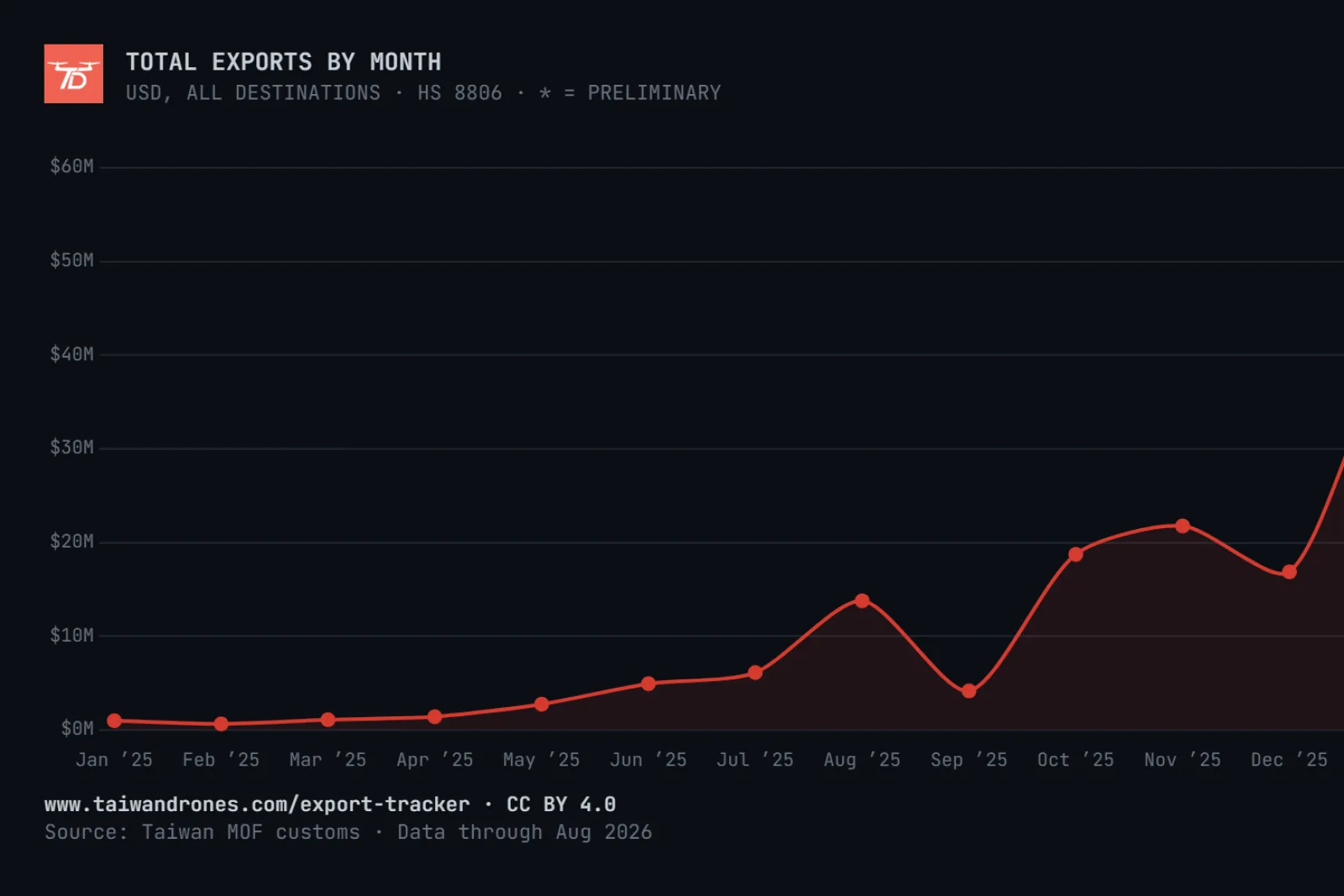
Taiwan exported US$36.4 million of unmanned aircraft in August 2026, up from $29.2 million in July, according to preliminary Ministry of Finance customs data released this week. Two things moved. The Czech Republic, which had taken under $7 million a month since May, took $24.9 million and is again the main route into Ukraine. And the United States bought $6.4 million, by far its largest month in the series. The Export Tracker has the full table; this is what it shows.
August was the fourth-largest month on record for Taiwan's drone exports (HS 8806), behind June's Saudi-driven $59.1 million, March's $43.7 million, and January's $39.7 million. Year-to-date exports now stand at $277.8 million. Taiwan's entire 2025 export total was roughly US$93 million; eight months into 2026 the industry has shipped three times that.
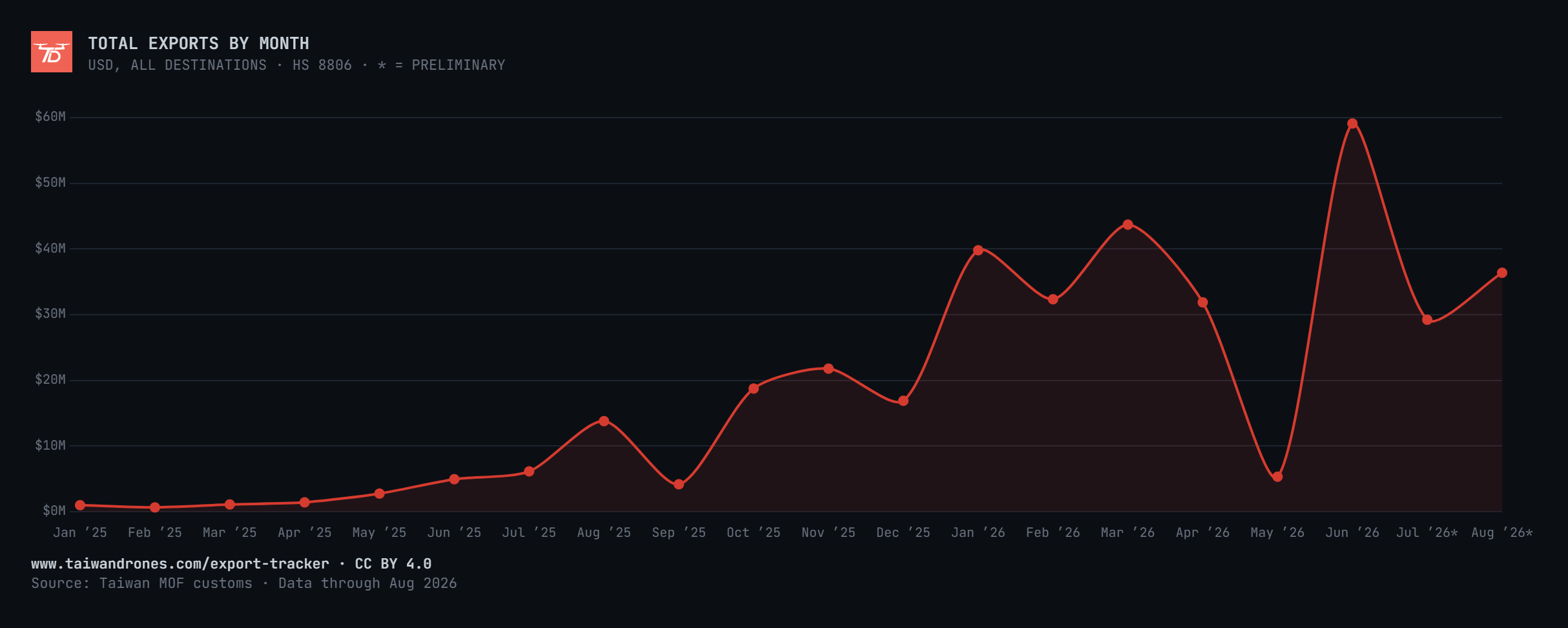
The July figures did not revise. The preliminary total of $29.2 million and every destination line carried through unchanged into August's release. That matters because each month's first number is preliminary, and if it is going to be corrected, the correction usually arrives with the following month's data. July's has now passed that check, so the July analysis stands as written.
The Ukraine corridor: Czech route back on, Polish route off
A note on terms. Taiwan's drone exports to the Czech Republic and Poland are, in practice, exports to Ukraine: neither country's own forces buy Taiwanese drones at this scale, and both host the logistics and procurement channels through which Ukraine sources equipment. We call the combined Czech-plus-Polish figure the Ukraine corridor, and it has carried the large majority of Taiwan's drone export value since the surge began in late 2025.
Through the first four months of 2026, the Czech Republic took between $23.6 million and $39.4 million every month, and Poland ran a distant second. Then Czech shipments fell sharply: $2.5 million in May, $4.5 million in June, $6.5 million in July, roughly $13.6 million across three months combined. In July it looked as if the shipments had moved to Poland, which rose to $19.9 million, its largest month on record.
August reversed that. Czech shipments came back to $24.9 million, their strongest month since April, while Poland fell to $4.3 million. Combined Ukraine corridor value was $29.2 million, up from $26.4 million in July and $10.8 million in June.
Taken together, the two months show that the Ukraine corridor has recovered to roughly its first-quarter level, and the choice of transit country swings from month to month without the underlying volume changing much. Whether that reflects different Ukrainian procurement channels drawing on different European intermediaries, or contract timing on the Taiwan side, the customs data cannot say. What it can say is that the May trough we flagged in July now looks like a pause, not a break. Three consecutive months of Ukraine corridor growth — $4.4 million, $10.8 million, $26.4 million, $29.2 million — is a recovery.
Value per kilogram says the same thing from the other direction. August's Ukraine corridor shipments came in at roughly $270/kg, up slightly from about $255/kg in June and July and off the May low near $225/kg. Since the series began in mid-2025 the corridor has stayed inside a $225–330/kg band, and August is in the middle of it. The mix of what is moving through the Czech Republic and Poland has not changed; the volume fell and then came back. For comparison, the two premium outliers, the UAE shipment in December 2025 at $2,825/kg and the Saudi order in June at $1,258/kg, were different products going to different buyers.
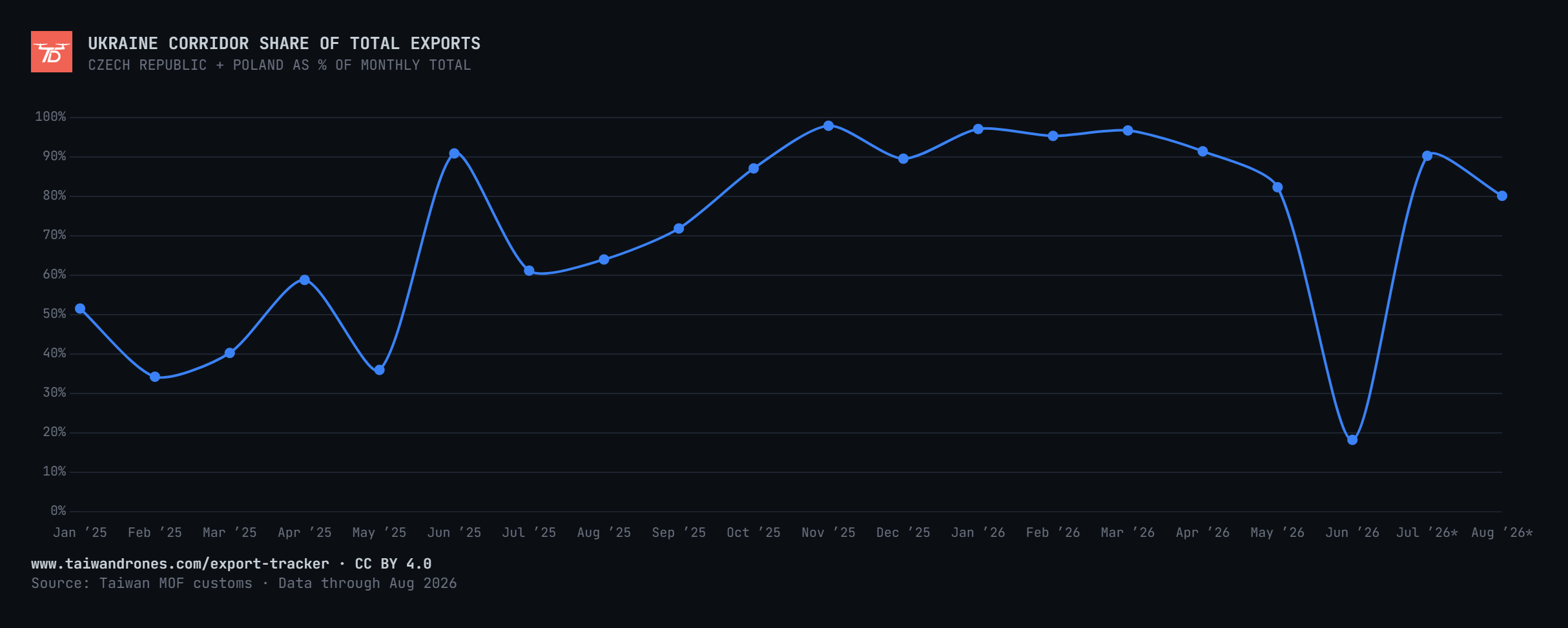
The Ukraine corridor's share of the total fell to 80.2% from 90.3% in July. That is the lowest share in a non-Saudi month since the surge began, and it fell because the other destinations grew faster than the Ukraine corridor did, not because the corridor shrank.
The United States: $6.4 million, most likely pulled forward
The US bought $6.4 million of Taiwanese drones in August. The previous high was $2.4 million in July; before that, no month had exceeded $2.3 million. In the first half of 2025 the US took $1.55 million total. It has now taken $14.8 million in the first eight months of 2026, and $8.7 million of that arrived in July and August.
The timing suggests a simpler explanation than a new program. On August 13 the White House signed the Section 232 proclamation imposing tariffs of 25% on drones at or under 25 kg and 100% on heavier aircraft, anything with a thermal imager, docking stations, and listed critical components, effective September 3. Taiwan-origin products can qualify for a 15% cap, but only where the importer certifies that substantially all critical components and technology come from the US or allied countries, and Commerce had not published the qualification process when the tariffs took effect.
It still has not.
CBP's entry guidance of September 2 instructs filers not to report duties under the allied-cap heading until further guidance is issued, so a Taiwan-origin drone entering since September 3 pays the full 25% or 100% regardless of what is inside it (our Section 232 guide covers the annexes, the certification requirement, and how the duties are being collected). A US buyer with a Taiwanese order in the pipeline had three weeks to land it under the old rate. August is consistent with orders being shipped early to avoid the new rate.
If that is right, September will show it. If August was front-loading, September's US figure should fall back, possibly below July's level, while importers work out whether their Taiwanese suppliers can document a qualifying bill of materials. With no cap claimable at entry, a US buyer has less reason to ship in September than the rule on paper suggests, which makes a fall the expected outcome. If the figure holds or grows, something else is going on — FY2026 NDAA co-production, Drone Dominance procurement, or Taiwanese firms inside US OEM supply chains — and the tariff was incidental. We will know in a month.
Either way, the tariff changes what the US line measures from here. Before September 3, a Taiwan-origin airframe with Chinese motors or a Chinese thermal core entered the US at the same rate as a fully non-Chinese one. Once the cap is claimable it will not: the difference between a 15% cap and a 100% duty on a thermal-equipped aircraft is whether the importer can certify the supply chain. From there the US customs line will reflect which Taiwanese exporters can document their component origins, not only which ones can sell. It is the same look-through requirement as the FCC Covered List, applied at the border as a tariff rate.
Two cautions. HS 8806 is finished aircraft; most of Taiwan's US business is in components and subassemblies, which ship under other codes and are invisible here, so this series undercounts the US relationship by construction. And the US line remains small: at $6.4 million it is a quarter of the Czech figure.
More destinations, still small amounts
Below the top three, August shows destinations that have not appeared in the table before, or not at these levels. Japan took $190,000, which is close to Taiwan's cumulative drone exports to Japan from 2023 through May 2026 (about NT$5.3 million, roughly US$170,000) in a single month. Germany took $379,000, its largest 2026 month. South Korea appeared for the first time this year at $12,000. Hong Kong took $283,000, in line with its monthly level this year.
Palau's $3,000 is worth a sentence because of what sits behind it. Taiwan donated four multifunctional drones to Palau in June and presented more at the Pacific Islands Forum on September 1; the Foreign Ministry has bought about 145 drones for staged donation to diplomatic allies and is setting up a Global UAV Academy to train their pilots. None of the June aircraft appeared in the customs data, so the program will mostly run outside this series. The August entry is probably equipment for the September event.
Together, destinations outside the Ukraine corridor and the US were about $870,000 — small amounts, but the number of active destinations is rising and Japan and Korea are the two markets we wrote about last week as the next sources of demand. August is the first month the customs data has shown either at more than trace levels.
Excluding the Ukraine corridor, August's exports were $7.2 million. Outside of June, that is the largest month in the series for everything else. The diversification the industry needs is now visible in the customs data, not only in announcements.
What we did not see
No Saudi Arabia. The June order was $47.2 million and there has been nothing since. That is consistent with a single delivered contract rather than a standing flow, which is how we read it at the time. If a follow-on order exists it has not shipped, or it has been suppressed from the published statistics under passive confidentiality. Either is possible; we check the suppression list with each pull and cannot tell you what is on it.
No United Arab Emirates either, after the small high-value shipment in December 2025. Gulf exports remain two shipments.
Caveats
The August figures are preliminary and may revise when finalized; the tracker archives each month's snapshot at a permanent address so citations stay fixed (August 2026 snapshot). Customs data records the declared destination, not the end user; the Czech and Polish figures are transit flows to Ukraine, not Czech or Polish demand. HS 8806 covers finished aircraft only; Taiwan's component exports, which are the larger part of its US and European business, ship under other codes and are not in this series (DSET puts unit volume at more than 200,000 drones this year, but that count is not derivable from the value series either). And published figures understate the true total: shipments suppressed at the exporter's request are absent from the public data.
The tracker
The Export Tracker carries the full monthly series with charts, CSV and JSON downloads, and the archived snapshot for each month. The Ministry of Finance publishes September's data around the 10th of October.
→ Subscribe to Taiwan Drone Weekly to get each month's analysis: taiwandrones.com/subscribe
→ Sourcing from Taiwan? Start a request at taiwandrones.com/source
Sourcing drones or components from Taiwan?
Tell us what you need — we match it to verified Taiwan-based manufacturers and make the introduction. There's no charge to submit a request.
Source these components from Taiwan →Which Factory Made This Lot? What the Unimicron Investigation Means for PCB Buyers
Sep 3, 2026
Taoyuan prosecutors raided Unimicron, a board supplier to Nvidia and Intel, on s...
Announcing: Compliance Guides for US and EU Drone Rules
Aug 29, 2026
We have published a set of guides covering the FCC Covered List, NDAA Sections 8...
Taiwan's "Non-Red" Advantage Does Not Apply to the Rule That Now Governs US Market Access
Aug 27, 2026
The FCC's Covered List asks where a drone or component was made, not whether it...