
What Taiwan's Counter-Drone Audit Reveals About Its Own Datalink Resilience

September 4, 2026
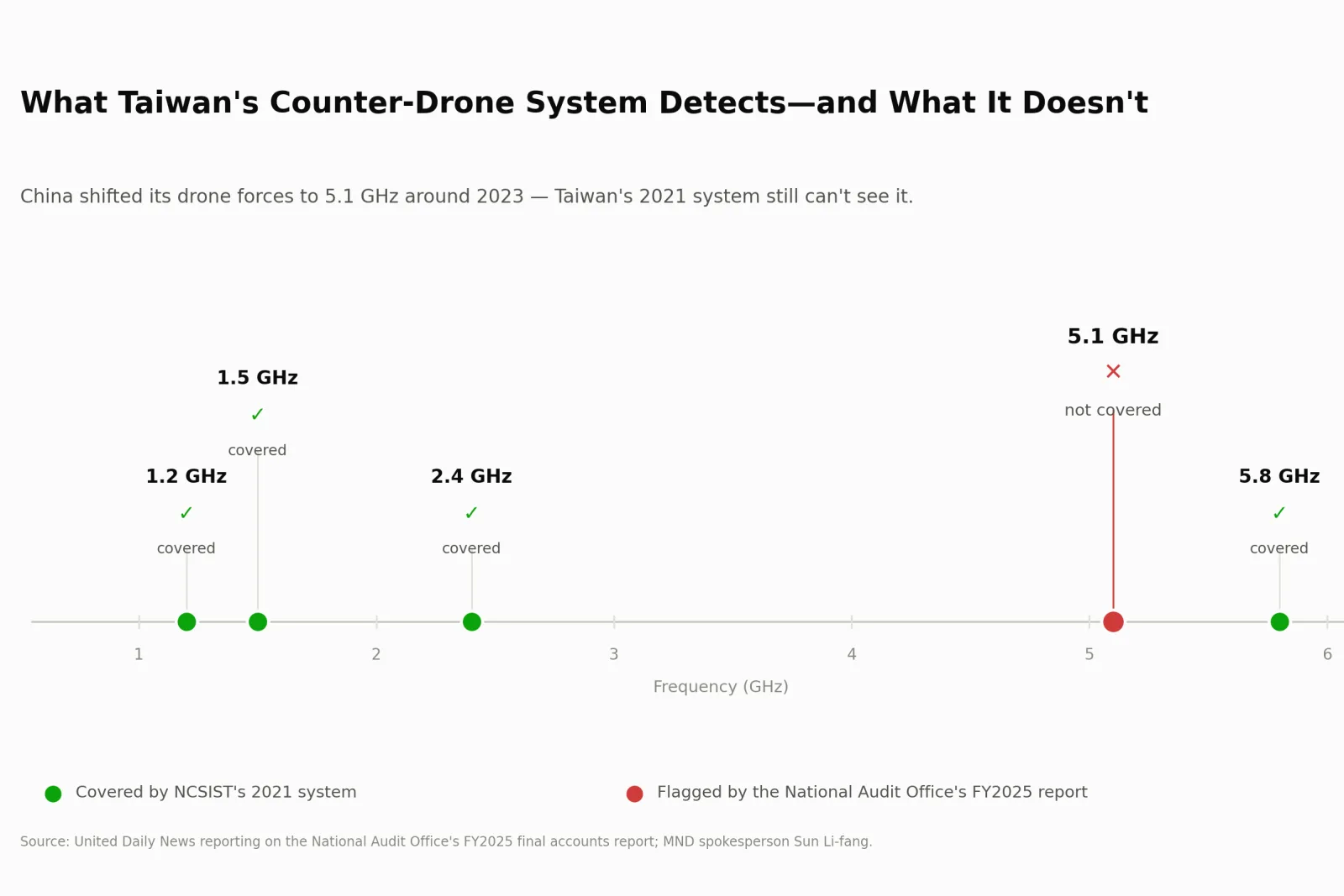
The counter-drone system the Ministry of National Defense ordered from the National Chung-Shan Institute of Science and Technology (NCSIST) in 2021 lacks effective detection and countermeasure capability against drones controlled over a physical fiber-optic tether, and against AI-autonomous drones that don't depend on a real-time RF control link, a structural blind spot rather than a simple coverage gap. That's according to reporting from United Daily News on Taiwan's National Audit Office's fiscal year 2025 final accounts report, released July 24, 2026, which also found the system still can't detect the 5.1 GHz band Chinese forces have increasingly adopted and only partially disrupts China's Beidou-3 navigation signal. The finding is about Taiwan's ability to detect and jam someone else's drones, and it doesn't by itself prove Taiwan's own COFDM datalinks share the same flaw. But it raises a more useful question: if Taiwan is counting on deploying drones at scale, can its own communication links stay usable under that same electronic warfare environment? That question puts a spotlight on a supply-chain layer Taiwan Drones has previously flagged as unusually thin.
The program the audit examined has a specific name and scope: the fixed-site Remote-Controlled Drone Defense System (遙控無人機防禦系統), commissioned by the Air Force and built by NCSIST to guard against illegal harassment and reconnaissance by Category 1 and 2 commercial drones. It carries a budget of roughly NT$3.55 billion (about US$111 million) and runs on a fiscal-year 111-to-115 (2022-2026) execution schedule.
Two things are worth separating before going further. First, the NCSIST system the audit examined is a counter-drone system aimed at detecting and jamming hostile drones over Taiwan, not the communications backbone for Taiwan's own drone fleet. Seeing and disrupting an adversary's drones and keeping your own drone's video and control link alive under that same adversary's electronic warfare are related problems, not identical ones. Second, the Ministry of National Defense pushed back on part of the finding rather than accepting it outright, arguing that some of what the audit calls gaps are narrower, or more deliberate, than they first appear. The specifics of that pushback are below.
That context is fair. It doesn't make the underlying pattern go away. Taiwan's defense planning for the past several years has leaned on asymmetric defense: large numbers of comparatively cheap, attritable systems, drones chief among them, substituting for the exquisite platforms Taiwan can't field in the volumes China can. That bet only pays off if the cheap half of the equation can be trusted to fly, see, and report back under exactly the conditions this audit says Taiwan's newest counter-drone system still can't fully characterize on the other side. A report about detecting someone else's drones is, by implication, a reminder of how capable that someone else's detection and jamming of Taiwan's drones is likely to be.
A blind spot, not a frequency gap
The specifics in the audit are narrow but pointed, and the sharpest one has nothing to do with frequency coverage. A drone flown over a physical fiber-optic tether emits little or no RF signal for a detection system to find in the first place. A drone executing a pre-programmed or AI-guided flight path is a different case: it doesn't need a continuous live RF link to an operator, which sharply reduces the effectiveness of any counter-system built around detecting exactly that kind of link. That's a structural limit of RF-based detection, not something regulators can close by adding a channel: RF detection depends on a drone talking to its operator over the air, and any drone that doesn't, by design, is functionally invisible to it, a limitation that shows up throughout the broader counter-UAS literature, not just in Taiwan's case. Taiwan's current system, the audit noted, still relies primarily on electronic warfare and electronic reconnaissance assets that auditors themselves called insufficient against the full range of threats now in the field. The Ministry of National Defense's response, per United Daily News, named a mechanism rather than a timeline: it said the Defense Innovation Office (國防創新小組, DIO), which it established in February 2024 explicitly modeled on the US Defense Innovation Unit, would source mature solutions abroad, which NCSIST would then integrate, test, and upgrade toward production, a division of labor between DIO and NCSIST rather than in-house development at DIO itself. No system, budget, or date was attached to that process.
The other two findings are narrower, and came with more concrete answers. China's forces have shifted meaningful drone traffic to 5.1 GHz, a band the system doesn't cover; spokesperson Sun Li-fang said on July 27 that the system was designed to cover four frequencies used by Category 1 and 2 commercial drones at the time the program was proposed in 2021, 1.2, 1.5, 2.4, and 5.8 GHz, and that China's 5.1 GHz band only appeared in 2023, after that scope was already fixed. NCSIST will fold 5.1 GHz detection and countermeasures into a future system update, Sun said. On Beidou-3, Sun's response was more specific than a simple omission: the finding concerns the satellite's S-band specifically, which isn't a primary frequency drones use in the first place and serves mainly as Beidou's short-message channel; part of that same S-band also falls inside spectrum the National Communications Commission has designated for 4G and 5G service, which NCC rules bar from general drone use, so it was never within the counter-drone system's scope to begin with. Separately, the program's own construction and testing had fallen behind schedule as of November 2025, on procurement problems and tender delays, according to Defense Express's account of the audit.
COFDM is the layer holding the bet together
Any drone datalink operating over Taiwan has to hold a usable signal through non-line-of-sight terrain, multipath reflection off buildings and mountains, and active interference, not just clear-sky conditions. The non-line-of-sight and multipath half of that requirement is exactly what Coded Orthogonal Frequency Division Multiplexing was built for. COFDM splits a signal across many narrow subcarriers rather than one wide channel, which is why it became the standard for digital terrestrial television broadcast decades before drones needed it: the same multipath resilience that lets a rooftop antenna pull in a clean broadcast signal around buildings and hills is what lets a ground station hold a stable video and control link to an aircraft that isn't always in a clean line of sight. That's not the same thing as jam resistance, and the two get conflated more than they should: COFDM's subcarrier structure is built to survive reflection and terrain, not a deliberate signal aimed at drowning it out. Whatever anti-jam performance a COFDM radio actually has comes from what's layered on top of the modulation, frequency hopping, adaptive channel selection, directional antennas, not from COFDM itself. It's still why high-bandwidth drone video links generally default to some form of OFDM rather than simpler modulation schemes built for line-of-sight conditions.
For Taiwan's asymmetric bet, that's not simply a nice-to-have; it's a link capability worth prioritizing. A drone fleet is only as useful as its worst-case link performance, not its best case in open water on a clear day. And the datalink is also the layer most exposed to a different kind of risk: it's the piece most easily backdoored, intercepted, or selectively jammed if the hardware and firmware underneath it aren't fully accounted for, which is why Taiwan's broader push toward a non-red supply chain, sourcing that excludes Chinese components, lands with particular weight on communications components specifically.
One of the few Taiwan suppliers building the whole chain
That combination, COFDM expertise plus a traceable, non-Chinese bill of materials, is a narrower field than it sounds. Taiwan Drones' own map of Taiwan's drone component suppliers said RF datalinks are "where Taiwan's English-language component story is currently weakest," a category with few non-red entrants building the full comms stack from the ground up.
HiDes Technology (和迪科技) is a useful case study in just how thin that layer is, precisely because it's one of the few counterexamples. The company was founded in 2012 in DVB-T/COFDM digital-TV modulation and wireless AV transmission, and spent roughly its first decade on long-range COFDM applications for hobbyist and consumer use, amateur FPV, aerial cinematography links, and weather-balloon telemetry, before shifting toward professional and defense-grade unmanned systems work, according to the company. HiDes' own site claims an engineering team with more than 20 years of COFDM experience, which predates the company's founding and points to prior work its founders brought with them rather than something built from scratch in 2012. That's the point worth sitting with: public records don't turn up many Taiwan suppliers that claim both long-range COFDM capability and a non-red supply chain at once; HiDes is one of the more easily verified from what's publicly available, which says as much about how thin the public record is for this layer as it does about HiDes itself. We haven't independently confirmed whether other Taiwan suppliers with similar capability simply don't publish the same level of detail. HiDes describes itself as offering "ultra-long-range HD video and broadband data links, chip to software, fully made in Taiwan," and markets itself as a non-red option: its HS-100 Ethernet switch board, for instance, is marketed as containing no components from entities named under NDAA Section 889, using semiconductors of Taiwan, US, and Japan origin on a board built entirely in Taiwan, with a traceable bill of materials and per-lot country-of-origin declarations, according to the company, a documented-origin claim, and a narrower one than a blanket China-free bill of materials.
The specifics matter less as a product pitch than as a measure of how high the bar actually sits. The company's COFDM video and data link, the FV-800/FV-810 series, claims line-of-sight range past 300 kilometers with an 8-watt amplifier and tracking antenna, AES-128/256 encryption, and dynamic on-the-fly channel retuning to dodge jamming, according to the product's published specifications. Clearing military-relevant range, encryption, and anti-jam performance at the same time, on hardware the company markets with the same documented-origin claims, is a combination few Taiwan suppliers have managed at all, which is the more relevant fact here than any single number on the spec sheet — and the numbers HiDes itself has published are worth reading carefully rather than taking at face value. Business Today reported in December 2024 that HiDes was, according to the magazine, the only company then holding a long-range drone communications certification issued by Taiwan's Ministry of National Defense. On range, though, the same article is internally inconsistent: its headline cites a 120-kilometer link that held HD video without interruption, while the body separately describes a flight "over 300 kilometers long" crossing the Taiwan Strait from Taichung Port to the coast of China's Fujian province, a route public mapping puts at closer to 170-200 kilometers in a straight line. We aren't able to reconcile the two figures, and flag the discrepancy rather than resolve it; whether it reflects round-trip distance or simply loose phrasing isn't clear from the source. What is corroborated is the client list: Business Today named Evergreen Aviation Technologies Corporation, which Taiwan Drones profiled among its 10 Taiwan drone manufacturers to know in 2026, as a customer, alongside Taiwan's FairTech Corporation (富蘭登科技股份有限公司) and unnamed US and Turkish defense contractors. The same reporting noted HiDes struggled to gain domestic traction early on and shelved its Taiwan sales push for a period, before demand picked up materially after Russia's 2022 invasion of Ukraine.
We didn't find HiDes listed on the Blue UAS Cleared List, which the US Defense Innovation Unit maintains, or on AUVSI's separately administered Green UAS program, and the company's site doesn't claim either. That's a gap worth watching rather than a disqualifier: for US defense and government buyers, NDAA supply-chain compliance and verification mechanisms like Blue UAS and Green UAS certification carry markedly more weight than they do for ordinary commercial buyers.
The Ukraine caveat: RF has a ceiling too
The audit's own fiber-optic blind spot points at COFDM's limit, not just its value. A drone flown over physical fiber emits no RF signal at all, the same property that makes it invisible to an adversary's RF-based detection system also makes it immune to that adversary's jamming, in a way no amount of frequency agility or encryption on a wireless COFDM link can match. Ukraine's battlefield has already forced the tradeoff into the open: facing increasingly capable Russian electronic warfare, front-line first-person-view and loitering munitions have moved toward fiber-optic control precisely because it can't be jammed, at the direct cost of range and maneuverability that a wireless link doesn't sacrifice.
For Taiwan, the read isn't that COFDM is the wrong technology. It's the right one for the mid- and long-range reconnaissance and data-relay role that most of Taiwan's asymmetric drone concept actually depends on, where 100-plus kilometers of range and real-time HD video matter more than immunity to point-blank jamming. But the front-line, single-use strike tier of that same concept, the tier where Ukraine's front lines have rapidly scaled up fiber-optic-controlled FPV in response to Russian electronic-warfare interference, is a different engineering problem, and in the public record we've been able to find, we haven't identified a Taiwan fiber-optic control option, with clear product and non-red supply-chain information, sitting next to its COFDM one. Betting the entire link layer on one modulation technology, however resilient, is the same kind of single point of failure the audit just found on the detection side.
Even a domestic supplier as capable as HiDes doesn't change that math. In our assessment, what Taiwan's asymmetric drone strategy needs isn't a single excellent non-red COFDM supplier, useful as one is, but a genuinely multi-track approach to link resilience, RF and non-RF both, sized to a threat that has already stopped waiting for either.
What we're watching
The nearer-term marker is whether NCSIST's promised 5.1 GHz update comes with a public budget line and timeline, since that's the one gap MND has actually committed to closing; the fiber-optic and AI-guidance response remains a named mechanism, the Defense Innovation Office sourcing abroad with NCSIST handling integration and upgrades, without a system, budget, or date attached. We're watching whether that changes, and whether either effort touches datalink resilience for Taiwan's own drone fleet rather than only detection of the other side's. And we're watching whether Taiwan's own procurement priorities start treating link resilience, RF and non-RF alike, as a named investment category the way GPS-resistant antennas and AESA radar already are, rather than leaving the publicly documented capability and range of suppliers in the country's non-red comms supply chain as limited as they currently are.
For buyers outside Taiwan, in Europe and Ukraine especially, weighing COFDM against fiber-optic control for their own programs, the sourcing question is as practical as it is technical: which suppliers can actually document component origin at the bill-of-materials level for either approach, a non-Chinese BOM, and for EU-funded programs, the content share SAFE and EDIP require. Taiwan Drones' datalinks & radios sourcing guide tracks current Taiwan-based COFDM and RF datalink suppliers; it doesn't yet list a dedicated fiber-optic control category, which is itself a small data point on how early that shift still is for Taiwan's domestic supply base.
→ Subscribe to Taiwan Drone Weekly for ongoing coverage: www.taiwandrones.com/subscribe
→ Suppliers: contact us at info@taiwandrones.com
This analysis draws on reporting from United Daily News, Defense Express, and Business Today, on HiDes Technology's own published product and company materials, and on Taiwan Drones' prior supply chain reporting. Company claims about product performance, certification status, and client relationships that originate with HiDes or its coverage in Business Today have not been independently verified and are attributed accordingly. It reflects the state of public information as of September 2026 and should not be read as investment advice or an endorsement of any product.
Sourcing drones or components from Taiwan?
Tell us what you need — we match it to verified Taiwan-based manufacturers and make the introduction. There's no charge to submit a request.
Source these components from Taiwan →Could Taiwan's US Supplier Parks One Day Include Drone Makers?
Oct 19, 2026
Taiwan plans industrial parks in the US to help the smaller suppliers of its chi...
Non-Red Is a Requirement, Not a Label: Why TaiwanDrones.com Is Asking Suppliers for Documents Instead of Declarations
Oct 9, 2026
We planned to launch a China-Free verification program with our supplier directo...
What Taiwan Offers Drone Component Buyers Besides Non-Chinese Origin
Oct 5, 2026
Non-red gets a Taiwanese part considered, and competitors elsewhere can claim it...