
Taiwan Drones Weekly News Roundup: October 5 - 11, 2026

October 11, 2026
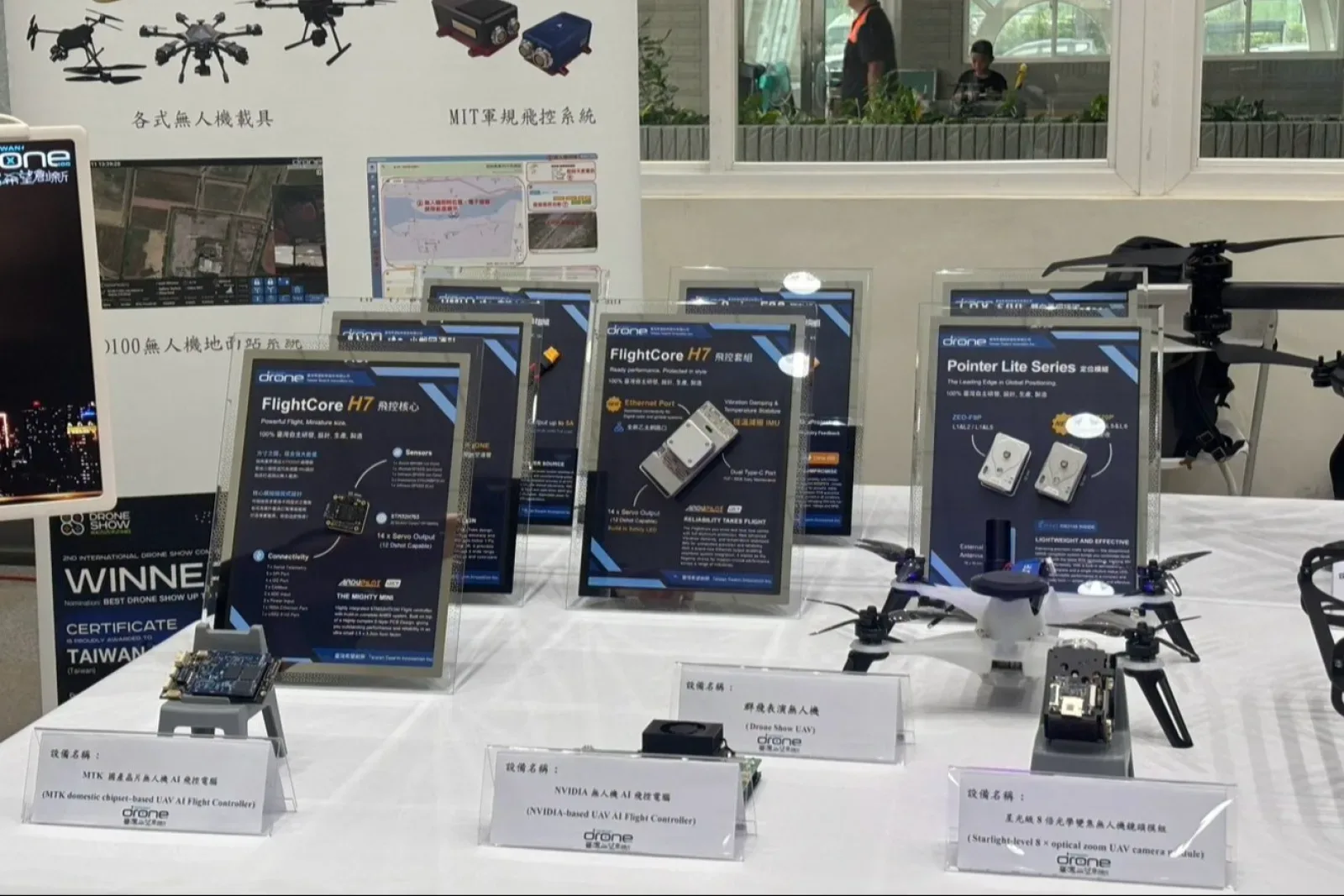
This week the government's money went to domestic components, while the uncrewed systems its agencies put on show were American. The Ministry of Economic Affairs more than doubled its drone R&D grants and aimed most of the awards at gimbals, radios and propulsion. Thunder Tiger flew a catapult-launched airframe with its own engine. But the uncrewed aircraft and boat the Coast Guard showed at the National Day rehearsal were US-made, and the most detailed advice on what Taiwan should buy came from a US vendor that plans to bid. That vendor proposed Taiwanese sensors and command systems on a foreign hull, which puts Taiwan's role at the component level, as the grants do. A New York county and an Ohio forum, meanwhile, invited Taiwanese drone firms to set up there. Here's the week.
1. Economics ministry approves 27 drone R&D projects, with components taking most of the awards
中央社 (CNA) — Oct. 9, 2026 · Read article
The Ministry of Economic Affairs' Department of Industrial Technology approved 27 of 49 applications under this year's drone R&D program, worth about NT$780 million. Last year's narrower chip-and-module program approved seven of 19, for NT$326 million. Most of the money went to components, not aircraft. Six complete-system projects take about NT$282 million, for long-endurance VTOL, heavy-payload logistics, smart agriculture and hydrological monitoring. The other 21, about NT$497 million, are component work: seven payload projects, seven communications, four propulsion, one flight control and two others. The department lists multi-sensor gimbals, anti-jam long-range links and light-rare-earth propulsion modules among the priorities, the last of which relates to the raw-material dependence covered in our September 21-27 roundup. The largest single award, NT$100 million, goes to AIDC for a heavy-payload logistics drone that keeps navigating and communicating without GPS, using optical image matching of the kind it showed in Taichung last week. CNA names no other recipient, so buyers cannot yet tell which gimbal, radio or motor makers were funded.
2. Thunder Tiger catapult-launches the PD-136 in Yunlin
中央社 (CNA) — Oct. 5, 2026 · Read article
Thunder Tiger said on October 5 that it completed a catapult launch and flight test of its Papa Delta PD-136 in Yunlin County on October 2. The company says the test verified two things: a stamped aluminum-alloy airframe and a pneumatic catapult working together. The catapult was co-developed with a German company it does not name, and is meant to ride on a vehicle carrying several airframes for rapid consecutive launches. The engine is Thunder Tiger's own Titan Power 250cc two-stroke. Payload of 10 to 15 kilograms and range above 300 kilometers are planned figures, and the announcement gives no duration or distance for the flight itself. A jet variant, the PD-136J, is in development around the CS-80 micro turbojet from NCSIST. Thunder Tiger says the stamped airframe simplifies the structure and keeps cost down in volume production. The company exhibits at AUSA in Washington on October 12-14, where it says it will promote Taiwan-made, non-red supply.
3. Saronic executive tells Taiwan its uncrewed boat plan is too narrow
中央社 (CNA) — Oct. 7, 2026 · Read article
At a TAITRA aerospace and defense forum in Taipei on October 7, Mira Resnick argued that Taiwan is buying the wrong mix of uncrewed boats. Resnick is a former US deputy assistant secretary of state and now Saronic Technologies' senior director for global policy and defense cooperation. By her count, Taiwan plans to buy more than 200,000 uncrewed systems, of which about 1,300 are boats, all one-way attack craft that matter only once a war starts. Her case is that China's daily gray-zone pressure burns fuel and scarce ship crews, and that multi-mission autonomous vessels that return to port could take on monitoring, escort and communications relay. She also said 1,300 remotely piloted boats would need more than a thousand trained operators, and that autonomy should let one operator supervise several boats. Saronic builds such vessels and, by her own account, intends to bid, so her advice is also a sales case. CNA carries no defense ministry response. Two of her recommendations would help Taiwanese suppliers whoever wins the contracts. She urged field tests for every bidder. She also said US vendors should integrate Taiwanese sensors and command systems and set up local maintenance, instead of selling complete boats.
4. Coast Guard shows its Jump 20 and M18 in public for the first time
中央社 (CNA) — Oct. 6, 2026 · Read article
The Coast Guard's column at the October 6 National Day rehearsal included a rescue vehicle paired with an uncrewed aircraft and an uncrewed boat. The presenter named neither model. CNA, citing unnamed sources, identifies them as AeroVironment's Jump 20 and MARTAC's M18, both American. The Jump 20 is already in service; the United States agreed to supply it at the end of 2022, and this was its first public display in Coast Guard hands. Manufacturer figures put it at more than 13 hours of endurance and a 185-kilometer operating range. The M18 has been delivered and crews are training on it, but it is not yet on front-line duty. Public figures give it a 5.5-meter hull, 50 knots, 500 nautical miles and a 450-kilogram payload. The domestic link is a memorandum NCSIST signed with MARTAC at last year's Taipei aerospace show, covering AI target recognition, autonomous interception and multi-boat coordination. Both platforms were bought complete from US makers, the model Resnick argued against in item 3. The Taiwanese work disclosed so far is in software and integration.
5. Ocean Affairs Council reports a federated-learning trial on an uncrewed vessel off Kaohsiung
海洋委員會 (Ocean Affairs Council) — Oct. 2, 2026 · Read release
The Ocean Affairs Council said a project it funds completed autonomous patrol trials of a medium-to-large uncrewed surface vessel off Fengbitou, outside Kaohsiung Port. The project uses federated learning: each vessel trains on its own imagery and shares only model parameters, so sensitive pictures of ports and installations never leave the boat. The team added a technique to stop the model from forgetting old classes when it learns new ones. Reported results are detection precision (mAP50) above 90 percent, inference at 15 frames per second or better, and forgetting held under 10 percent. In sea state 2 or higher, the vessel ran obstacle avoidance between two points, hexagonal circuits, Z-pattern cruising and grid search. The project also produced what the council calls Taiwan's first open-water operating procedure for vessels of this size, with manual takeover within three seconds if the link drops. The council says the algorithms are entirely home-developed and tied to local suppliers, with freedom from foreign export controls as the stated aim. Its release names neither the research team, the boat builder nor the hull's size, and the figures are self-reported.
6. A New York county and an Ohio forum court Taiwan's drone makers
Mid Hudson News — Oct. 5, 2026 · Read article · 中央社 (CNA) — Oct. 10, 2026 · Read article
Orange County, New York, sent its second mission to Taiwan, and County Executive Steven Neuhaus told Mid Hudson News he met 20 businesses and would welcome an R&D site or a drone facility. He said Chinese drones are better than American ones, that the US and its allies are trying to catch up, and that the county wants a share of that work. The report names no companies and no commitments. On October 8, Ohio's annual Future Forum in East Liberty ran a Taiwan session on semiconductors, drones and tire technology, with US Representative Bob Latta and several state legislators attending. The head of Taiwan's representative office in Chicago told the audience that Taiwan has more than 200 drone firms and exported 150,000 light drones in the first seven months of the year, mostly to Eastern Europe. He also cited ITRI's role as an evaluator for AUVSI's Green UAS program, an industry credential and not a government one. Neither event produced an order or a named investment, but they show that US localities now treat Taiwanese drone makers as investment prospects. For firms considering US assembly to qualify for American programs, that is a separate discussion from selling parts.
That's the week. Watch for the names of the other 26 grant recipients, what Thunder Tiger brings back from AUSA, and whether the defense ministry answers the case for multi-mission uncrewed vessels.
Sourcing drones or components from Taiwan?
Tell us what you need — we match it to verified Taiwan-based manufacturers and make the introduction. There's no charge to submit a request.
Source these components from Taiwan →Taiwan Drones Weekly News Roundup: September 28 - October 4, 2026
Oct 4, 2026
This was the week Taiwan's drone strategy got concrete in the literal sense: a s...
Taiwan Drones Weekly News Roundup: September 21 - 27, 2026
Sep 27, 2026
Taiwan's drone story this week is really two stories running in parallel: one ab...
Taiwan Drones Weekly News Roundup: September 14 - 20, 2026
Sep 20, 2026
Attack drones joined Taiwan's live-fire drills for the first time this week, whi...