
Taiwan Drones Weekly News Roundup: September 28 - October 4, 2026

October 4, 2026
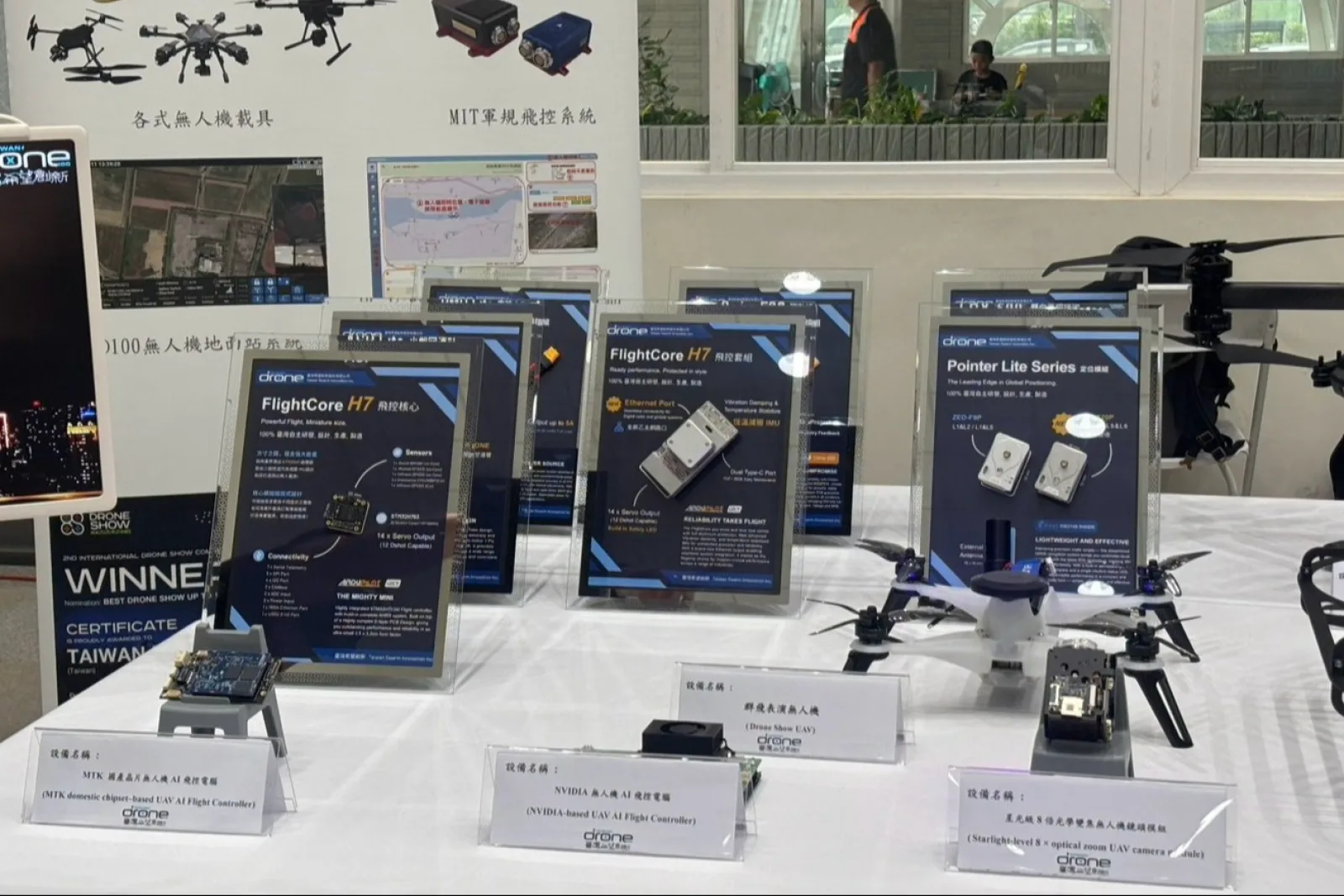
This was the week Taiwan's drone strategy got concrete in the literal sense: a state-run campus opened in Chiayi, a university won a national regional center in the south, and a Taichung trade show put prototypes on the floor. What the reporting keeps circling back to is not ambition but plumbing. Industry voices at a Commercial Times forum named scarce test sites and uneven validation rules as the bottlenecks, and most of the exhibitors' headline specs come from their own press materials, not field results. Buildings and booths are going up faster than the places and procedures needed to prove what they hold, even as Washington stood up a command of its own for autonomy. Here's the week.
1. NCSIST opens Minxiong campus; the industrial park is a 2028 story
The Drone Front — Oct. 1, 2026 · Read article
President Lai Ching-te presided on September 28 over the opening of the Minxiong campus of the National Chung-Shan Institute of Science and Technology (NCSIST), which The Drone Front describes as a site meant to host 100 companies, with research facilities, hangars, test labs, and AI "digital twin" simulation for vetting designs before real flights. Its write-up blurs two events, though: the Presidential Office's own readout says the campus opened but the adjacent industrial park, where manufacturers would actually be housed, only broke ground, with nearly NT$6.9 billion in central funding and completion due in 2028. The Drone Front also reports that an earlier drone R&D center, opened in 2022, ran for several years without manufacturers and now hosts more than 50 companies and institutions with another 50 waiting, which is the occupancy test Minxiong's park will face. It sits neatly beside the target flagged in last week's roundup: raising domestic manufacturing capability for key components to 90 percent by 2030, up from roughly 30 percent for large drones.
2. AIDC shows Raven X loitering munition prototype in Taichung
Taiwan News — Oct. 2, 2026 · Read article
Aerospace Industry Development Corporation (AIDC) is exhibiting a prototype Raven X at the Taichung AI & Smart Manufacturing Show, a fixed-wing loitering munition it says can find and lock onto moving ground and sea targets within 100 kilometers under an AI pilot system, with flight tests still under way. The item that has actually flown is AIxVNAV, co-developed with US-based Vantor, which estimates position by matching drone camera imagery against a database when GPS fails; AIDC says it completed round-trip flights with it during August's Presidential Cup. AIDC's counter-drone system, which it says can pull a target's type, altitude, and speed and then jam or laser it, was used in a September exercise run by the Agency of Corrections. Last week's roundup noted that Taiwan's first fixed counter-drone systems keep missing the military's 6-kilometer detection and 4-kilometer jamming bar in testing, and AIDC's release offers no comparable figures. The display also included a miniature Spearhead for an overseas client and an agreement with France's I-See to design and manufacture multiple drones.
3. Coretronic bets on 3D printing and modular design
Taiwan News — Oct. 1, 2026 · Read article
Coretronic is arguing in Taichung that the drone industry is drifting toward low-cost, modular, locally scaled production, and that 3D printing shortens the gap between design and test flights by producing shared parts for quick assembly. It brought a Sniper-class medium-range defensive drone, which combines electro-optical and infrared imaging, advanced computing, and frequency hopping against jamming, alongside Seagull, a vertical-takeoff surveillance drone for coastal defense and interception. Seagull's numbers are the useful part: six hours of continuous flight, networking with other drones within 100 kilometers, and identification of up to 80 targets at once, with personnel within 5 kilometers and vehicles within 10. The report, which draws on CNA, also lists Taiwan-US drone firm collaboration and a non-China supply chain as show highlights without naming the US partners.
4. Swancor pitches reclaimed carbon fiber for drone parts
Taiwan News — Oct. 2, 2026 · Read article
Nantou-based Swancor arrived with a materials argument rather than an aircraft: its Aeraxa subsidiary 3D-prints structural parts from reclaimed carbon fiber and assembles them with AI computing chips, cameras, and satellite communication modules into a lightweight vehicle, while Swancor Regener supplies the recycled composites. The company says its composites, which also include recycled fiberglass and epoxies, have a recovery rate above 95 percent, and it is showing propellers made from reclaimed material and robotic arms for cheaper manufacturing. Every figure comes from Swancor's press release, and there are no endurance, payload, or range numbers, so the pitch is production cost and speed rather than capability. Still, it shows a chemicals company reaching for the drone supply chain through feedstock instead of a finished airframe.
5. Industry forum names test sites and validation as the bottlenecks
工商時報 (Commercial Times) — Oct. 2, 2026 · Read article
At a forum the Commercial Times hosted itself on October 1, panelists from industry, academia, and the Taiwan Unmanned Vehicle Alliance agreed the outlook is bright and that validation standards still need work. The alliance is pushing AI chip autonomy, non-red key components, modular design, and cross-vehicle common platforms, but the shortfall panelists kept returning to was test sites, which remain scarce and hard to schedule despite the Executive Yuan's efforts. The most concrete ask came from Carbon-Based Technology CEO Yu Pei-wen (游沛文): clear precedents on which common changes, such as swapping a camera, radio, or battery, can reuse existing test results and which require retesting, plus pre-submission exchanges so inspectors and vendors stop trading rounds of paperwork. That reads as the domestic version of the cost problem Yu raised in our September 11 profile, where she called Green and Blue UAS certification a significant per-product investment.
6. NSYSU wins southern Taiwan's only national drone regional center
大紀元 (Epoch Times) — Oct. 1, 2026 · Read article
The Ministry of Education has approved National Sun Yat-sen University as the only national drone regional center in southern Taiwan, with two funded projects: commercial and military-grade drone key technologies, and a drone soccer center. President Li Chih-peng (李志鵬) pitches the Xiziwan campus's mix of sea, land, and mountain terrain as a natural test range and as the ground for training students in peacetime-to-wartime conversion. The research base is a team the school says has achieved 1080p video transmission beyond 100 kilometers with military-grade jamming resistance, plus AI-driven missions and automatic takeoff and landing; those are university claims, not independently tested figures. The terrain pitch lands right after this week's forum complaint about scarce test sites, and the center's three-year program is aimed at the shortage of senior R&D staff and hands-on operators, with qualifying graduates matched to industry.
7. Pentagon creates Autonomous Warfare Command
Reuters — Sep. 30, 2026 · Read article
US Defense Secretary Pete Hegseth announced at Quantico on September 30 a new command, to be led by a four-star officer, dedicated to building and providing autonomous and robotic capabilities across the US military. Reuters notes that new commands are rare: the last was US Space Command in 2019, and the US currently has 11 combatant commands. Hegseth framed the move as process catching up with technology ("The pace of war is changing faster than the process to support it"), and the piece ties it to a shift from costly platforms toward cheaper AI-driven systems, with Ukraine as the reference case, where Reuters cites estimates that drones account for about 70 percent of Russian casualties. Taiwan doesn't appear in the article, but for suppliers selling into US programs it signals that autonomy now has an institutional home in Washington, though the piece says nothing about how the command will buy. Reuters also notes experts' warnings about unchecked military AI development and calls from US and Chinese security experts for guardrails.
That's the week. Watch for Raven X's flight-test results, how the new US autonomy command takes shape, and any movement on test sites and validation guidance.
Sourcing drones or components from Taiwan?
Tell us what you need — we match it to verified Taiwan-based manufacturers and make the introduction. There's no charge to submit a request.
Source these components from Taiwan →Taiwan Drones Weekly News Roundup: September 21 - 27, 2026
Sep 27, 2026
Taiwan's drone story this week is really two stories running in parallel: one ab...
Taiwan Drones Weekly News Roundup: September 14 - 20, 2026
Sep 20, 2026
Attack drones joined Taiwan's live-fire drills for the first time this week, whi...
Taiwan Drones Weekly News Roundup: September 7 - 13, 2026
Sep 13, 2026
This week's clearest signal was not that Taiwan needs more drones. It was that b...