
10 Taiwanese Drone Suppliers Suspected of Using Chinese Parts. Taiwan Won't Name Them.

November 16, 2026
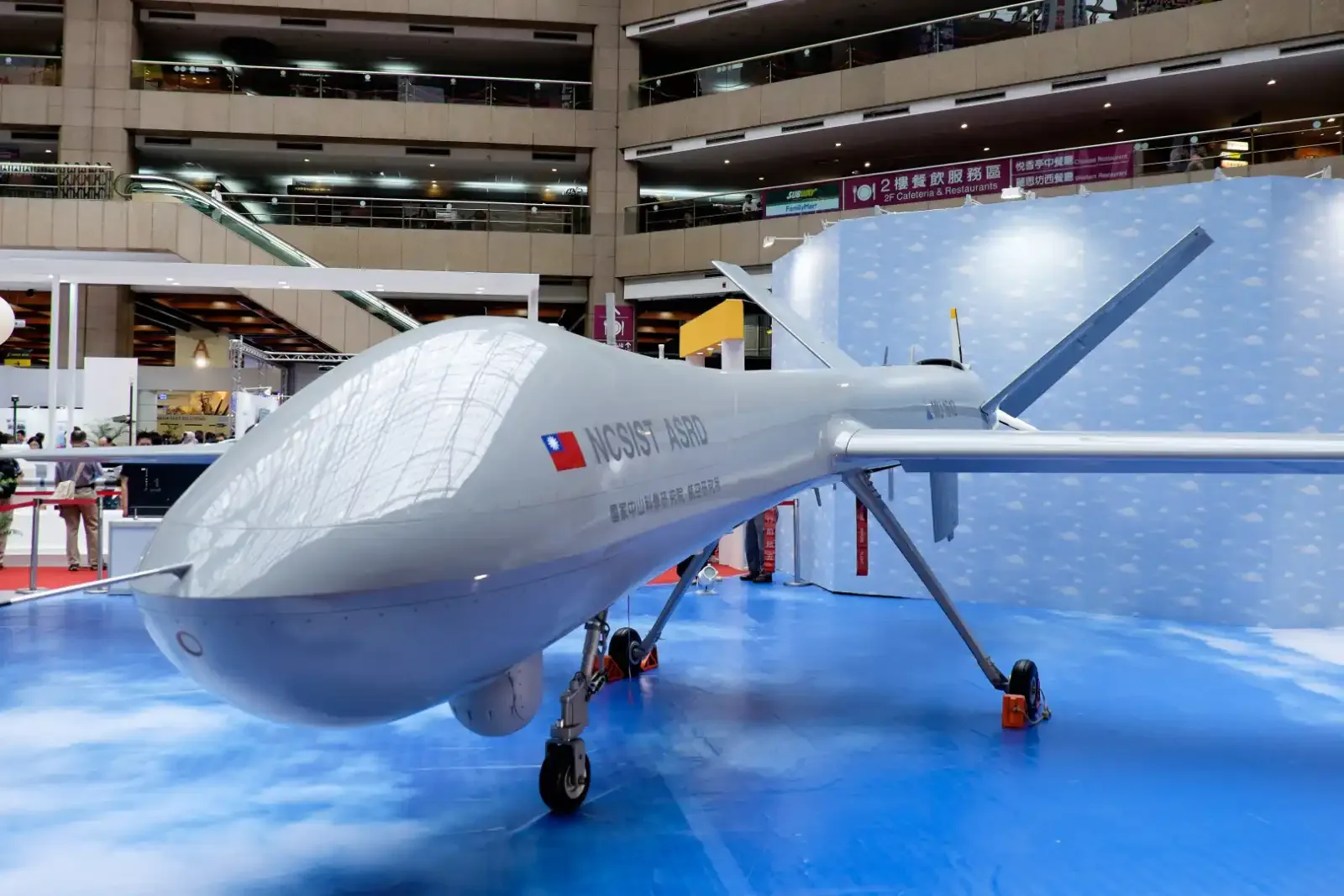
Taiwan's state weapons developer, the National Chungshan Institute of Science and Technology (NCSIST), has found suspected Chinese-made parts in drones from 10 of its own suppliers, companies that had signed pledges not to use them. For now, it is not revealing who they are.
NCSIST announced the findings on Nov. 13 after taking apart drones already delivered to it. The 10 suppliers have been told to replace the parts, and their names are being withheld while they do.
That matters to buyers in Europe, the US and India, who buy Taiwanese drones and drone components mainly because they are "non-red," or free of Chinese parts. Taiwan's own military had to take drones apart to find the problem. Most foreign buyers rely on paperwork.
What the institute found
NCSIST, which develops Taiwan's missiles and military drones, said it had traced the origin of core components in drones from suppliers that had already delivered to it. Technicians took apart drones delivered before 2024 and checked flight control boards, communication modules, sensors and microprocessor chips, according to Taiwanese media reports.
Ten suppliers were suspected of using Chinese-made items. Parts that can't be verified must be replaced immediately, or the design revised. Suppliers that refuse to submit samples or make fixes will be dropped from the institute's supply chain, and other government agencies will be notified.
The institute said the checks are meant to build a trusted supply chain, not to single out particular companies. Liberty Times reported that the checks provoked a backlash from some suppliers. Taiwanese news outlet BigMedia, citing unnamed insiders, reported that the harshest penalty is a suspension from bidding until the parts are replaced.
From now on, every drone delivered to Taiwan's military will be taken apart for inspection, Defense Minister Wellington Koo told lawmakers. Until now, small orders of two to four drones were not dismantled, he said, which gave manufacturers an opening to exploit.
Three criminal cases
The audit follows three criminal cases since August, each involving Chinese parts in drones sold to Taiwan's military.
In August, prosecutors detained the head of Hang Jian Technology, accused of putting Chinese-packaged chips and Chinese flight control boards into training drones for the Army. In October, two executives of Jiin Ming Industry, a company listed on Taiwan's over-the-counter market, were detained over Chinese chips and camera lenses in military drones. In both cases, prosecutors allege origin labels were hidden and certificates falsified.
The third case reached an indictment this week. Prosecutors charged Tu Da-sen, chairman of Taichung-based Align Corp, and his wife under the National Security Act, Taiwan News reported. Tu admitted during questioning to using Chinese parts in drones for four military buyers, United Daily News reported. Inspectors found chips marked "PUYA" and "CHINA," some with markings scraped off, and the origin listed as Taiwan. Prosecutors are seeking at least five years in prison for Tu and his wife.
Tu told prosecutors that Taiwan's drone industry "currently can't be fully self-made," citing a lack of specialized chips.
Those three companies faced prosecutors and detention. The 10 found by the institute's audit have been given time to fix the problem, and their names are confidential. The criminal cases involved signs of deliberate concealment, and some of the 10 may turn out to have paperwork issues rather than Chinese parts. The institute hasn't said whether it will refer any of them to prosecutors.
How widespread is the problem?
The institute's announcement leaves out the details that would show how widespread the problem is.
How many suppliers were checked? Ten out of a dozen would mean most of the institute's drone supply chain failed. Ten out of 60 would still be one in six. The institute hasn't said.
Are these old cases or current ones? Reports suggest the 10 were found mostly by taking apart drones delivered before 2024. But the institute says its sample and factory checks also cover suppliers it is preparing for mass production, and it hasn’t said which group the 10 belong to. If they are old deliveries, officials can point to a much smaller industry: Taiwan exported just 3,472 drones as recently as 2024, against 122,726 in 2025. If any are current suppliers, the problem is ongoing.
Which parts? A swapped memory chip suggests a shortcut. A Chinese radio module or battery cell suggests the supplier had no practical alternative.
Large programs or small? Koo says the Chinese parts were found in small orders. The institute handles development and mass production. If any of the 10 supply large programs, the problem isn't limited to small orders.
Carelessness or concealment? The criminal cases involved scraped markings and fake certificates. Whether any of the 10 did the same would separate a verification problem from a fraud problem.
What's already flying? Drones accepted before teardowns became standard passed on paperwork alone. No official has said whether those are being rechecked.
Can they replace the parts?
Whether the 10 can replace the parts will show whether non-Chinese alternatives exist. Some swaps are easy. Others may not be possible yet.
Memory chips, microcontrollers and camera optics should be straightforward. Non-Chinese makers are plentiful, including Taiwan's own memory makers, and Taiwan has a deep optics industry.
When the problem is a handful of parts, fixes can be quick. Albacore, which builds drone submarines, found three Chinese-origin components among roughly 5,500 parts in its vehicles and replaced them in about two weeks, news site Domino Theory reported this week.
A September report by DSET, a government-funded think tank, found Taiwan still imports flight controller chips, communication modules and satellite positioning and imaging chips. Some domestic alternatives will take two to three years to validate and reach mass production, it said. Battery cells and the rare-earth magnets in motors are still sourced mainly from China, the report found. Taiwan aims to make only a third of the magnets it needs by 2030.
Thermal sensors, used for night surveillance, are a partial exception. Imported thermal cores are export-controlled and cost US$2,200 to US$3,500 a module. TianYuan Industrial, which says it is Taiwan's only maker of thermal imaging chips, planned volume production from late 2025 and million-unit capacity after an expansion due at the end of 2026. Those are the company's targets; output hasn't been independently confirmed. The germanium used in thermal lenses is another Chinese dependency.
Radar may also be hard to replace. Align's Tu said he used Chinese radar because Taiwanese radar caused serious interference.
A short fix period would suggest easy swaps. Extensions, design revisions or suppliers dropping out would suggest the parts aren't available at a workable price.
What it means for buyers
Taiwan's drone exports reached about US$115 million in the first quarter of 2026, more than in all of 2025. The Czech Republic bought about US$100 million, Poland US$11.76 million and the US US$2.58 million. Analysts say many Czech and Polish purchases end up in Ukraine.
Because the names are confidential, those buyers can't tell whether their supplier is among the 10. A flagged company could still be selling "non-red" drones or components abroad, and nothing public would show it.
The institute's reason, that the companies are still fixing the problem, is common practice for a buyer managing its suppliers. But the institute is a state body under the defense ministry, and it has promoted Taiwan's non-red supply chain abroad, including at a major US drone show in May. Withholding the names protects the suppliers and the policy. It leaves foreign customers without information they need.
There were doubts about the non-red label before this audit. In May, the head of Taiwan's Industrial Development Administration said the "vast majority" of drone exports were non-red. Several industry insiders told AFP they suspected most were not.
Some buyers are already acting on those doubts. Domino Theory also reported that Singapore's BeeX, which makes underwater drones, shifted from Taiwanese circuit board suppliers to US contract manufacturers after the procurement fraud cases. Albacore's John Huddleston said factory visits can show that a supplier lacks the machinery to make a part it sells.
"It is physically going to the supplier, see where they make the thing, because often you'll be surprised what they don't make,” he told Domino Theory.
For buyers, that means:
- Treat paperwork as a starting point. Origin certificates and signed pledges failed inside Taiwan's own military supply chain.
- Ask what's inside the part, not just where it was assembled. A motor or battery pack assembled in Taiwan can carry Chinese magnets or cells.
- Check the hard parts first. Radios, flight controller chips, battery cells, motors and thermal cores are where substitution is hardest.
- Watch the price. Genuinely non-red drones cost more. A Taiwanese quote at Chinese prices on any of those parts deserves a closer look.
In our own sourcing work, we know that for certain component requests there are few if any Taiwanese suppliers who could deliver a fully non-red part, and we tell buyers that.
Part of the challenge is expectations. Taiwan's "non-red" marketing has worked. Many buyers now arrive expecting it to be easy to find non-Chinese components for an entire drone, with drop-in replacements for common Chinese parts. That isn't yet the case. If a supplier promises a fully non-red version of one of the hard parts, especially at a low price, check thoroughly before proceeding.
What comes next
Taiwan is catching and prosecuting suppliers who cheat, which many supplier countries don't. And it isn't alone in depending on Chinese parts: Ukraine, now a major drone producer, still relies on Chinese magnets and lithium batteries.
But Taiwan promised a "100% non-red" supply chain while its own think tank says key chips, radios and battery cells are years from domestic production. It awarded contracts to the lowest bidder and relied on paperwork checks for small orders until this month. The 10 flagged suppliers may be the result of a policy that moved faster than the supply chain.
If all 10 replace their parts quickly, the problem was suppliers taking shortcuts. If they can't, the non-Chinese parts don't yet exist at the price or scale needed. Either way, foreign buyers have a right to know. It is also in Taiwan's interest to avoid the perception that gaps in its supply chain are being deliberately obscured.
Sourcing drones or components from Taiwan?
Tell us what you need — we match it to verified Taiwan-based manufacturers and make the introduction. There's no charge to submit a request.
Source these components from Taiwan →Why Taiwan's military drone tenders keep failing
Nov 4, 2026
Taiwan fined Tron Future NT$140 million over a failed counter-drone contract. Th...
Taiwan Solved Its Drone Funding Problem. Ownership Risk Is the One That's Left
Sep 26, 2026
Taiwan's NT$240 billion drone act, a fresh NT$55.9 billion budget, and preferent...
The Ukraine Corridor Came Back and US Buyers Beat the Tariff Deadline: Taiwan Drone Exports, August 2026
Sep 12, 2026
Taiwan exported $36.4 million of drones in August 2026. The Czech Republic took...