Taiwan Drone Supply Chain: Why "Made in Taiwan" Is Not Always China-Free

June 24, 2026
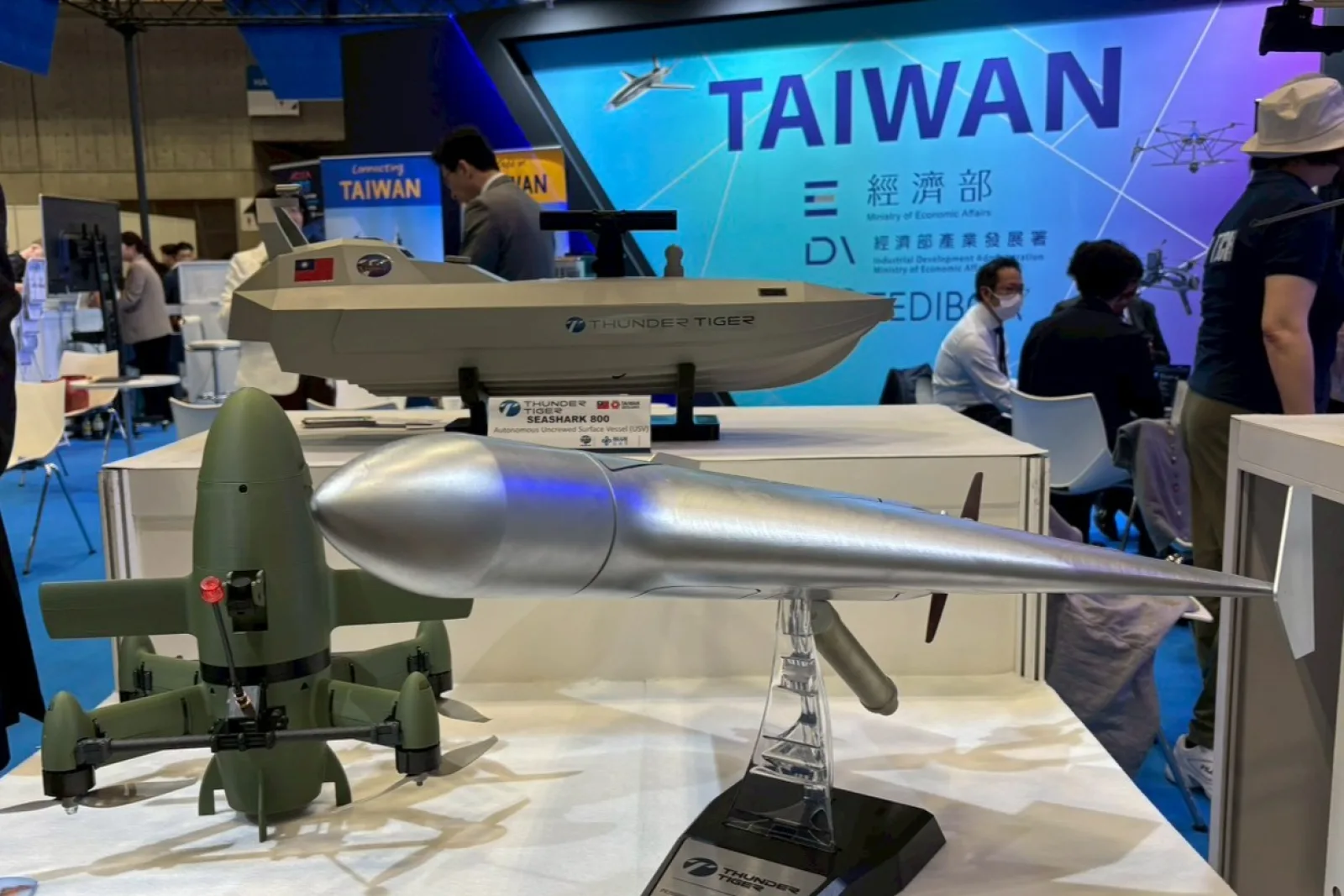
Earlier this month I spent two days (June 4–5) at Drone Japan 2026 in Chiba, interviewing Taiwanese drone makers and component suppliers — integrators with combat-tested airframes, battery and thermal-materials manufacturers, training-aircraft builders, and the industry association that brought many of them there under one banner.
I went in expecting the standard trade-show pitch. What I got instead, from nearly every booth, was candor — and the most candid thing anyone told me is the thing this industry's marketing rarely says out loud: it is extremely rare, almost microscopic, for any manufacturer to truly emphasize that their aircraft is 100% Taiwanese, and "Made in Taiwan" does not automatically mean "China-free."
That sounds like a problem. I'd argue it's the opposite. The suppliers willing to say it are showing you exactly how a trustworthy non-Chinese supply chain actually gets built — and exactly what buyers should be asking for.
What "de-redding" really involves
The industry's own term for removing Chinese content is 去紅化 — "de-redding." I interviewed one integrator who walked me through what de-redding actually looked like on the ground: over a year of engineering work, swapping out components one by one, retuning electronic speed controllers and flight controllers around each new part, and rebuilding mass production from zero. As they put it, de-redding is not a procurement memo — it is a redesign program.
And even after all of that, the result is not a purely Taiwanese aircraft. Two integrators I spoke with — independently, in separate interviews, without prompting — told me the same thing: certain components simply cannot be sourced in Taiwan at any price. Both mentioned that inertial navigation systems and camera modules come from the United States and Europe; one also noted that commodity chips are sourced from the Philippines, because Taiwan's domestic semiconductor industry only produces the high-end variants.
Neither company framed this as an admission of failure — both treated it as straightforward engineering reality. One supplier made clear that what matters to a defense buyer is the absence of PRC content, not national purity; an aircraft with an American INS, a European camera, Philippine commodity parts, and Taiwanese everything-else can be meaningfully China-free. A spec sheet that says "Made in Taiwan" and nothing more tells you almost none of that.
The same factory ships both
Here is the detail that should permanently change how buyers read supplier marketing: the market runs on two tracks, often inside the same company.
Multiple suppliers described a version of the same split. Some overseas customers want de-redded product and will pay a premium for it. Others — and there are many — want fast, high-volume, and cheap, and do not care where the components come from. Taiwanese makers serve both. The same firm can ship a China-free configuration to one customer and a cost-optimized configuration, Chinese parts included, to another, in the same quarter.
On documentation, the same practical logic applies: the integrators I interviewed told me that government and defense customers receive full country-of-origin paperwork, while commercial clients can request verification documents or sign an NDA prior to formal cooperation — but a BOM will not be shared with an uncooperated client at the initial stage.
None of this is deception. It is rational segmentation, and the suppliers were open with me about it. But it has a hard implication: "China-free" is not a property of a company. It is a property of a specific product line, in a specific configuration, at a specific point in time. A company-level badge — or a flag on a website — cannot carry that information.
Registration is not independence
There is a third layer, and it is the least visible from a trade-show aisle: some Taiwan-registered suppliers remain commercially entangled with China, and a few are quietly hedging.
At the component level, I met a manufacturer whose Taiwanese plant can build fully non-red product on demand — the capability is real and the line exists — but whose group also operates major production in mainland China. The non-red line is new, has no orders yet, and is not the cheapest option, and the company is candidly cautious about promoting it for fear of consequences for its mainland business. When interviewing one of the manufacturers, they deliberately avoid publicizing their drone work at all and do not even have a website, because their corporate parent is based in China and they worry about the potential impact on their main corporate business.
I am not naming these companies, because they disclosed their situations honestly and deserve better than to be punished for candor. But the pattern matters for buyers: a Taiwanese business registration is not, by itself, evidence of independence from China — commercially or politically. Some of the skepticism American engineers direct at "Not China" labels, which Taiwanese exporters find so frustrating, is not prejudice. Part of it is rational. (Why that trust gap persists even for genuinely clean suppliers — and what actually closes it — is a separate question, and the subject of a coming analysis.)
The right question, and the honest answer
Put the three findings together and the conclusion writes itself. "Where is this company from?" is the wrong question. The right question is: "For this product line, in this configuration, what is the origin of every component — and how is that claim verified?"
What struck me most at the show is that Taiwan's serious suppliers welcome that question. One integrator's sales lead put it to me plainly: open up the aircraft and show us which part is Chinese. Suppliers who have actually done the de-redding work — the ones I interviewed at the show — want their supply chains inspected, because that work is precisely their differentiation. It is the suppliers who have not done the work who benefit from vague, company-level labels.
The honest answer, as multiple interviewees framed it, will rarely be "100% Taiwanese." It will be an itemized one: these parts from Taiwan, these from the US and Europe, these from third countries, none from the PRC — documented at the bill-of-materials level, per product line. That answer is checkable. "Made in Taiwan" is not.
To be fair to the ecosystem: the gap is closing from the supply side too. I met component makers whose non-red credentials are genuinely clean — one thermal-materials manufacturer produces entirely in Taiwan from Japanese raw material, with no Chinese content anywhere in the line; one training-aircraft builder runs a fully localized bill of materials, down to domestically produced flight controllers. A real non-red component layer is forming in Taiwan. For now it is thin, and it is not the cheapest option on the table — capability is appearing faster than order flow. But it exists, and order flow is exactly what will deepen it.
Where this leaves buyers — and Taiwan
Taiwan's drone industry is having its moment: output is projected to more than double in 2026, export demand from Europe and the United States keeps climbing, and Western procurement policy is moving its way. The temptation, on both sides of the transaction, is to let "Made in Taiwan" do the compliance work by itself.
It can't — and the best Taiwanese suppliers already know it. The ones who impressed me most at Drone Japan weren't the ones with the boldest "China-free" banners. They were the ones who could walk me through their supply chain component by component, including the parts that come from somewhere else, and tell me exactly which product lines the claim covers.
That is the standard worth building on: verification per component and per product line, with documentation to match — not flags, and not slogans. It is the standard we designed TaiwanDrones.com's China-Free verification program around, beginning with structured supplier self-declarations and BOM-level disclosure. The suppliers doing the hard work have nothing to fear from it. That, more than any label, is what should give buyers confidence.
Sylvaine Li is the co-founder of TaiwanDrones.com. She interviewed Taiwanese drone manufacturers, component suppliers, and industry-association representatives at Drone Japan 2026 in Chiba, June 4–5.
Sourcing drones or components from Taiwan?
Tell us what you need — we match it to verified Taiwan-based manufacturers and make the introduction. There's no charge to submit a request.
Source these components from Taiwan →Taiwan Drones Weekly News Roundup: September 14 - 20, 2026
Sep 20, 2026
Attack drones joined Taiwan's live-fire drills for the first time this week, whi...
Taiwan Drones Weekly News Roundup: September 7 - 13, 2026
Sep 13, 2026
This week's clearest signal was not that Taiwan needs more drones. It was that b...
Taiwan Drones Weekly News Roundup: August 31 - September 6, 2026
Sep 6, 2026
This was the week Taiwan's drone advantage got priced by three different governm...