
Saudi Arabia Just Set the Record for Taiwanese Drone Purchases. The Customs Data Tells a Bigger Story.

July 22, 2026

In June, Saudi Arabia purchased US$47.2 million worth of Taiwanese drones — the largest amount any single country has bought in any month since Taiwan began keeping drone-specific export statistics in mid-2023. Bloomberg reported the milestone, and the Taiwanese press picked it up. But the customs database behind the headline contains a story that one number can't tell. We pulled the full monthly series — every destination, every month since January 2025 — from the Ministry of Finance's trade statistics portal. This piece is what the data actually shows, and it launches something new: a Taiwan drone export tracker that is updated as each month's figures are released.
First, the headline: according to Ministry of Finance customs data, Taiwan exported US$59.1 million of unmanned aircraft (HS code 8806) in June 2026, itself an all-time monthly record. Saudi Arabia accounted for $47.2 million of it, roughly 80% of the month. Bloomberg reported that the shipments averaged seven to 15 kilograms per aircraft, and that their purpose has not been disclosed; Su Tzu-yun of the Institute for National Defense and Security Research told Bloomberg the drones were likely acquired for reconnaissance.
Instantly, one order made Saudi Arabia the second-largest destination in the history of Taiwan's drone exports. Only the Czech Republic, with roughly $185 million cumulative since January 2025, has bought more. (Taiwan's entire 2024 drone exports were roughly a twentieth of 2025's NT$2.99 billion — about US$5 million — so the pre-2025 history cannot change this ranking.) That is worth pausing on, because Riyadh has been one of the most significant buyers of Chinese military drones — CH-4s from 2014 and at least 15 Wing Loong II strike platforms with reported interest in hundreds more, flown operationally over Yemen, a very different class from the 7–15 kg reconnaissance aircraft speculated to be in this shipment.
And the Chinese relationship is not fading: as recently as March, industry reporting described a $5 billion agreement to build a Wing Loong-3 factory in Jeddah. The reporting was unconfirmed by either government, but consistent with a decade of deepening ties. So there is no evidence Saudi Arabia is replacing its Chinese fleet. It is something more instructive: a kingdom that already buys Chinese strike drones and co-produces Turkish ones opening yet another procurement lane and choosing Taiwan for it rather than defaulting to Beijing. For the supply chain built explicitly as the non-Chinese alternative, that is precisely the pattern that matters: Taiwan does not need buyers to abandon China to win; it needs to win segments, and it just won one in a market China has spent a decade cultivating. June's figures are preliminary and the buyer, supplier, and end use are all undisclosed, so this is a milestone and not yet a trend. But it is a milestone with geopolitical weight.
The bigger story: a 40x scale-up in twelve months
The Saudi order landed on top of an export curve that was already remarkable. Through April 2025, Taiwan's monthly drone exports ran under $1.5 million — a hobby-scale trickle. The inflection came in mid-2025, and by the first quarter of 2026 the industry was shipping $30–44 million every month. March 2026, at $43.7 million, held the all-time record until June broke it.
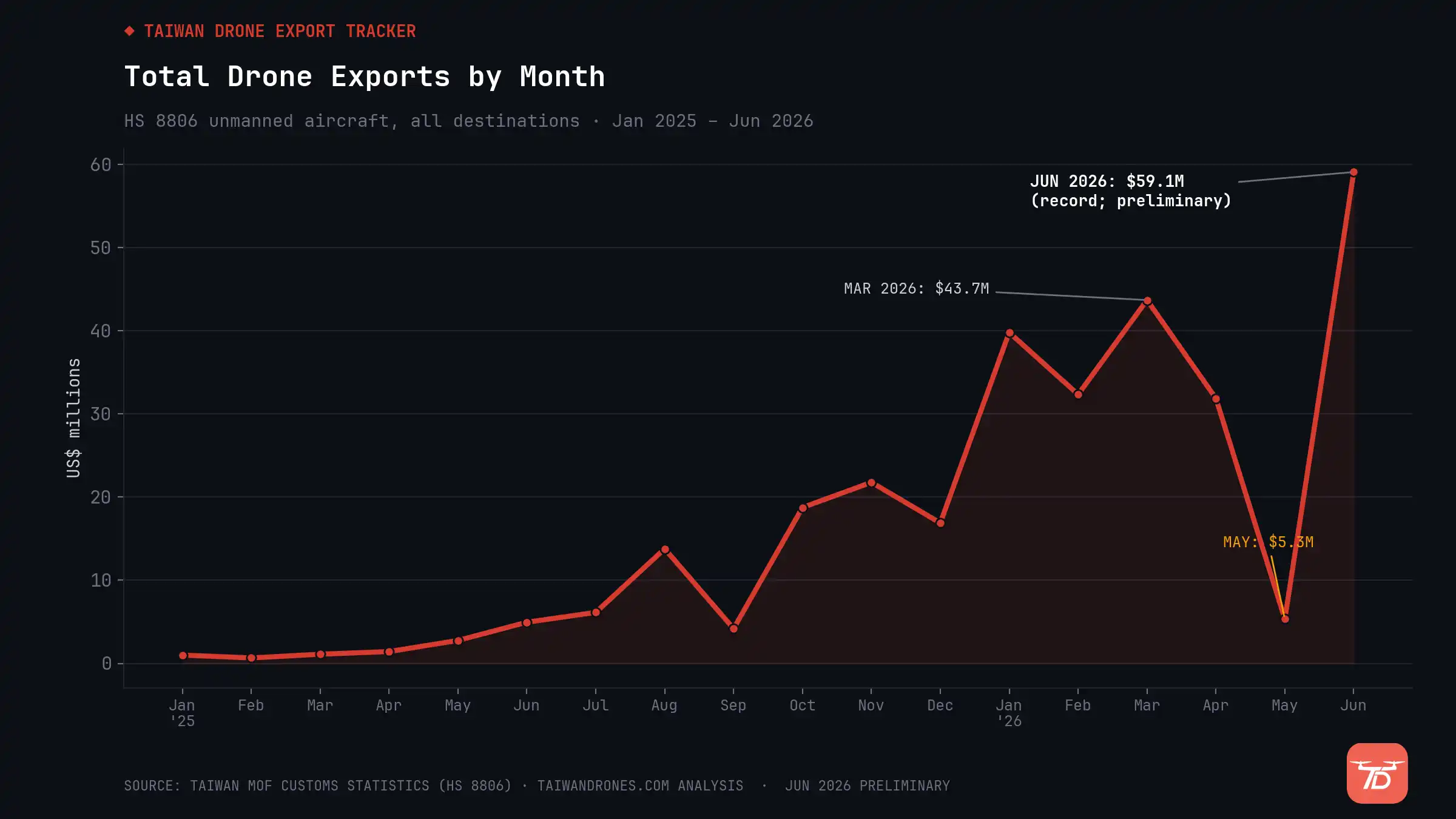
From roughly a million dollars a month to the thirty-to-forty-million range within a year — with Bloomberg's annual framing telling the same story: 2025's full-year exports were twenty times 2024's. That is the curve underneath every headline about Taiwan's drone industry, and it is the context the government's push toward 100,000 units of monthly capacity by 2030 should be read against: the demand signal arrived before the capacity did.
Almost all of it went through one corridor
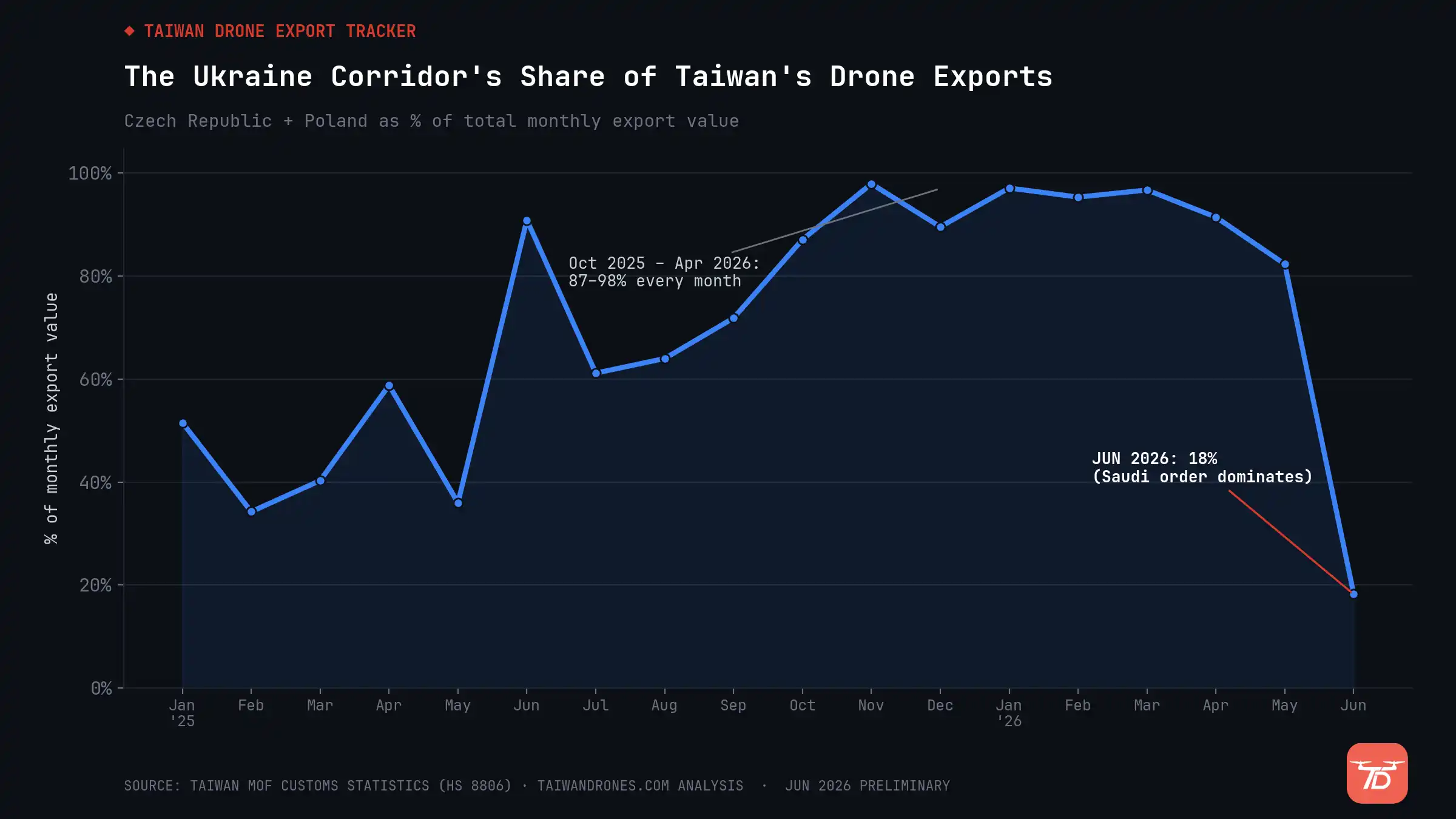
Where did that growth go? Overwhelmingly, to two countries that are not the final destination. The Czech Republic and Poland — documented transit hubs for deliveries to Ukraine — have been the largest destination bloc in nearly every month of the series, and from June 2025 through April 2026 they took an outright majority of Taiwan's drone exports every single month. Poland led through the summer of 2025; the flow then shifted heavily to the Czech Republic, and at the corridor's peak — October 2025 through April 2026 — the two countries combined took 87% to 98% of all Taiwanese drone exports, with the Czech Republic dominant within that share.
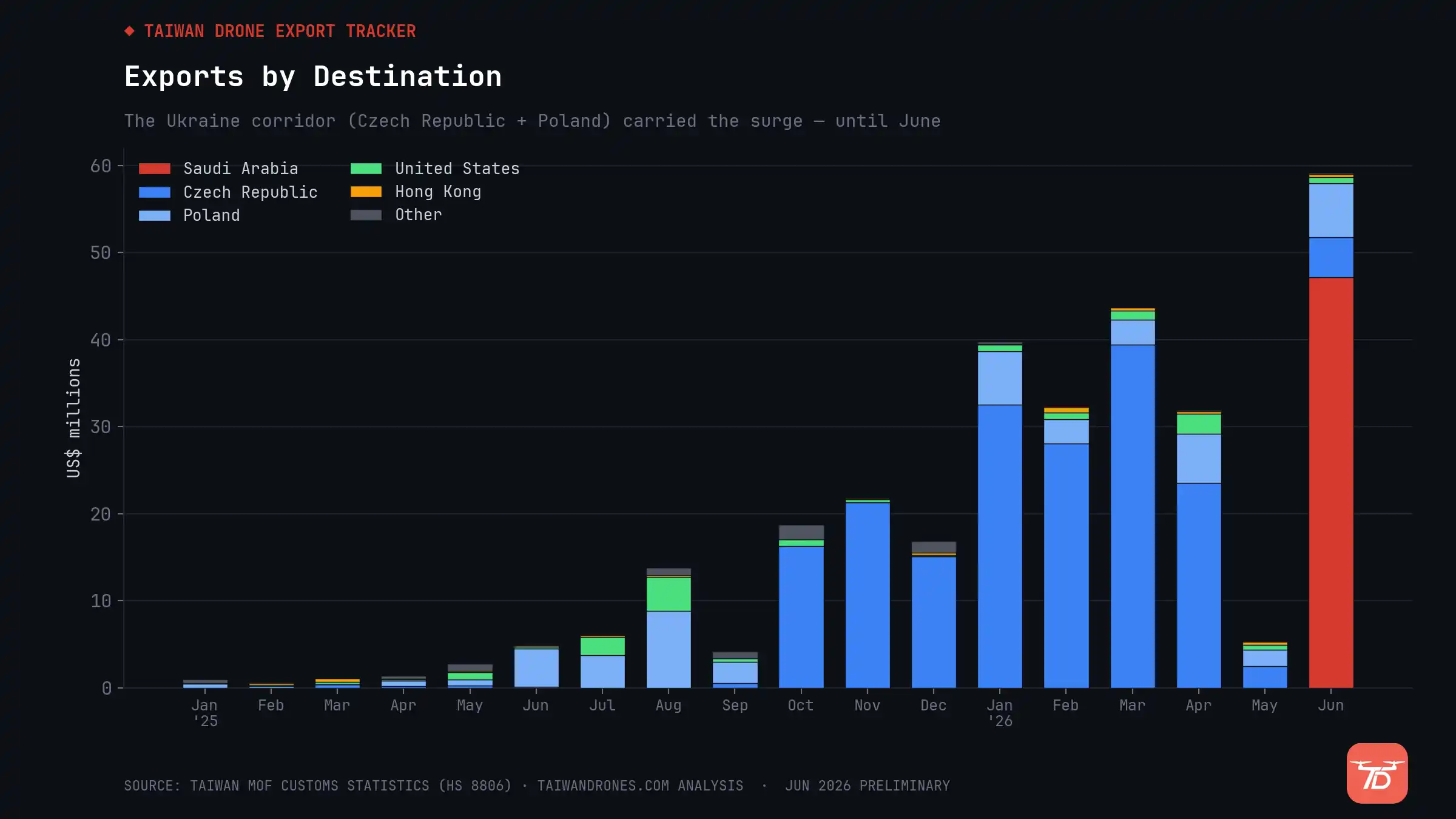
Until June, Taiwan's drone export boom was essentially one customer: Ukraine's war effort, routed through Central Europe. That concentration cuts both ways. It validates Taiwanese hardware in the most demanding proving ground on earth, and it is the commercial engine that let manufacturers scale. But it also means the industry's export revenue has been exposed to a single conflict's procurement cycles. This makes diversification stories like Saudi Arabia's order commercially existential, not just diplomatically interesting.
The June data shows the corridor is still running — Czech and Polish shipments totaled $10.8 million, more than double May — but for the first time since the surge began, the corridor was not the story.
What the price per kilogram reveals
Customs data at this level does not include unit counts, but it does include weight, and dividing value by weight produces the most revealing metric in the series. Across the corridor's high-volume months — October 2025 through June 2026 — Czech and Polish shipments priced with remarkable stability at roughly $230–320 per kilogram, the signature of high-volume, attritable FPV-class systems. (Earlier months are too small and mixed-destination for the ratio to mean much; we compute it only where the volumes support it.)
The Saudi shipment priced at approximately $1,258 per kilogram. Four to five times the corridor's value density.
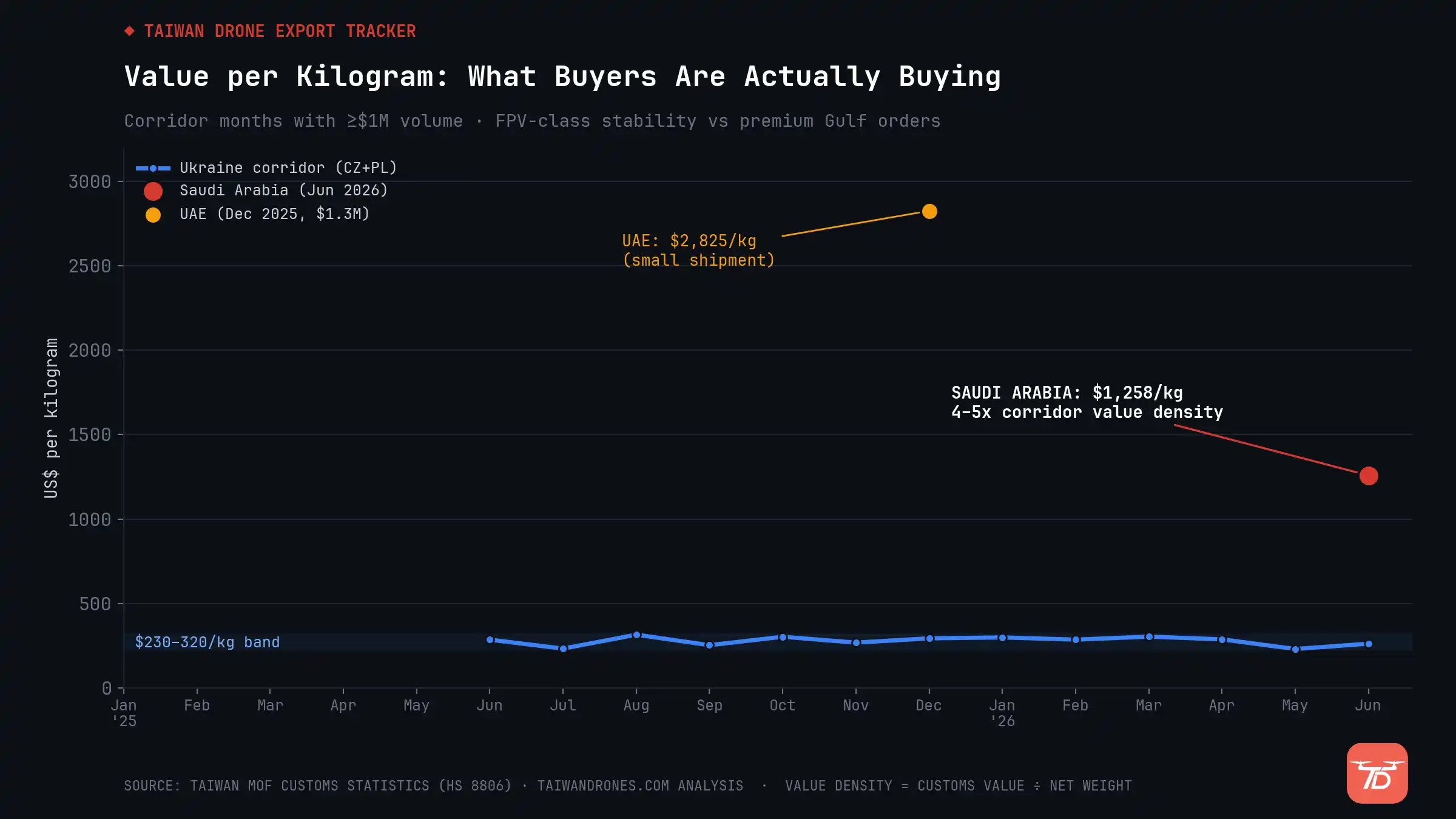
That gap is the clearest available evidence of what Saudi Arabia actually bought: not massed FPV volume, but a smaller number of premium systems consistent with the 7–15kg class Bloomberg cited and with Su Tzu-yun's reconnaissance assessment. And it suggests something important about where Taiwan's export market may be heading: the Ukraine corridor proved Taiwanese drones at volume prices, and the Gulf may be where Taiwanese drones earn margin.
There may be a precursor in the data. In December 2025, the United Arab Emirates took a small shipment — $1.3 million, less than half a tonne — at roughly $2,800 per kilogram, the highest value density of any non-trivial shipment in the series. A single small shipment could be a demonstration batch or a one-off, so we shouldn't read too much into this. But six months before the Saudi order, a Gulf buyer was sampling Taiwan's premium end, and in hindsight it reads as a possible early signal.
The May anomaly nobody has explained
One more thing the monthly series surfaces, and we flag it as an open question rather than an answer: May 2026. Total exports collapsed to $5.3 million — down 83% from April, the weakest month since the surge began, with Czech shipments falling from $23.6 million to $2.5 million. Then June set an all-time record.
A contract cycle between orders? A logistics or certification pause? Something on the Ukraine side? The customs data cannot say, and to our knowledge no one has reported on it. We will be asking manufacturers about it directly, and we note it here because it illustrates why a monthly series matters: single-month headlines — good or bad — mean little without the curve around them.
What to watch
A few cautions belong in any serious analysis of this data, and they will accompany every edition of this tracker. Customs statistics record the last known destination, not the end user. The Czech and Polish figures prove exactly that. The June figures are preliminary and may revise. HS 8806 covers finished aircraft only: Taiwan's component exports — the motors, optics, and modules that increasingly fly inside other countries' drones — ship under different customs codes and are invisible in this series entirely. An industry can be growing in components while flat in finished aircraft, and this data would not show it.
And one caveat that matters more for this commodity than most: the published figures are a floor, not a ceiling. Taiwan's customs statistics follow the international "passive confidentiality" convention under which an exporter can request that its trade line be suppressed from publication, and the Customs Administration maintains a list of applied suppressions on the statistics portal. For an ordinary commodity that is a statistical footnote. For a defense-adjacent one, it means a sensitive or government-to-government shipment could be entirely, and legally, absent from this data. We check the suppression list as part of each month's pull, but by design, what is suppressed cannot be counted. Everything in this tracker should be read as at least this much, to these destinations at minimum.
Two smaller threads we are watching in the destination table: a persistent, modest flow to Hong Kong (a few hundred thousand dollars most months), and the fact that Israel, Japan, the Philippines, and others now appear as small but recurring buyers, the long tail of a customer base that eighteen months ago barely existed.
The tracker
Taiwan's Ministry of Finance publishes each month's trade data around the 10th of the following month. Our new dedicated tracking page provides a monthly analysis: total exports, destination breakdown, value-per-kilogram trends, and whatever the new month's data surfaces — with the caveats stated and the source data linked, so you can check our work. If your sourcing or strategy work would benefit from the underlying dataset, or you have insight into what the data shows — especially the May question — we want to hear from you.
→ Subscribe to Taiwan Drone Weekly to get the tracker every month: taiwandrones.com/subscribe
→ Suppliers and buyers: contact us at info@taiwandrones.com
Sourcing drones or components from Taiwan?
Tell us what you need — we match it to verified Taiwan-based manufacturers and make the introduction. There's no charge to submit a request.
Source these components from Taiwan →Taiwan Solved Its Drone Funding Problem. Ownership Risk Is the One That's Left
Sep 26, 2026
Taiwan's NT$240 billion drone act, a fresh NT$55.9 billion budget, and preferent...
The Ukraine Corridor Came Back and US Buyers Beat the Tariff Deadline: Taiwan Drone Exports, August 2026
Sep 12, 2026
Taiwan exported $36.4 million of drones in August 2026. The Czech Republic took...
Which Factory Made This Lot? What the Unimicron Investigation Means for PCB Buyers
Sep 3, 2026
Taoyuan prosecutors raided Unimicron, a board supplier to Nvidia and Intel, on s...