
Ukraine Is Now Making Its Own Drone Motors and Flight Controllers. What's Left for Taiwan?

August 21, 2026
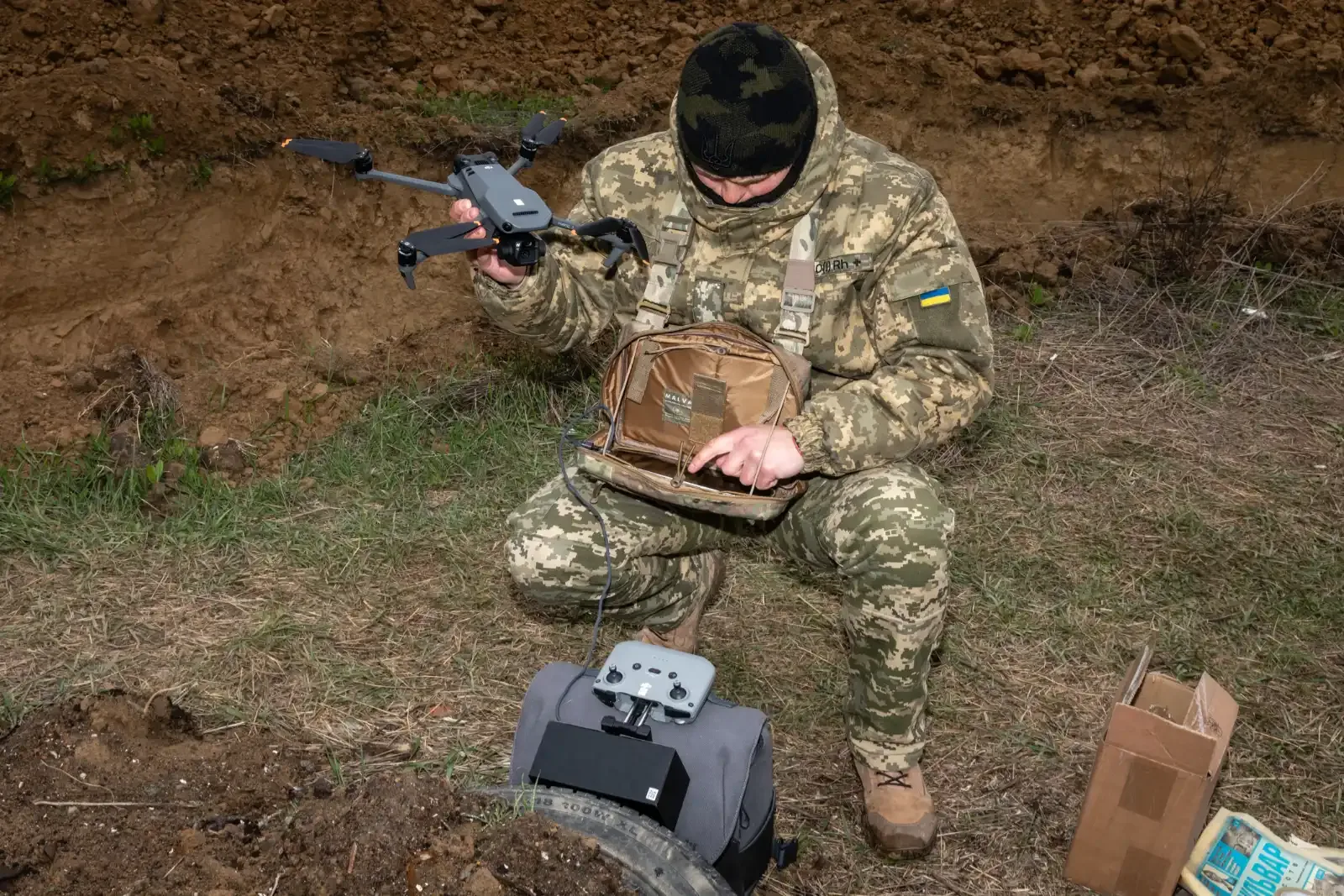
On August 20, the Ukrainian defense-tech firm EDRONE told Militarnyi that it had established in-house production of frames, motors, propellers, and circuit boards — flight controllers, initiation boards, and ESCs — with the explicit goal of replacing Chinese components. Founder and CEO Viktor Yevpak framed it as a shift from assembling drones out of purchased parts to manufacturing the parts themselves.
That list should get the attention of every Taiwanese component manufacturer currently shipping into the Ukraine corridor. Drone motors, flight controllers, ESCs, propellers, and airframes are close to the whole basket that Taiwanese suppliers are currently selling into Ukraine, and EDRONE has just announced in-house production of all of it.
The instinct is to read this as the window closing. That reading is wrong, but so is the reassuring one. The question is not whether Ukraine is localizing — it clearly is and doing so quickly — but where the localization ends, and what remains beyond it.
EDRONE is not an outlier
The first important fact in this story is that this is not one company's announcement. Instead, it reflects the general state of the Ukrainian drone sector in 2026.
In March, the New York Times reported that Ukraine had reached the point of being able to build drones with no components imported from China at all, with circuit boards — long the most stubborn foreign dependency in small strike drones — now produced domestically (summary via RBC-Ukraine). In August, F-Drones CEO Stanislav Khutor told Interfax-Ukraine that his company had become the first in Ukraine to localize 100 percent of component production in-house: motors, frames, flight controllers, speed controllers, communication systems, video transmitters, and antennas across the full frequency range. Fire Point's technical director Iryna Terekh has said the company now produces more than 97 percent of the engine components in its FP-1 and FP-2 long-range strike drones. In electronic warfare, Unwave's head of strategy Taras Bublyk has described jammers and amplifiers that were once entirely Chinese as now fully locally produced.
The driver for localization was never compliance. It was supply denial. China's September 2024 export restrictions on drone components were applied asymmetrically, with Ukrainian buyers facing genuine cutoffs while Russian production lines kept receiving parts. A supplier that can be switched off by a government favoring your adversary is not a supplier. Ukraine chose higher cost over that exposure, and has moved faster than almost anyone predicted.
Seven million drones need twenty-eight million motors
Every one of the figures above is a firm-level claim. The sector itself operates at a different order of magnitude.
At a March industry event reported by Defense Daily, Brave1 COO Iryna Zabolotna put Ukraine's 2026 production plan at more than seven million drones. Sergiy Orlov, director of international cooperation and government relations at General Cherry, supplied the math from the year before: five million drones built in 2025 meant a requirement of something like twenty million motors, on the order of seventy thousand a day. Against the 2026 plan, the same calculation runs to roughly twenty-eight million — before spares and attrition losses are counted at all.
Set that against what a localized Ukrainian motor line actually looks like. In EDRONE's case, the company machines the housings and handles assembly and winding; the wire and other inputs are still purchased. On batteries, the announcement covers pack assembly, propeller molding, and landing legs — not cell manufacturing. This is localization of the integration layer. It is real, it is strategically significant, and it does not produce seventy thousand motors a day.
The same qualifier belongs on the Taiwanese side of the ledger. "Made in Taiwan" is also an assembly and design claim rather than a statement about the bill of materials, and Taiwan's first military drone procurement case charged under the National Security Act turns on precisely that gap: prosecutors allege that Chinese chips and flight control boards were built into aircraft delivered to the army, with markings obscured and certificates of origin falsified. The case is under investigation and nothing has been proven. But the structural point does not depend on the outcome. Neither country's localization claims survive contact with the component tier without evidence, and a buyer who accepts either at face value has accepted a declaration rather than a finding.
The hardest tiers remain the ones you would expect. Lower-tier printed circuit board components, flight controllers, and motors have proven the most resistant to substitution, in the motors' case partly because of Chinese control of the manganese that goes into lithium-ion cells — the same upstream battery-materials exposure that runs underneath Taiwan's own non-red supply chain. Rare-earth magnets, cells, and upstream materials trace back to Chinese sources regardless of where final assembly happens, which is why "China-free" in the Ukrainian context is better understood as a direction of travel than a binary status. Thermal imaging is the starkest remaining gap: Ukrainian manufacturers surveyed by Ukraine's Arms Monitor put FPV thermal camera dependence on China at roughly 90 percent or higher, and EO/IR cameras and gimbals remain one of the least localized categories in the entire stack.
The most telling single number we have found on this comes from a Snake Island Institute and Ukrainian Council of Defence Industry survey of thirty Ukrainian manufacturers, reported by the Taipei Times in July: all but one still import at least some Chinese components, and 76.7 percent said they would abandon Chinese sourcing entirely if competitive alternatives became available.
That figure is the addressable market, as stated by the buyers themselves. It also contains the operative condition: competitive.
Taiwanese parts cost up to three times Chinese ones
Taiwanese drones and components can run up to three times the price of Chinese equivalents. That is not a marketing objection to be argued around; it is a structural consequence of scale, and the Ukraine corridor has already tested it. DSET's analysis describes Taiwanese platforms being field-tested in Ukraine without converting into volume orders, on cost rather than capability grounds.
The component picture looks different, and the contrast is the most important thing in the data. The same April DSET report found seven of sixty-one Ukrainian drone-related firms sourcing flight controllers, batteries, motors, and microelectronics from four Taiwanese suppliers. Taiwan's Ukraine business is a component business. The platform experience is the evidence for why.
Ukrainian analysts are direct about the tradeoff. Aviation expert Anatoliy Khrapchynskyi noted in April that some components remain cheaper to buy from China, and that buying Chinese lets producers scale faster. In a war fought at seven million units a year, scaling faster is not a preference, it is a necessity.
None of this means that Taiwanese components cannot compete. It means that they compete on qualification, consistency, delivery, and specification, and not on being non-Chinese. Non-Chinese is now table stakes in a market that has spent two years building its own non-Chinese supply base.
Under EU rules, Ukrainian components beat Taiwanese ones
There is a second-order effect of Ukrainian localization that deserves more attention than it has received, and it runs against Taiwanese interests in a way the component-substitution story does not.
The rule is set out most precisely in SAFE, the EU's €150 billion defence loan instrument. Article 16(10) of Council Regulation (EU) 2025/1106 requires that components originating outside the Union, the EEA-EFTA states, and Ukraine account for no more than 35 percent of the estimated component cost of the end product — which is to say that at least 65 percent must come from inside that perimeter. EDIP carries an equivalent cap at Article 10(3). Ukraine is named inside the perimeter. Taiwan is outside it.
The perimeter is not fixed by geography, and that is important. Eligibility can be extended to a third country that concludes an agreement with the Union under Article 17 of SAFE, or — under the Ukraine Support Loan — to one meeting three cumulative conditions including a Security and Defence Partnership with the EU. The United Kingdom went through that second door on 13 July 2026, on the strength of its support to Ukraine since 2022. Canada signed a partnership in June 2025 and member states endorsed its participation that December. Both routes run through instruments requiring a diplomatic relationship no member state extends to Taipei. The cap is therefore not a judgement about a country's manufacturing — it is a door opened by treaty, and Taiwan competes inside the 35 percent allowance alongside the United States, Turkey, and China.
One boundary matters before any of this is applied to a specific order. SAFE, EDIP, and the €90 billion Ukraine Support Loan are separate instruments with similar architecture and different detail, and a position under one does not transfer to another. Most of the corridor volume in the customs data is transit to Ukraine rather than sales into EU-funded programmes, and privately funded orders are governed by none of these rules. We have set out what the Ukraine Support Loan rules actually admit separately; the short version is that the establishment test reaches only subcontractors supplying critical inputs at 15 percent or more of contract value with classified access, which is not where most Taiwanese component suppliers sit.
This means every new Ukrainian component line does not merely displace a Chinese part. It produces content that European buyers are affirmatively incentivized to prefer over a Taiwanese equivalent of identical specification — cheaper and rules-advantaged at the same time.
That channel is already operating. In April, General Cherry signed a memorandum of understanding with the Croatian component manufacturer Orqa for a joint venture producing interceptors without Chinese components; under the plan, reported by the Kyiv Independent, Orqa staff help build a component factory inside Ukraine that then supplies Orqa's Croatian assembly operations. Ukrainian components flowing into EU-based assembly is the exact position Taiwanese suppliers have been advised to target.
The American market is not insulated either. In July, F-Drones — the company claiming full in-house localization — completed Ukraine's first authorized export of finished combat drones to another continent, supplying 2,000 F10 strike UAVs to the United States under a Pentagon contract linked to the Drone Dominance program. Khutor cited NDAA China-free requirements directly when describing the company's localization strategy.
Taiwan's position in that channel is stronger than the legislative timeline implies. The Blue Skies for Taiwan Act does contain a fast-track certification provision, but Section 6 is the least likely of the bill's three mechanisms to survive conference in substantive form, and the working group — the provision most likely to be enacted — is by construction slow. The detail that matters more to a supplier is the condition attached: the fast track applies to manufacturers whose products contain no PRC-connected subcomponents, which makes the interval before it opens a preparation period rather than a waiting one.
Legislation is not the only route in any case. ITRI signed an agreement with AUVSI in January and formally launched as an authorized Green UAS evaluation body on June 4, the first such body recognized outside the United States, which lets key evaluations be completed in Taiwan rather than abroad. The distinction matters: Green UAS is the commercial standard, Blue UAS the government one, and ITRI conducts the assessment while AUVSI still issues the certification. AUVSI chief executive Michael Robbins has described Green UAS as a route toward Blue UAS and, more immediately, as grounds for exemption from the FCC Covered List.
The comparison, then, is not years of legislation against a Ukrainian firm already shipping. Thunder Tiger has held Blue UAS clearance since September 2025 and is already bidding into the same Drone Dominance Program that F-Drones sold into. The difference is depth rather than access: one Taiwanese platform among roughly thirty-nine cleared airframes and a hundred and sixty-five cleared components, against a Ukrainian supplier arriving with combat references and finished-platform credibility. The gap is measured in certification steps and demonstrated use, not in acts of Congress.
A factory in Europe is the only way out of the 35 percent bucket
DSET's recommendation that Taiwanese firms pursue joint ventures or production facilities abroad tends to get read as generic internationalization advice. Under SAFE and EDIP it is something far more specific: the mechanism that moves Taiwanese output from the capped third-country allowance into the eligible one. It is not the only way a Taiwanese component reaches a European programme — a smaller supplier below the subcontractor thresholds is often not caught by the establishment rules at all — but it is the only one that changes the content math rather than working inside it, and the only one that survives a customer being told to raise its European percentage.
The demand signal for this is already documented, and it is Polish rather than Ukrainian. Poland took $19.9 million of Taiwanese drones in July 2026, its largest month on record — more than double its previous best, and the first time this year it has displaced the Czech Republic as Taiwan's leading destination. The relationship is older than that peak. Bloomberg reported in September 2025 that Poland had already become the largest buyer of Taiwanese drones, and the industrial relationships behind the customs data were visible then: Farada Group sourcing most of its motors and batteries from Taiwanese supplier Ahamani since 2023, with COO Joanna Rutkowska describing the Taiwanese parts as quality equivalents with comparable availability that meet American security standards, and WB Electronics — Poland's largest drone producer, with 2024 revenue near $829 million and an existing production facility in Ukraine — proposing a joint venture. Ahamani said at the time that it planned to open a plant in Poland. We have found no public confirmation that the facility has opened in the eleven months since.
The legal question underneath is the one that decides whether any of this works, and there are two separate tests in play. Conflating them is the most common way to get this wrong.
The first is about components. The 35 percent cap turns on where a component originates, not on who owns the firm that made it. A motor manufactured in Poland counts inside the perimeter whether its parent sits in Taichung or Toulouse. That mechanism works, and it is the whole reason a European plant is worth building.
The second is about entities, and it is where a Taiwanese parent becomes a problem. SAFE Article 16 requires contractors and subcontractors to be established in the Union, an EEA-EFTA state, or Ukraine, to have their executive management there, and not to be controlled by a third country. EDIP mirrors this: Article 9 requires establishment and executive management inside the perimeter and, as a general rule, disqualifies entities controlled by a non-associated third country or third-country entity. Control means decisive influence, exercised directly or through intermediate entities — which a wholly owned subsidiary plainly is.
There is a route through it, and it is the operative point for any Taiwanese firm considering this. A foreign-controlled entity established in the Union can still qualify where the acquisition of control has been subject to investment screening, or where it provides guarantees — approved by the member state in which it is established — that third-country influence will not compromise the Union's security and defence interests. The Commission is to supply a standardised template for those guarantees. Separately, and for EDIP-funded actions specifically, Article 10(5) requires that the recipient be able to decide on the definition, adaptation, and evolution of the design without restrictions imposed by non-associated third countries, including the legal authority to substitute or remove restricted components. That test does not travel to every instrument. Under the Ukraine Support Loan the equivalent requirement reaches category two products only, and small drones — NATO class 1, which is most of what the corridor carries — sit outside it.
Read together, that is a governance test more than a capital test: local establishment, executive management on the ground, screening or member-state-approved guarantees covering the parent's influence, and design authority genuinely vested in the European entity.
The implications for a Taiwanese supplier are significant, and they are more specific than "open a factory." Manufacture in Poland and the components made there count inside the perimeter — that much is automatic. But leave the subsidiary wholly controlled from Taiwan with no screening and no guarantees on file, and the entity itself cannot contract or subcontract on a SAFE-funded programme, however European its output. Do both — manufacture inside the perimeter and clear the control test — and you have converted your production from capped content into preferred content, which is the highest-leverage move available to a Taiwanese component manufacturer in the European market and the one advantage Ukrainian localization cannot erode.
The timing argument points in the same direction. Duerr has cautioned that if the war ends, demand is likely to fall while Ukraine floods international markets with its own UAVs, complicating Taiwan's efforts to scale. A European position built inside the EU before that scenario arrives is one of the few things that survives it.
Four things Taiwanese suppliers should do differently
The optimistic reading — Ukraine will keep buying because it cannot make everything — is true but lacking. The pessimistic reading — the window is closing — mistakes a firm-level capability for a sector-level one.
The accurate reading is narrower and more actionable. Ukrainian localization is closing the commodity tier of the market and leaving the qualified tier open, because qualification is exactly what a wartime industrial base optimizing for volume and speed does not have spare capacity to build. DSET's recommendations: standardize drone batteries, obtain international certifications such as AS9100D, and pursue joint ventures or production facilities abroad. As DSET analyst Samara Duerr has put it, access to orders comes down to whether Taiwanese suppliers can compete on cost, production scale, and delivery time.
Sell up the stack, not across it. Cells rather than finished packs — with the caveat that a Taiwan-made cell answers the question at the assembly layer and leaves it open at the precursor layer, where China holds most of the world's cathode and anode material capacity and roughly seventy percent of a cell's cost sits. Wire, magnets, and machined inputs rather than finished motors. Board assembly capacity rather than finished controllers. The Ukrainian integration layer is being localized; the input layer beneath it is not, and every new domestic assembly line increases demand for what feeds it.
Certification is the differentiator, not origin. A procurement person at a Ukrainian or European OEM can evaluate AS9100D, lot traceability, and delivery performance. "Non-red" tells them nothing they cannot already claim about their own production. The line that matters runs between a supplier assertion and a third-party assessment: NDAA compliance is declared, Green UAS is evaluated. The camera sold as NDAA-compliant that was later found communicating with Chinese servers aboard a Royal Navy vessel is what the declared version is worth to a buyer who gets audited. ITRI made the same argument to Taiwanese suppliers at Asia Innovation Drone Day this month: certification is the threshold for selling into US and European buyers, and it does not wait on Taipei. The pathway exists and the assessment work now transfers. What is keeping suppliers from taking the pathway is cost and the hope that demand will appear before they invest in qualifying for it. This is precisely the wrong order, because the demand will only arrive addressed to the firms that are already qualified.
Watch where Ukrainian production lands. EDRONE's Cluj-Napoca facility with OVES Enterprise is scheduled to begin at roughly 1,000 drones a month, scaling toward 10,000 to 15,000, with the first Romanian-built systems — FPV, interceptor, and reconnaissance — due to be presented in September. A facility ramping at that rate will outrun what in-house component lines can supply long before it reaches its ceiling. The interesting Ukrainian customers for Taiwanese components over the next eighteen months may not be in Ukraine.
Treat European establishment as a structuring problem, not a real estate one. The address moves your components inside the 65 percent perimeter, which is the easy half. The corporate architecture — executive management located in the Union, and either investment screening or member-state-approved guarantees covering the parent's influence — decides whether the entity can hold the contract at all. This is work for counsel before it is work for a site selection team, and for suppliers without the capital to build alone, a contract manufacturing partner already established in the Union reaches the same result faster.
Two categories are worth flagging as comparatively uncontested. Data links and radios and ground control stations sit further from the FPV consumable economics that have driven Ukrainian localization hardest, and neither appears in the in-house production announcements that have accumulated this year.
The conclusion is that Taiwan's opening in this corridor was never as wide as the export figures suggested, and it is narrowing at the commodity end. It is also not closing at the end that matters. Taiwan has exported $241.4 million of unmanned aircraft so far in 2026, roughly two and a half times the $93.4 million shipped in all of 2025, with five months still to run. But that figure counts finished aircraft under HS 8806 and nothing else: Taiwan's motors, flight controllers, batteries, and optics ship under other codes and are invisible in it entirely. The component business this article is about does not appear in the numbers that made the corridor famous — which is the clearest indication available that the market that grew on a compliance argument will have to be held on an industrial one.
We publish Taiwan's monthly drone customs figures in the Export Tracker. If you are sourcing components from Taiwan, tell us what you need — we match requests to verified Taiwan-based manufacturers and make the introduction directly. There is no charge to submit a request, and we take no position in transactions between buyers and suppliers.
Sourcing drones or components from Taiwan?
Tell us what you need — we match it to verified Taiwan-based manufacturers and make the introduction. There's no charge to submit a request.
Source these components from Taiwan →What Taiwan Offers Drone Component Buyers Besides Non-Chinese Origin
Oct 5, 2026
Non-red gets a Taiwanese part considered, and competitors elsewhere can claim it...
Who Pays for Drone Dominance, and Who Gets Paid
Oct 1, 2026
Venture-backed startups absorb the losses. The margin goes to whoever makes the...
Foreign Buyers Are Asking Taiwan for Drone Parts. Too Often the Answer Is No.
Sep 23, 2026
Foreign buyers want non-Chinese drone parts from Taiwan. Some suppliers decline;...