Asia Innovation Drone Day Turns Five: The Certification Window Is Open Now. The NT$44.2 Billion Plan Still Isn't.

August 12, 2026
The Asia UAV AI Innovation Application R&D Center in Chiayi County hosted the fifth edition of Asia Innovation Drone Day (亞創無人機日) — officially the 2026 Asia UAV AI Innovation Application Expo — on August 9, with a trade expo, an MOU with a European think tank, and a public plea from County Magistrate Weng Chang-liang (翁章梁) to pass more than NT$40 billion in stalled drone procurement funding, per Taiwan News. TaiwanDrones.com attended. Two other threads ran underneath the ribbon-cutting: a push from Taiwan's research establishment to get certified now, and a warning from the center's own leadership about where the industry's next materials bottleneck sits.
Two things were true on the floor of the Asia UAV AI Innovation Application R&D Center in Puzih City (朴子) this past weekend. The industry the center anchors has grown from a description five years ago as an "aerospace wasteland," per the Taipei Times, into a site hosting more than 60 companies and research units and drawing delegations from 36 countries, according to Liberty Times. And the money the government itself says the industry needs to compete internationally is still sitting in the Legislative Yuan.
Weng's ask was specific: more than NT$40 billion (roughly US$1.24 billion), which he wants passed before the end of August. That figure is the NT$44.2 billion Unmanned Vehicle Industry Development Coordination Plan the Executive Yuan approved in October 2025, a six-year program running through 2030 that the KMT caucus moved to freeze in July. What's stuck in the legislature isn't a single-year operating line item. It's a multi-year industrial pillar spanning chip R&D, National Development Fund investment in component manufacturing, public procurement demand aggregation, and cluster-building in Chiayi and Minxiong. We flagged the same funding fight in our August 3-9 weekly roundup. For suppliers, the stakes are the ones we described in July: a domestic demand-aggregation mechanism that gives Taiwanese manufacturers a qualified order history before they chase export contracts, currently on hold over a partisan procedural dispute rather than a policy disagreement about the industry itself.
The physical proof the money is needed
Whatever the bill's fate, demand for the center's own space has already outrun what exists. Weng said 40 to 50 additional companies want in and can't fit, and that a new aerospace and drone industrial park in nearby Minxiong, designed to hold about 100 firms, breaks ground in September, per Taiwan News. Chunghwa Telecom used the expo to demonstrate a drone delivery link between the center and nearby commercial areas, with more than 1,000 test flights completed and safety checks ongoing. None of that capacity expansion depends on the NT$40 billion clearing the legislature. But converting the physical footprint into export orders, the stated purpose of the funding fight, does.
The certification pitch that doesn't wait on the legislature
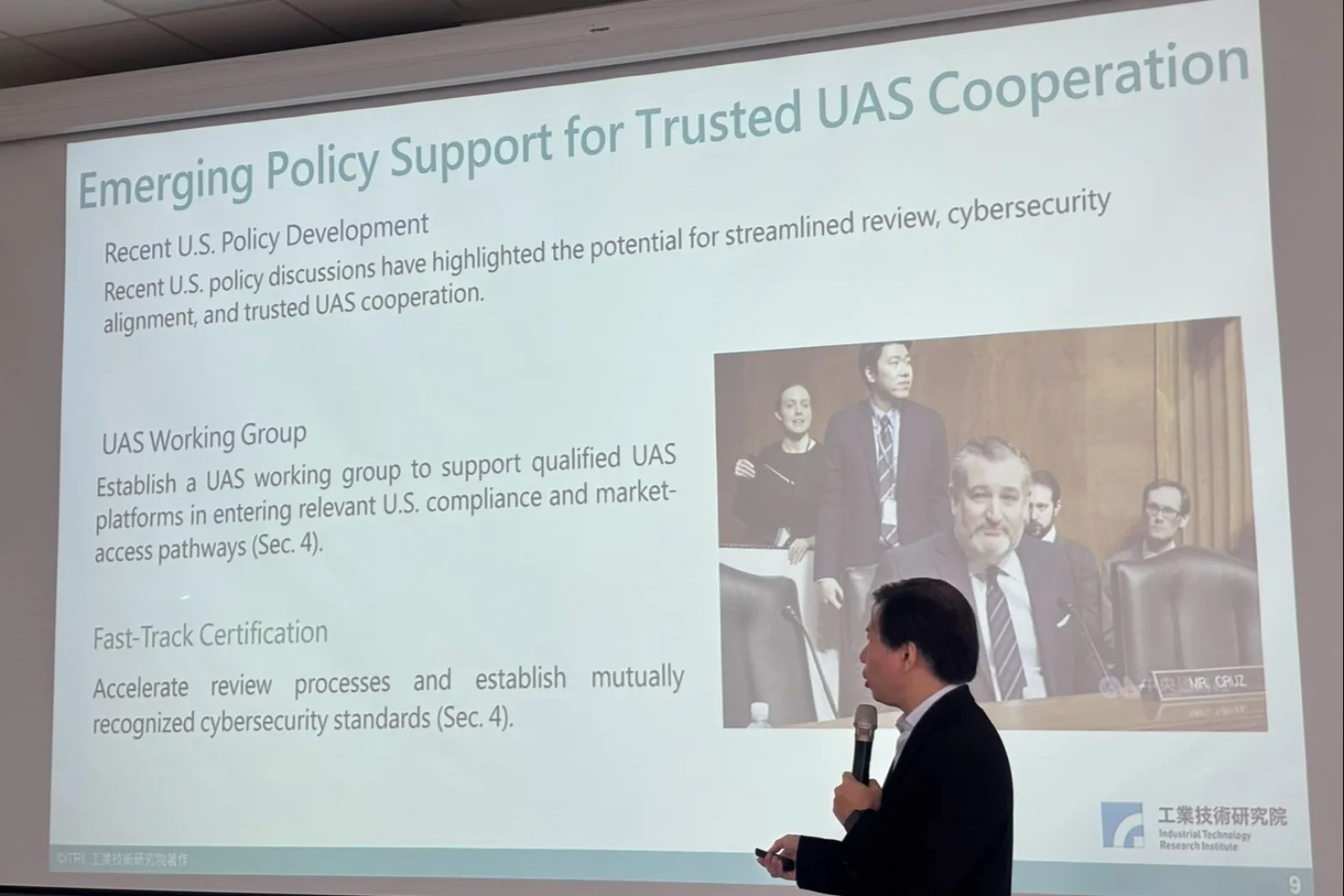
For suppliers standing in the room, the most actionable message of the day wasn't about the NT$40 billion at all. It was a push, delivered on-site by Industrial Technology Research Institute (ITRI) representatives to the companies and researchers filling the center, to apply now for the credentials that actually open buyer conversations: Green UAS certification, with an explicit signal that Blue UAS is the natural next step for firms whose product lines and customer targets call for it. ITRI serves as a Recognized Assessor under the Green UAS program, the first such body authorized outside the US, responsible for the cybersecurity testing and technical evaluation that underpins certification. The pitch at Chiayi framed certification as more than paperwork: for suppliers targeting US defense and federal buyers specifically, Green UAS is increasingly the credential those buyers screen for before a conversation about specs or price even starts, and it's a track a Taiwanese firm can pursue independent of anything the legislature does with the industrial plan. It's worth being precise about what the credential does and doesn't do, though: Green UAS certification is a recognized pathway toward eventual inclusion on the Blue UAS Cleared List, not an automatic upgrade. A supplier waiting on the NT$44.2 billion program to clear before starting the Green UAS process is waiting on the wrong gate. That track is open now. For a reader who has followed the certification story elsewhere, the framing at Chiayi added little that's new in substance. What it signaled is where ITRI wants supply, not just demand, to concentrate: inside a cluster that already has the density to make third-party evaluation efficient.
Materials science is catching up to the airframe
A second thread ran through the expo's technical sessions: composite materials. National Formosa University assistant professor Wang Cheng-hsien (王正賢), whose research focuses on composite material mechanics and UAV structural design, presented on where drone airframe materials have actually moved, describing progress toward better engineered solutions for structural design rather than incremental tweaks to existing layups. This is a smaller story than the funding fight, but it points at the same underlying claim Taiwan's industry keeps making to buyers: that its advantage isn't assembly labor, it's materials and precision manufacturing depth that's hard to replicate quickly, in composites as much as in semiconductors or optics.
The rare earth warning
The sharpest framing of the day came from the Asia UAV AI Innovation Application R&D Center's chairman, who used his remarks to name the industry's next structural risk directly: rare earth materials, concentrated in the hands of a small number of producing regions, with prices that he expects to keep rising. His argument to the room was that this is an opening, not just a threat. Democratic-aligned countries, in his framing, need to cooperate on stockpiling rare earth inputs against future disruption, and Taiwan has a genuine case to make for a role in that cooperation. Non-red supply chains are hard to build everywhere, he noted, but Taiwan's core technical strengths, semiconductors, PCBs, optics, and composite materials, sit squarely inside the components a drone actually needs, and those same components are currently difficult for European buyers to source domestically. That gap, in his telling, is where Taiwanese suppliers currently hold an edge worth defending.
The claim is consistent with what we've reported elsewhere. We've previously documented that Taiwan's propulsion strength sits on the same rare-earth-magnet dependency that undercuts many "Chinese-free" motor claims, and DSET's own research puts China's control of upstream battery materials at 65 to 97 percent depending on the input. The chairman's remarks extend that same structural concern from batteries to the broader materials category and frame it as a strategic window rather than only a vulnerability. Whether that window stays open long enough for Taiwan's suppliers, and the democratic buyers courting them, to build stockpiling and sourcing arrangements around it is the open question, and one that depends on coordination among allied governments that, as of this writing, remains at the level of talk rather than a funded program.
The European thread
The expo's other concrete deliverable was international rather than fiscal. Taiwan's foreign ministry drone diplomacy task force signed an MOU with the European Values Center for Security Policy, witnessed by Weng, intended to deepen cooperation on drone industry development, talent cultivation, and international exchange. The signing followed a week-long Taiwan-Czech Republic-Ukraine Battlefield Experimentation Workshop at the center, co-hosted by Chiayi County, the task force, and Czech Republic-based Farpoint Academy, with 22 experts from the National Chungshan Institute of Science and Technology and the Institute for National Defense and Security Research in attendance, according to the Taipei Times. It's a smaller data point than the funding fight, but it's consistent with a pattern this publication has tracked since April, when a Czech delegation led by former Chamber of Deputies Speaker Markéta Pekarová Adamová first visited the center: Chiayi is increasingly functioning as one of Taiwan's important platforms for Central European drone engagement, running alongside the island's institutional relationship with Washington.
What we're tracking
For suppliers, the actionable item from Chiayi isn't waiting on Taipei: Green UAS certification, evaluated through ITRI as a Recognized Assessor, is available now, it's a recognized pathway toward Blue UAS Cleared List inclusion rather than an automatic upgrade, and that credentialing track runs independent of the legislature's calendar. The near-term test that does depend on Taipei is whether the NT$44.2 billion Unmanned Vehicle Industry Development Coordination Plan clears the freeze before the month is out, since that program funds the demand-aggregation and component-manufacturing investment that complements, rather than substitutes for, certification. The longer-term test is the one the chairman raised without naming a timeline: whether Taiwan's semiconductor, PCB, optics, and composite strengths translate into a durable role in allied rare-earth strategy, or whether that conversation stays at the level of expo remarks.
→ Subscribe to Taiwan Drone Weekly for ongoing coverage: www.taiwandrones.com/subscribe
→ Suppliers: contact us at info@taiwandrones.com
This analysis draws on reporting from Taiwan News, Liberty Times, and the Taipei Times, on TaiwanDrones.com's own attendance at the August 9 expo, and on prior TaiwanDrones.com reporting on Taiwan's non-red supply chain and battery materials data. It reflects the state of public information as of August 12, 2026. Remarks attributed to ITRI representatives, Prof. Wang Cheng-hsien, and the Asia UAV AI Innovation Application R&D Center's chairman are drawn from TaiwanDrones.com's own on-site notes rather than a published transcript, and should be read accordingly.
Sourcing drones or components from Taiwan?
Tell us what you need — we match it to verified Taiwan-based manufacturers and make the introduction. There's no charge to submit a request.
Source these components from Taiwan →Taiwan Solved Its Drone Funding Problem. Ownership Risk Is the One That's Left
Sep 26, 2026
Taiwan's NT$240 billion drone act, a fresh NT$55.9 billion budget, and preferent...
The Ukraine Corridor Came Back and US Buyers Beat the Tariff Deadline: Taiwan Drone Exports, August 2026
Sep 12, 2026
Taiwan exported $36.4 million of drones in August 2026. The Czech Republic took...
Which Factory Made This Lot? What the Unimicron Investigation Means for PCB Buyers
Sep 3, 2026
Taoyuan prosecutors raided Unimicron, a board supplier to Nvidia and Intel, on s...