Who Pays for Drone Dominance, and Who Gets Paid

October 1, 2026
The Pentagon's Drone Dominance Program publishes what it pays. After Gauntlet II in September, a long-range strike drone sells to the Department of War for $4,500, a close-quarters drone for $3,500, and each warhead for another $3,250. Those prices are several times what Ukraine is estimated to pay for a first-person-view drone.
Yet people inside the program say the vendors are losing money. David Smith, president and CEO of Robinson Helicopter, whose Ascent Aerosystems unit holds a Phase I order, wrote in a public LinkedIn discussion in late September that venture-backed startups were selling below cost. He said at least one Gauntlet II winner carried onboard hardware costing several times the program's fixed sale price.
No vendor has published its unit economics, so that claim cannot be verified directly. But the program's own documents point the same way. They also show where Taiwanese suppliers fit: airframe makers likely lose money, and suppliers of compliant parts earn the margin.
What the program pays
Drone Dominance is a $1.1 billion program, funded by the July 2025 reconciliation law and run by the Defense Innovation Unit and the Test Resource Management Center. It buys small one-way attack drones through six-month competitions called Gauntlets, then places fixed-price orders with the top scorers. Unusually for the Pentagon, it publishes its prices and its delivery record vendor by vendor.
| Round | Drone price | Warhead | Delivery terms |
|---|---|---|---|
| Phase I (Gauntlet I, Feb 2026, inert payload) | $4,000 or $6,000 | None | $4,000 for the first half within 2.5 months; $6,000 for the second half within five months; $4,000 after that; undelivered drones cancellable at eight months |
| Phase II, deep strike (15 km) | $4,500 | $3,250 | Full price within five months; 20% less from five to eight months |
| Phase II, close quarters | $3,500 | $3,250 | Same as deep strike |
The Phase II drone price also covers one ground control set per 20 drones, 5% spares and operator training. The program's original plan then cuts the average to $3,000 in Phase III (from February 2027) and $2,300 in Phase IV (from August 2027), though each round's details are set in its own solicitation. Program manager Travis Metz has told senators the goal is a one-way attack drone under $2,000.
The usual comparison is Ukraine, where a Defense Department estimate puts a first-person-view drone at $500 to $1,500. The two figures are not the same bundle: the US price includes ground equipment, spares and training, and the Ukrainian estimate does not say what it covers. The gap is real, but its size depends on what each price includes.
Why the vendors still lose money
The cost is in the parts. Section 848 of the FY2020 NDAA already bars the Pentagon from buying drones with Chinese flight controllers, radios, cameras, gimbals, ground control systems or software. Drone Dominance goes further: from Phase II it requires motors and battery packs to be assembled outside China, Russia, Iran and North Korea, a rule no statute imposes on drones of this size.
The program says openly what this costs. Its supply chain framework states that components from non-covered countries will be more expensive at first, and that only committed purchasing volume will bring their prices down. Creating that volume is the program's stated purpose.
Phase I showed how little compliant supply exists. Orders for 22,320 base-order drones went to 11 vendors from March, with half due within 2.5 months. By late August only 13,440 had been delivered, and Inside Unmanned Systems traced the delay to an industry-wide shortage of NDAA-compliant motors, batteries, chips, speed controllers, sensors and navigation systems.
The program's tracker on September 10 showed 12,720 drones accepted, 57% of the base orders. Neros, the one vendor to finish early, has since received 800 extra drones reallocated from competitors that missed the production deadline.
Smith's account is consistent with that record. He described orders concentrating on the same few suppliers of radios, autopilots, batteries and motors, producing scarcity, surge pricing and expedite fees. The drone's sale price, meanwhile, was fixed in advance. A vendor paying spot prices for scarce compliant parts, against a price set months earlier, absorbs the difference.
Who pays: vendors and their investors
Selling below cost is rational if the prize is the next contract. Drone Dominance awards are prototype Other Transaction Agreements, outside the normal federal acquisition rules. The Phase II solicitation allows a follow-on production award without further competition once a vendor completes a successful prototype order. A vendor that accepts a loss on a few thousand drones can qualify for a sole-source production contract.
Vendors are also positioning for a much larger budget. The FY2027 budget requested $53.6 billion in mandatory "Drone Dominance" funding, which belongs to the Defense Autonomous Warfare Group, a separate organization despite the shared name. It depends on a reconciliation bill that has not passed. Congress has so far approved only the group's $1.0 billion discretionary request, and the government is running on a continuing resolution through December 11.
The gap between cost and price is being covered by investors. Neros, the clearest winner so far, raised $250 million in August and has just announced a Gauntlet II order for 14,000 drones and warheads worth more than $100 million. Smaller vendors are doing the same with less capital.
The current prices therefore show what vendors will accept to stay in the competition, not what a compliant drone costs to build. Phase II order sizes are still projections the program says may change, and the larger funding may not arrive. That shapes the risk for anyone selling to these buyers.
Who gets paid: whoever holds the compliant parts
When airframe makers compete at a fixed price and all need the same scarce inputs, the suppliers of those inputs can raise their prices. Phase I's bottleneck was compliant motors, batteries, speed controllers and radios. Surge pricing and expedite fees show that the suppliers of those parts were setting the terms.
Motors are the clearest case. The framework states it plainly: "Motor sourcing is entirely a DDP program requirement." No law requires non-Chinese motors on a drone this size; the program created that demand itself. The requirements then become stricter: a magnet sourcing plan that complies with the Pentagon's DFARS rules becomes mandatory in Phase III (February 2027), and non-Chinese magnet production and winding in Phase IV (August 2027).
The program and US investment are designed to end this premium. The Office of Strategic Capital has made a conditional $820 million loan commitment to Performance Drone Works for drone component manufacturing. Unusual Machines reports building about 15,000 motors a month in Orlando. The Army's Tobyhanna depot has opened a brushless motor line rated at up to 500,000 a year and selected Vulcan Elements to supply its magnets.
The framework's preferred tiers, which become later minimums, also point toward US and Western Hemisphere production. Suppliers of these parts earn more today because compliant supply is scarce, and the program's purpose is to end that scarcity.
What this means for Taiwan
Taiwan is a non-covered country at every phase, so a Taiwanese motor, battery pack or speed controller can meet the program's minimum. But US final assembly becomes mandatory from Phase III. From February 2027, a complete Taiwanese airframe is out and a Taiwanese part inside an American airframe stays in. That mirrors Taiwan's position under Europe's content rules.
Thunder Tiger, the only Taiwanese company with a Drone Dominance order, illustrates both points. Thunder Tiger's Overkill FPV, entered through its US partner Farage Precision, placed 11th in Gauntlet I and received a 1,520-drone order. As a listed company rather than a venture-backed startup, it ostensibly has no investors willing to absorb years of losses for a later contract. It is responding with US production: it reports a motor and key-component line already running in Ohio.
Tariffs add a condition. Under the Section 232 proclamation, designated drone components face duties from February 9, 2027, but Taiwan-origin products are capped at 15% if substantially all critical content comes from the US or listed partners. A Taiwanese motor with Chinese magnets may not qualify.
Inquiries reaching this platform show that not every buyer comes for the same reason. One, building for a defense-adjacent end use in India, required components with no Chinese content at any level. Another, a UAV maker in Latin America, set no origin requirement at all. It wanted a second source for a US-made part whose lead times had become a problem.
The first buyer pays for compliance. The second pays for availability, and still budgets for a premium: its own price references put Taiwanese parts at 1.4 to 2.2 times their Chinese equivalents, with no rule requiring it to buy outside China. The two may be linked: when US programs take up US suppliers' capacity, buyers outside those programs wait longer for the same parts.
For a Taiwanese component maker, the opportunity is real but carries three risks:
- Buyers will push component prices down. An integrator losing money on each airframe, with a $2,300 target ahead, will push component prices toward the Chinese benchmark.
- The buyer may not last. The customers are startups spending investors' money on order sizes the program calls projections. Payment terms matter as much as unit price.
- The advantage is temporary. The premium exists because compliant supply is scarce, and US capacity is being financed to end that. Later tiers favor US and Western Hemisphere production, which Taiwan is not.
This changes how to read some of the refusals described in our September 23 analysis. A supplier that declines to develop a custom part at a startup's target price, for an order that may shrink, may be making the right decision. The argument for evaluation orders still holds: a supplier that qualifies now will be the established supplier if the funding is approved.
Outlook
If the reconciliation money passes, the US becomes a far larger market for compliant parts, and suppliers already qualified will be first in line. If it does not, Drone Dominance stays a $1.1 billion program whose prices depend on investor funding. In either case, component suppliers, not airframe makers, earn the margin in the US small-drone market.
Europe and Ukraine are a different market. Demand there comes from battlefield attrition rather than a single program's budget, and Taiwan already ships volume into it, as our Export Tracker shows. Prices are lower, but the demand does not depend on a bill in Congress.
India is as strict as the US on origin, and its goal is the same: Defense Minister Rajnath Singh has said that everything from a drone's molds to its batteries must be made in India. For now, though, its rules leave more room for Taiwanese parts. India has banned imports of complete drones since 2022 while leaving component imports open, and since November 2023 a military drone needs only half its value made in India. By one industry estimate, half or more of components are still imported, and India's rare-earth magnet scheme opened technical bids only in August.
India's route to local production also runs through foreign partners. Its defense acquisition rules include a category for buying from a foreign manufacturer that produces in India through a subsidiary, joint venture or technology transfer. Kaohsiung-based Ahamani Advanced has taken that path in civilian drones: it set up a unit in Delhi in 2023 to build drones, motors and batteries, and in January Indian bearing maker NBC Bearings agreed to take a 30% stake in its Indian subsidiary to make industrial drones and components locally.
Buyers with no origin rules at all, like the Latin American one above, still budget a premium for Taiwanese parts. Drone Dominance pays for compliant parts while US capacity is built to replace them; a supplier that also sells into these markets keeps its business when that happens.
This platform matches buyers with Taiwanese suppliers and has an interest in this argument; readers should weigh it accordingly.
Sourcing motors, batteries or speed controllers that meet Drone Dominance requirements? Start a sourcing request.
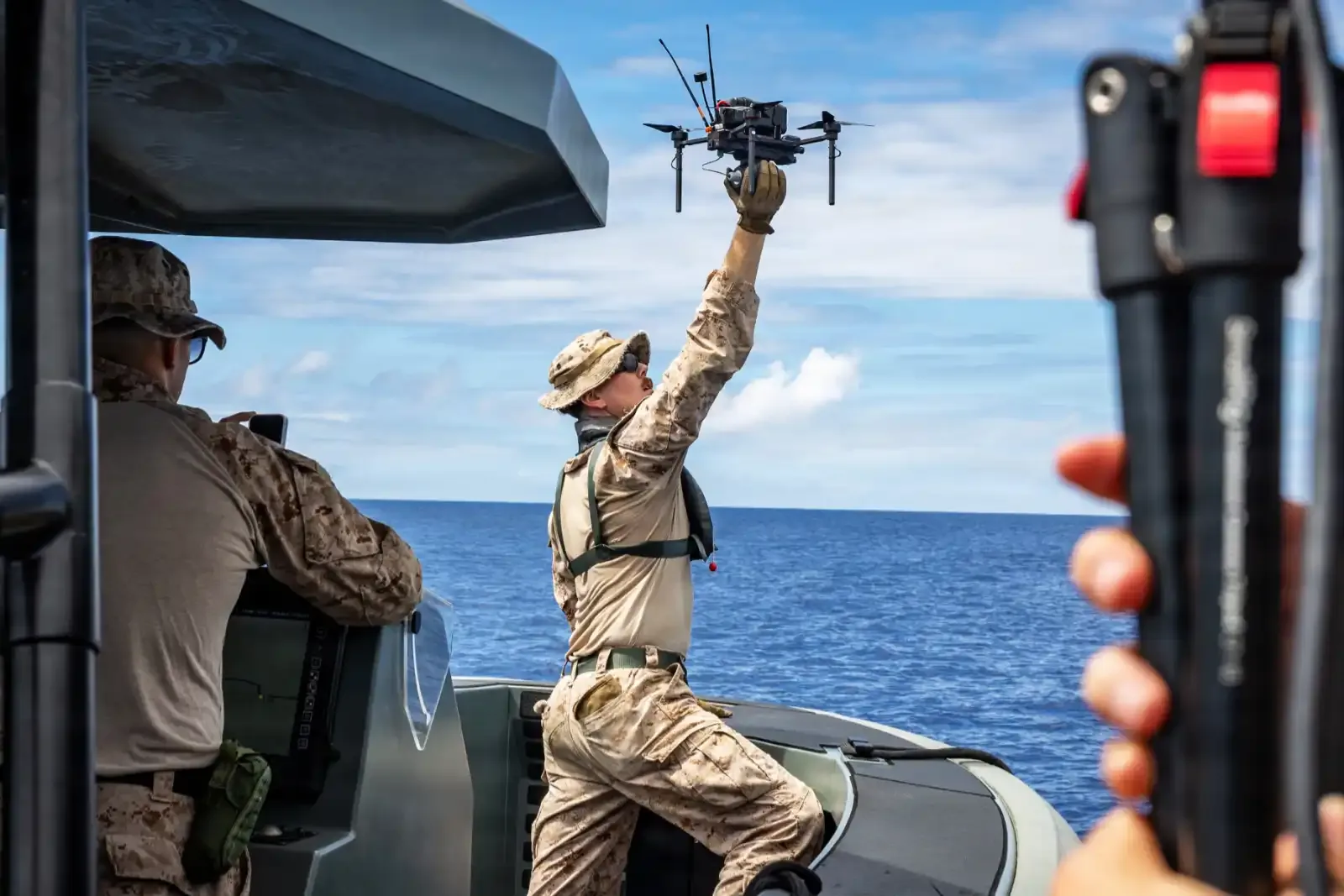
Photo credit: Department of War — Marine Corps Lance Cpl. Oscar Ocampo
Sourcing drones or components from Taiwan?
Tell us what you need — we match it to verified Taiwan-based manufacturers and make the introduction. There's no charge to submit a request.
Source these components from Taiwan →Foreign Buyers Are Asking Taiwan for Drone Parts. Too Often the Answer Is No.
Sep 23, 2026
Foreign buyers want non-Chinese drone parts from Taiwan. Some suppliers decline;...
Non-Red Is a Capability, Not a Market
Sep 17, 2026
On drones alone, going non-red rarely pays: a small market, custom lots, and a r...
Taiwan's Anduril ALTIUS-600M Drones Arrived Without a Charger. The Original Was Made in China.
Sep 15, 2026
Taiwan's Army took delivery of 291 Anduril ALTIUS-600M loitering munitions and t...