Announcing: Compliance Guides for US and EU Drone Rules

August 29, 2026
Over the past several months we have spent a lot of time in conversation with Taiwanese manufacturers and overseas buyers looking to source from them. Supplier meetings, sourcing requests, follow-up calls on inquiries that went quiet. The pattern that came out of it was consistent enough to act on.
What we have seen: there is a lot of confusion about the rules and regulations governing the sales of drones and components.
That is not the result of carelessness. Numerous separate regimes now govern whether a Taiwanese drone or drone component can be sold into the United States and Europe, at what cost, and to whom. They were written at different times, by different bodies, for different purposes. They ask genuinely different questions. And in ordinary conversation they often get collapsed into singular phrases, like "NDAA compliant", that aren't always clearly understood or accurate.
The consequences of the confusion can be significant. In one case, a supplier concluded that the US market is completely closed to them when it is one specific channel that is closed. Others have published on their websites and in buyer materials compliance claims citing provisions that do not govern their products. Defense buyers who read this are likely to move on without saying why. In one case, a European buyer assumed an EU content threshold applied to a program that is not spending EU money. Multiple manufacturers have spoken about a particular certification as a long-term ambition without realizing they might not have a realistic market opportunity if they don't have it by a certain date.
None of these are exotic mistakes. They are what happens when the rules change six times in eight months and the only available summaries are primarily written for American and European defense primes.
So we have published a set of guides to help suppliers and buyers understand the rules that govern the acquisition of Taiwan drones and drone components.
Different rules, different questions
The first guides we have published cover the FCC Covered List, NDAA Sections 848 and 889, Blue UAS, the Section 232 tariffs, and EU content rules under SAFE and EDIP.
The most useful thing to understand about them is that they apply different tests to different parties, and a product can satisfy one while failing another:
| Regime | Where | Who it binds | What it tests | Can a Taiwanese supplier pass? |
|---|---|---|---|---|
| FCC Covered List | US | Whoever seeks equipment authorization, usually the aircraft manufacturer | Country of production | No — the test is being foreign |
| NDAA Section 848 | US | DoD as a buyer, flowing down to primes and their subcontractors | Chinese content | Yes, with documented origin |
| Section 232 allied cap | US | The US importer of record | Allied-country content | Yes, with documented origin |
| Blue UAS | US | Voluntary, but required in practice for DoD sales and FCC exemption | Program evaluation | Yes — one Taiwanese company listed |
| EU SAFE / EDIP | EU | Recipients of EU defense funding | EU and associated-country content share | Partially — capped at 35 percent |
Two things are worth paying attention to in this table.
The last column. Documentation changes outcomes under Section 848, the Section 232 allied cap, and Blue UAS. It changes nothing under the FCC Covered List or the EU content thresholds, because neither asks a question that documentation answers. A supplier who believes the barrier to the US commercial market is trust will try to solve it with attestations and audits. None of that clears the Covered List, because trustworthiness is not the test, production location is. The same supplier's ability to document origin, meanwhile, makes all the difference in three other places.
The middle column. In none of these regimes is the Taiwanese supplier the directly bound party. The FCC binds whoever applies for equipment authorization. Section 232 binds the importer of record. Section 848 binds the Department of Defense and flows down through its primes. EU content rules bind whoever is spending the funding.
That is part of why these rules are easy to miss from Taiwan. In many cases, nothing arrives specifically addressed to the supplier. The consequence shows up instead as a customer who stops responding, changes a specification, or prices a quote differently, and the supplier is left to speculate about the reason.
The regime with a deadline
The Section 232 guide is the most urgent one for the US market. Tariffs on imported drones and components take effect September 3, 2026 — less than a week from today.
Taiwan is one of the allied jurisdictions eligible for a capped rate of 15 percent rather than the 25 or 100 percent that otherwise applies. But the cap is conditional, and the condition is that the US importer certifies substantially all critical components and technology originate in allied countries. A Taiwan-origin product with Chinese content inside it may not qualify its buyer for the cap.
This is the one US instrument where being free of Chinese content pays directly, at the border, and imminently. It is also the one where a supplier who has prepared documentation in advance is in a materially different position from one who has not. The certifying party is the importer (read: buyer), who will not usually explain why they went elsewhere when a supplier can't provide the documentation they need.
Written for both sides
Every guide carries a section headed "If you are buying from Taiwan," written for the other end of the transaction: US integrators, European and Ukrainian OEMs, procurement teams evaluating Taiwanese components.
The two views answer the same facts from opposite directions. A US importer needs to know that the Section 232 certification liability is theirs, not their supplier's. A European buyer needs to know that EU content thresholds attach to EU funding and not to their private-capital program. A supplier can send a customer to the same page they are working from, which is faster than explaining a rule secondhand.
Kept current, and dated
The FCC has revised the Covered List framework repeatedly since December 2025. The Blue UAS exemption date moved from January 1, 2027 to January 1, 2028 in July. The Commission's own FAQ page currently carries both dates, in different answers.
That is the environment these guides exist in, so each one shows when it was last reviewed and how often it is scheduled for review. Where a rule is genuinely unsettled, the guide says so rather than pretending otherwise. Several sections list open questions we cannot answer from published sources — whether electronic speed controllers count as critical components, whether Commerce has published the Section 232 certification mechanism, whether the FCC's pending import and marketing prohibition is adopted.
A guide that looks certain about an uncertain rule isn't helpful.
Where to start
If you sell into the US, the tariff guide has an upcoming deadline attached.
If you publish a compliance claim anywhere on your website or in materials you send to potential buyers, the NDAA guide is the fastest way to check whether it names the right provision. Fixing any references you have made to an incorrect provision is a fast and cheap way to ensure that you don't eliminate credibility with buyers before they even contact you.
If a buyer has told you their program has European funding, the EU guide covers what that changes and what it does not.
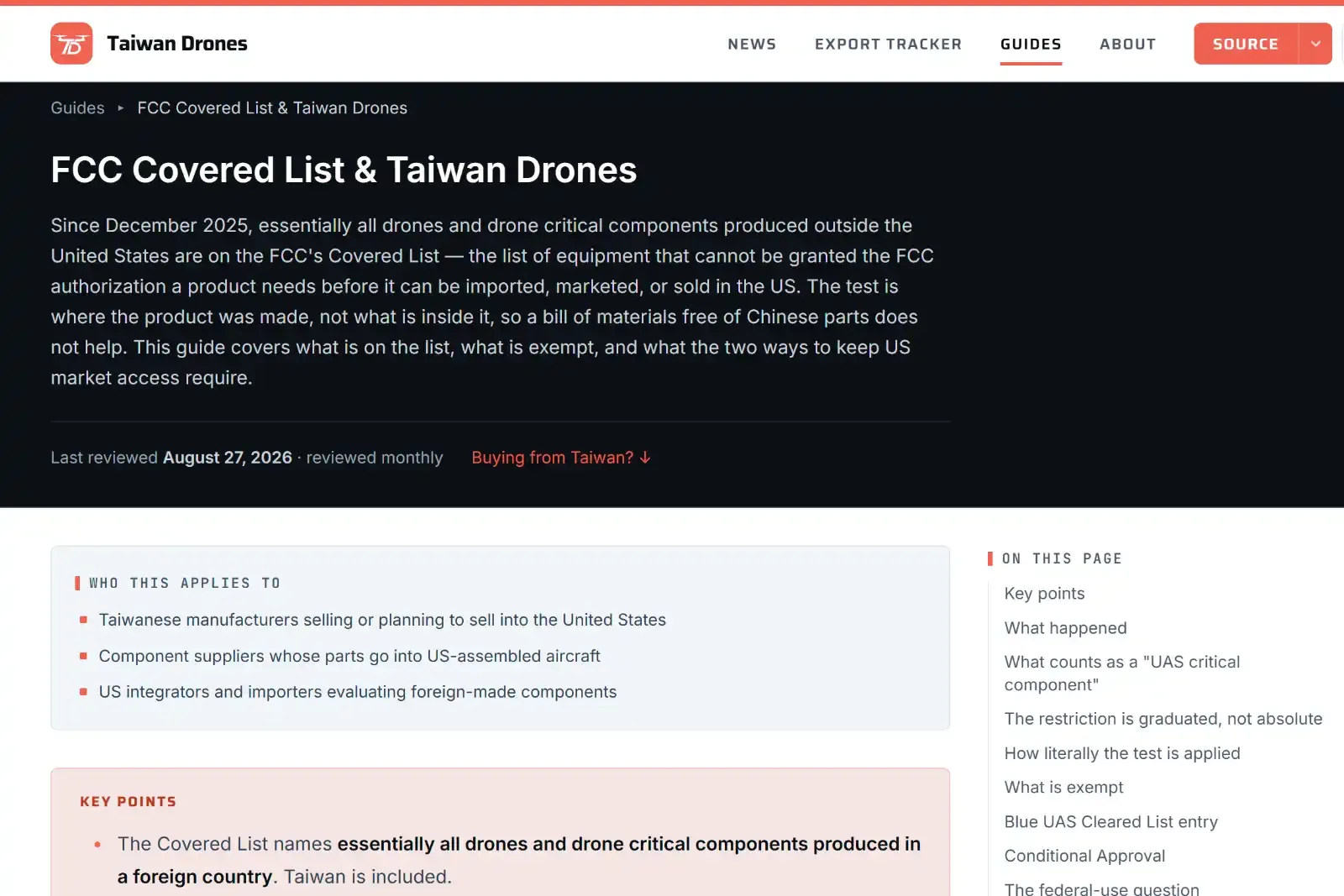
And if you have concluded the US market is closed to you, the FCC Covered List guide is worth reading before acting on that. It is closed in one channel and graduated in another, and where your product sits on that gradient decides a great deal.
All five are at taiwandrones.com/guides.
We will add more guides over time as the market evolves and we discover more areas where we believe this type of resource can be of benefit to suppliers and buyers. In the meantime, if you think something is missing, wrong, or unclear, tell us: info@taiwandrones.com.
Sourcing drones or components from Taiwan?
Tell us what you need — we match it to verified Taiwan-based manufacturers and make the introduction. There's no charge to submit a request.
Source these components from Taiwan →Taiwan Solved Its Drone Funding Problem. Ownership Risk Is the One That's Left
Sep 26, 2026
Taiwan's NT$240 billion drone act, a fresh NT$55.9 billion budget, and preferent...
The Ukraine Corridor Came Back and US Buyers Beat the Tariff Deadline: Taiwan Drone Exports, August 2026
Sep 12, 2026
Taiwan exported $36.4 million of drones in August 2026. The Czech Republic took...
Which Factory Made This Lot? What the Unimicron Investigation Means for PCB Buyers
Sep 3, 2026
Taoyuan prosecutors raided Unimicron, a board supplier to Nvidia and Intel, on s...