Buying a Non-Red Drone Battery From Taiwan: What E-CURRENT's Bill of Materials Actually Proves

August 27, 2026
China's share of Chinese-made cells inside Taiwan-assembled drones fell from roughly 70 percent to roughly 50 percent over the past year, according to a Research Institute for Democracy, Society and Emerging Technology (DSET) report cited by the Taipei Times. That is real progress, and it is also the wrong number to celebrate: a finished drone can pass a non-red origin check while its battery pack is still built on Chinese-refined cathode precursor, anode material, and graphite. We spent time with one of the suppliers trying to close that gap, a Taiwan-based Tier-1 (T1) battery maker called E-CURRENT, and asked it to walk us through its bill of materials, cell chemistry by cell chemistry.
What follows is not a marketing deck. E-CURRENT gave us specific answers, including ones that undercut its own pitch, and we have flagged where its numbers are company self-reporting rather than independently audited figures. That distinction matters more in batteries than almost anywhere else in the drone stack, because the industry has a habit of using "non-red" to mean "the logo on the pack isn't Chinese" while the electrode material two steps upstream still is.
The chokepoint sits above the finished pack
Non-red procurement rules, as currently written and enforced, mostly check where a drone or a component was assembled. That test misses the part of the battery supply chain China actually controls. DSET's own analysis puts Chinese capacity at roughly 65 percent of cathode-active material, 95 percent of cathode precursor, 97 percent of anode material, and 95 percent of battery-grade graphite processing. A Chinese-language opinion piece in the China Times citing the same think tank goes further, arguing Taiwan's non-red drone strategy has a structural blind spot because the country has no domestic upstream refining capacity of its own. CSIS's friendshoring research backs the shape of the problem, if not the Taiwan-specific numbers: as of 2022, China produced 70 to 90 percent of global cathodes, anodes, separators, and electrolyte solutions, with Japan and South Korea a distant second and the United States responsible for roughly 7 percent.
Taiwan is not alone in trying to route around this. Other Taiwan-based battery makers have announced strategic alliances explicitly aimed at building a domestic non-red supply chain for the cells that go into drones, evidence that this is a sector-wide effort rather than one supplier's marketing claim.
Where E-CURRENT sits in the stack
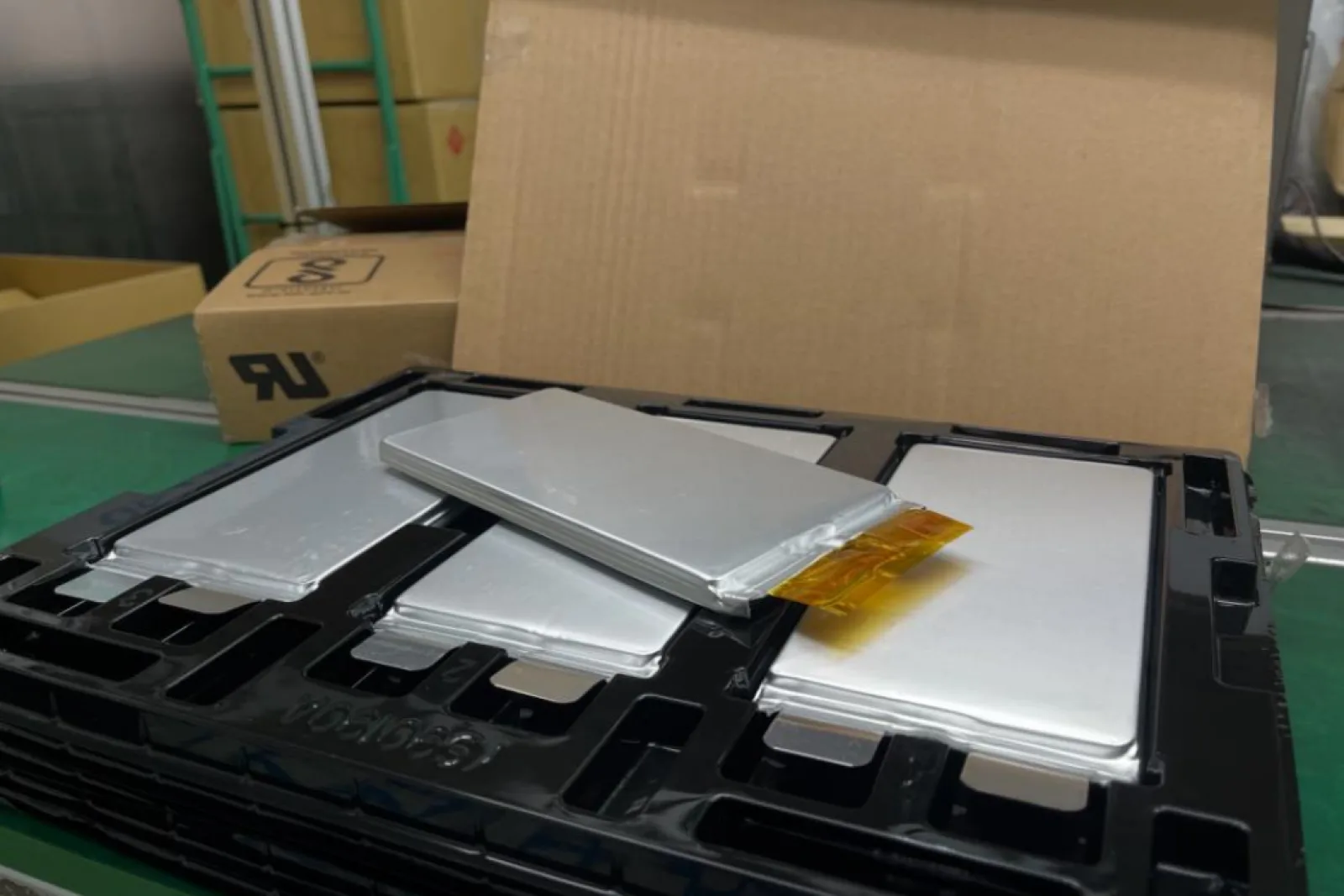
E-CURRENT is not trying to be Taiwan's answer to CATL. It assembles battery packs using Taiwan-made pouch cells alongside cells sourced from Japan and South Korea, an approach that lines up with what DSET has previously flagged as the realistic near-term path for Taiwanese module makers: build the non-red chain around Taiwan-made or Japanese and Korean cells rather than waiting for a domestic cathode-to-cell industry that does not yet exist at scale. That is a different approach from Molicel (E-One Moli Energy), the Taiwan Cement-owned cylindrical-cell maker we profiled in our supplier map of Taiwan's drone component base, which manufactures its own cells domestically. E-CURRENT's model is closer to systems integration: source non-Chinese inputs at every layer it can, be transparent about the layer it can't, and sell traceability as the product.
The bill of materials, cell by cell
The cathode is fully de-red, with one asterisk. E-CURRENT sources cathode-active material from South Korean producers. The company was direct that some of that material is still produced at facilities located in China, and that a fully US-origin cathode is available, but only on specific buyer request and at added cost.
The anode comes from the US, Japan, or a Taiwan-capital-only supplier. This is the one layer where E-CURRENT told us it has real optionality among non-Chinese sources, which tracks with CSIS's finding that anode material is one of the segments where friendshored capacity, while still a fraction of China's, is furthest along.
The separator is sourced from Japan. E-CURRENT uses a Japan-produced separator film rather than a Chinese-made one.
The electrolyte is Taiwan-produced, with a caveat on the solvents. E-CURRENT buys electrolyte from a Taiwan production base, but told us the base solvents that go into it are still, in large part, made in China.
The additive is the one input E-CURRENT will not claim to have solved. More on that below.
The BMS chip and firmware are fully Taiwan-built. E-CURRENT was unambiguous that this layer, battery management system silicon and the firmware that runs it, is entirely domestic. It is also, not coincidentally, the layer where China's raw-material dominance is least relevant and Taiwan's electronics base is strongest.
What a buyer can actually verify
The pitch E-CURRENT makes to defense and commercial buyers is not "we are 100 percent Chinese-material-free." It is "we can show you exactly where we are not, and where we still are." The company told us its bill of materials is fully traceable back to named suppliers for every buyer that asks, which is a meaningfully higher bar than the industry norm of self-certifying finished-drone origin.
That traceability has a ceiling, though. E-CURRENT was candid that visibility into raw ore and precursor sourcing, lithium, cobalt, nickel, and graphite at the mine-and-refinery level, depends on its upstream partners knowing and disclosing that information themselves, and that only a small number of large material producers globally have the capability to refine from raw ore in the first place. A Taiwan pack assembler can audit its direct suppliers. It cannot, on its own, audit a mine.
The premium is real, and steeper than the industry line
Ask most people in this supply chain what a non-Chinese battery costs and you will hear "40 to 50 percent more," a figure that shows up in the Taipei Times' reporting on DSET's findings and matches the general industry talking point. We asked E-CURRENT for its own number rather than the industry line. Its answer was rougher: roughly 2.5 times the cost of an equivalent Chinese-sourced battery, materials alone. On performance, the company scored Chinese cells at 100 and rated its own output at 80 to 90, a gap it says it is closing but has not closed.
Both numbers are self-reported and worth treating as directional rather than audited. But the willingness to name a figure well above the industry's public talking point, against its own commercial interest, is itself informative. It suggests the 40-to-50-percent number circulating in trade press understates what full-chain de-risking actually costs today, at least for a supplier building at E-CURRENT's scale.
The gap no one has closed
We asked E-CURRENT directly whether there is any layer of the battery it has genuinely not found a non-Chinese alternative for. The answer was the liquid additive package, the small-volume, high-specification compounds that tune electrolyte performance and cell stability. E-CURRENT's assessment is that this segment remains almost entirely controlled by Chinese producers globally, not just as a matter of cost but of available production capacity, and that Taiwan lacks the ability to manufacture these additives at the volume and price a commercial battery program needs. This is consistent with CSIS's broader finding that active-material production, the category additives sit inside, is where China's structural lead over friendshoring alternatives is largest and hardest to dislodge by 2030 even under aggressive US and allied investment.
Why "non-red" is operationally hard, not just expensive
Cost is the headline problem. The operational one is worse. E-CURRENT described a supply chain where buyers are often asked to commit to non-red cells that the factory has not yet finished producing, where certification of new material sources runs on its own slow timeline independent of demand, and where the pool of qualified non-Chinese cell options is small enough that program schedules end up hostage to a single factory's build-out pace. A buyer committing to a non-red battery program today is, in practice, committing to schedule risk that a Chinese-sourced program does not carry.
Capacity, for now
E-CURRENT put its current output at roughly 3,000 cells a month, which at 12 cells per pack works out to somewhere in the neighborhood of 250 finished packs monthly. For context, the Taipei Times report cited above notes at least one Taiwanese manufacturer already supplying Ukraine with 5 to 7 million drone battery cells a month. E-CURRENT is not operating at that scale, and did not claim to be. It is scaling from a smaller, fully traceable base rather than retrofitting traceability onto volume production after the fact. DSET has recommended Taiwan's industry target zero Chinese material suppliers in public-sector drone procurement by 2028, with six months of buffer inventory against a Chinese export restriction. Measured against that benchmark, E-CURRENT looks less like a finished answer and more like an early, honestly-documented data point on how far the industry still has to go.
What it means for buyers
For a procurement officer evaluating a Taiwan battery supplier, the useful question is no longer "is this non-red." It is "which layers, specifically, and at what premium." E-CURRENT's answers, cathode nearly clean with a China-made-material caveat, anode genuinely diversified, separator and electrolyte sourced through real Taiwan and Japan production with a solvent caveat, BMS fully domestic, additives not solved, are a more useful data point than a supplier that simply asserts a clean bill of materials without naming where it isn't. We will be watching whether E-CURRENT's traceability model, and its willingness to name its own weak points, becomes the standard other Taiwan battery suppliers get held to, or stays the exception.
→ Subscribe to Taiwan Drone Weekly for ongoing coverage: www.taiwandrones.com/subscribe
→ Suppliers: contact us at info@taiwandrones.com
This analysis draws on a TaiwanDrones interview with E-CURRENT, together with public reporting from the Taipei Times, the China Times, DSET, FTV News, and CSIS's friendshoring battery supply chain research. Cost premium, performance, and production-capacity figures are E-CURRENT's own self-reported estimates as of August 2026. TaiwanDrones has not independently verified or conducted a financial audit of these figures. They should be read as directional, not as verified financial or technical claims.
Sourcing drones or components from Taiwan?
Tell us what you need — we match it to verified Taiwan-based manufacturers and make the introduction. There's no charge to submit a request.
Source these components from Taiwan →Carbon-Based Technology: What Drone Buyers Should Know About Taiwan's Non-Red Composite Supply Chain
Sep 11, 2026
Carbon-Based Technology builds composite airframes in-house, from resin to final...
10 Taiwan Drone Manufacturers You Should Know in 2026
May 29, 2026
Taiwan's drone ecosystem includes more than 260 companies. For a procurement off...