
Taiwan Drones Weekly News Roundup: August 24 - 30, 2026

August 30, 2026
Taiwan's drone-funding fight finally produced a number this week: NT$240 billion, six years, and a KMT-authored law that beat the Cabinet's own version to the finish line. The ink was barely dry before the Ministry of Economic Affairs, the agency now responsible for administering it, said the bill would slow it down. Layer in an academic's case for regulatory reform and a Washington argument that Taipei is counting the wrong thing, and the throughline is clear: Taiwan has decided how much to spend on drones and is only now working out how it will build and use them. Thunder Tiger, unbothered by any of it, kept selling into the Philippines. Here's the week.
1. Legislature passes the NT$240 billion drone law
Taiwan News — Aug. 27, 2026 · Read article
The Legislative Yuan passed the Act to Strengthen National Defense Self-Reliance 60-50, with Legislative Yuan President Han Kuo-yu presiding over a KMT-backed ordinary law that displaced the Cabinet's own NT$210 billion special procurement proposal. The winning version allocates NT$240 billion (roughly US$7.6 billion) over six years, NT$40 billion annually, covering coastal surveillance drones, coastal attack drones, and small one-way attack unmanned boats, with the Ministry of Economic Affairs running civilian industry development and the Ministry of National Defense handling military procurement. A new National Unmanned Vehicle Industry Development Strategy Special Committee, chaired by the vice premier and seated with 15 to 19 members, gets biennial review authority once the law takes effect six months from now. The bigger story here isn't the price tag, it's the process: the opposition wrote the funding mechanism the executive branch now has to live with.
2. The ministry that has to run the law didn't want it
Taipei Times — Aug. 29, 2026 · Read article
Two days after the NT$240 billion act cleared the legislature, the Ministry of Economic Affairs went public with its objections, and its complaint isn't about the money. It's about the special committee's makeup: the law requires more than half of the seats to go to experts and academics nominated by legislative caucuses, which the ministry warns invites "political gridlock" into a process it says the Executive Yuan already handles through quarterly coordination meetings. The ministry called the whole structure "more symbolic than practical significance," a notable line to say out loud about a law it's now stuck implementing. Reporter Meryl Kao's piece also puts a number on the supply chain the committee will oversee: more than 274 companies across the drone sector, which is the more useful figure here than the ministry's committee objections.
3. Building 200,000 drones is the easy part
19FortyFive — Aug. 27, 2026 · Read article
While the legislature argued over the government's NT$210 billion, 210,000-drone proposal versus the opposition's NT$240 billion counter, Andrew Latham used the same week to argue Taipei is fighting over the wrong number entirely. Latham, a senior fellow at the Institute for Peace and Diplomacy and professor at Macalester College, notes Taiwan's domestic manufacturers can currently assemble roughly 15,000 drones a month, with a stated goal of exceeding 100,000 by 2030, and that China still produces about 90 percent of the world's sintered rare earth magnets used in drone motors. His line worth sitting with: "a large stockpile in January is spent by summer unless a production line keeps refilling it." The real deterrent value, he argues, isn't Taiwan's opening inventory, it's whether production keeps running three weeks into a conflict after Chinese strikes hit factories, ports, and supply chains, a variable he says Beijing's planners can't cleanly model.
4. An academic's case for a risk-based drone framework
Taipei Times — Aug. 29, 2026 · Read article
Edwin Yang, an associate professor at National Taiwan Normal University and chairman of the Central Taiwan Association of University Professors, published this the same day the Ministry of Economic Affairs was airing its committee complaints, and the two pieces read like a matched set. Yang's target isn't the funding fight but the regulatory one underneath it: oversight of drones is currently split across aviation, telecommunications, transportation, cybersecurity, and local government agencies with no coordinating structure, which he argues leaves gaps around high-risk sites like airports, ports, hospitals, and energy infrastructure without giving industry the clarity to compete globally. His prescription, drawn from international practice, is a risk-based classification system paired with cybersecurity standards, supply chain certification, and independent third-party testing. It's the rare piece this week making a structural argument rather than an appropriations one, and it lands the same week Taipei proved it still hasn't settled who's in charge of the structure.
5. Thunder Tiger's Philippine pipeline keeps growing
Politiko — Aug. 20, 2026 · Read article
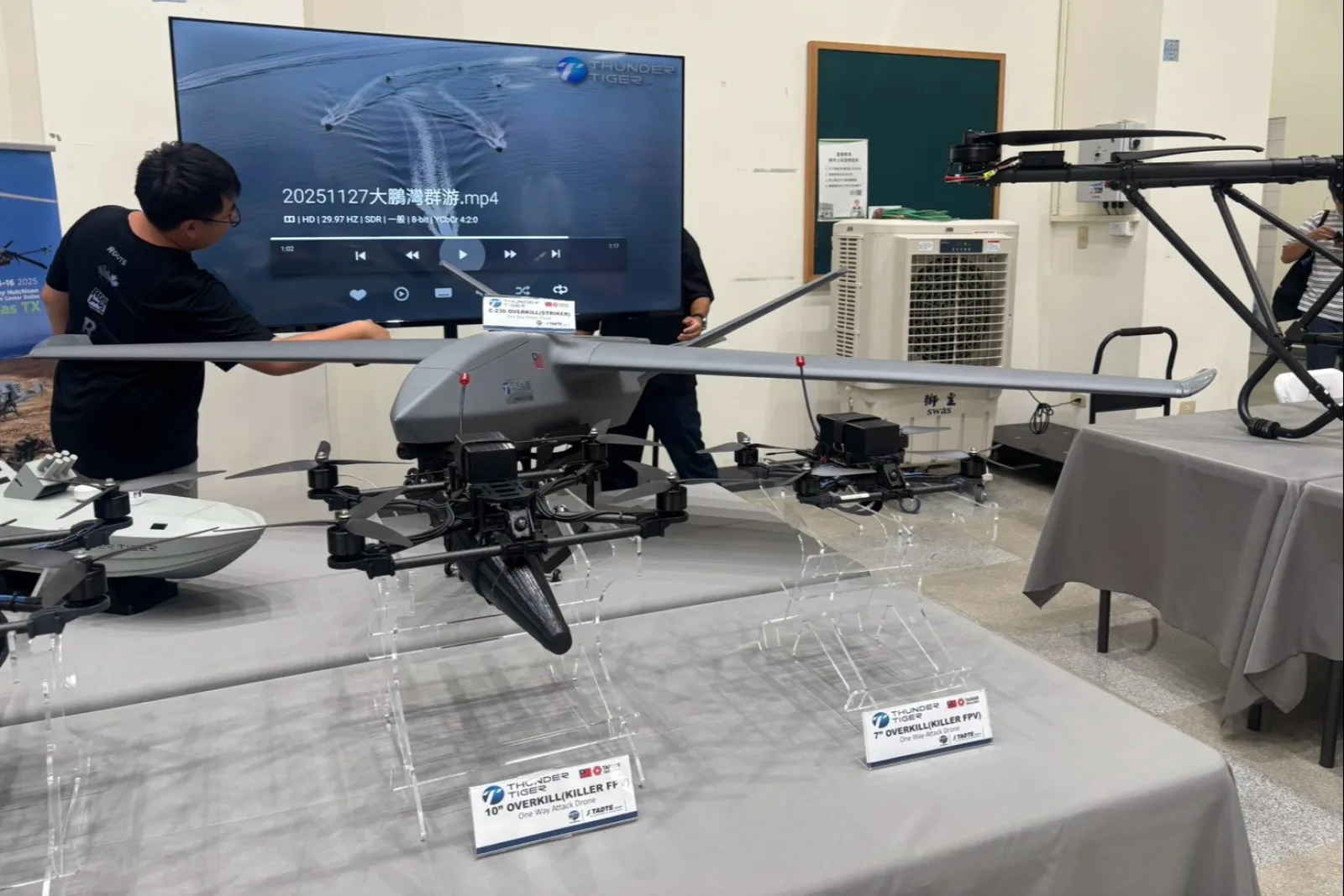
While Taipei argued over committees, Thunder Tiger kept closing deals. Sales specialist Allan Chi says the company has supplied "a couple hundred" of its Overkill FPV drones, which sit on the U.S. Department of Defense's Blue UAS Cleared List, to the Philippine military for training, with the Philippines now ranking among Thunder Tiger's largest overseas markets alongside the United States and Japan. The company is also pitching its SeaShark 600 and 800 unmanned surface vessels and fiber-optic and interceptor drones built to resist electronic warfare, all marketed on a supply chain Chi describes as free of Chinese components. Short item, but it lands next to a domestic law built around "small one-way attack unmanned boats": Taiwan is separately seeking funding for 1,320 unmanned surface vessels of its own, a reminder that the export pitch and the domestic procurement fight are drawing from the same production base. Chi is candid that Taiwanese manufacturers still trail DJI on technology and price, but estimates the gap closes in two to three years with sustained government support.
That's the week. Watch for who actually gets seated on the new special committee, whether the Ministry of Economic Affairs' objections change anything before the law takes effect in six months, and whether Thunder Tiger's Philippine numbers show up in Taiwan's Q3 export data.
Sourcing drones or components from Taiwan?
Tell us what you need — we match it to verified Taiwan-based manufacturers and make the introduction. There's no charge to submit a request.
Source these components from Taiwan →Taiwan Drones Weekly News Roundup: October 5 - 11, 2026
Oct 11, 2026
Taiwan’s economics ministry more than doubled its drone R&D grants this week and...
Taiwan Drones Weekly News Roundup: September 28 - October 4, 2026
Oct 4, 2026
This was the week Taiwan's drone strategy got concrete in the literal sense: a s...
Taiwan Drones Weekly News Roundup: September 21 - 27, 2026
Sep 27, 2026
Taiwan's drone story this week is really two stories running in parallel: one ab...