
Taiwan's Drone Exports Jumped 20-Fold. Its SMEs Have Three Years to Cash In.

July 2, 2026
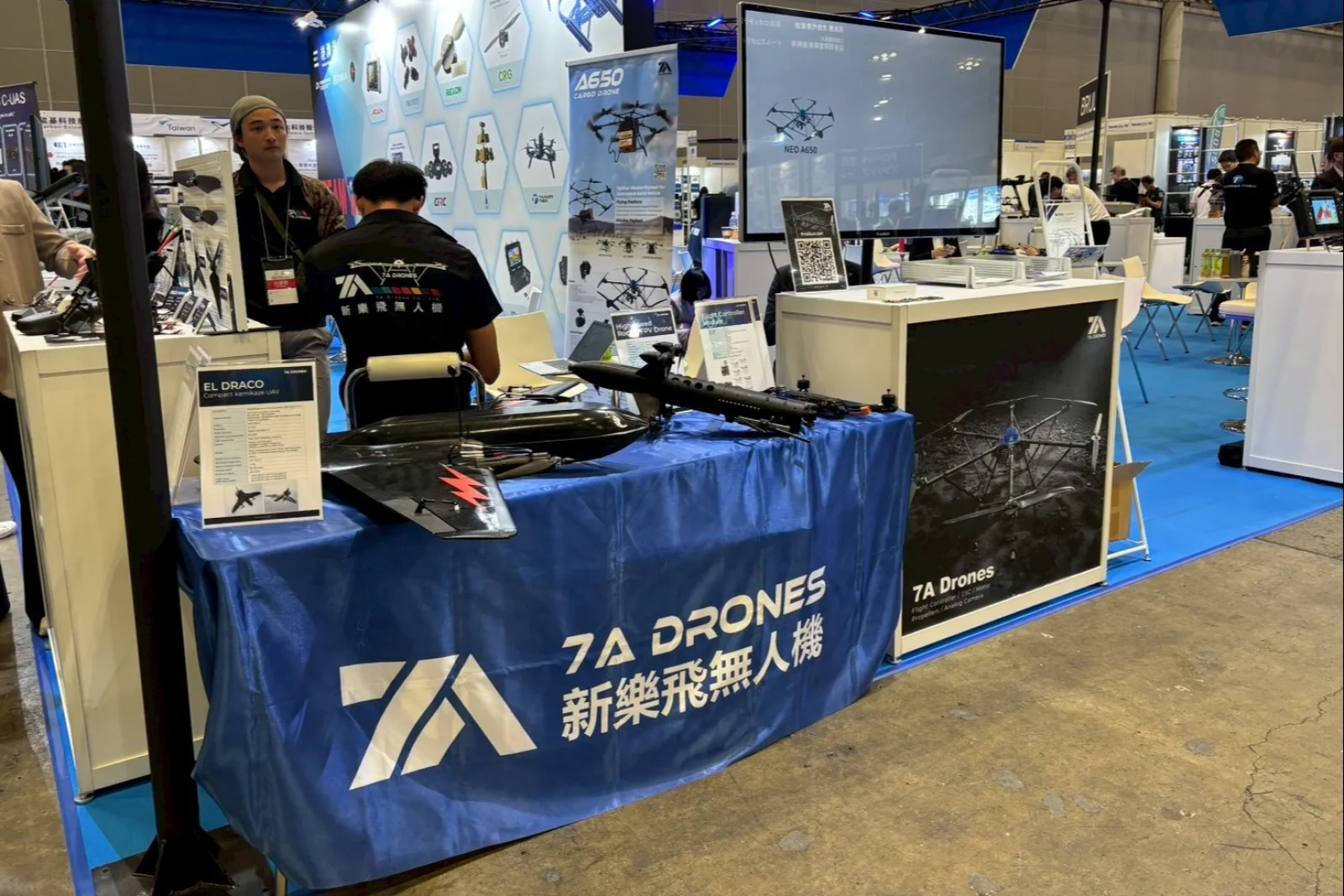
Taiwan's drone exports rose almost 20-fold in the first four months of 2026, hitting 181,159 units and already exceeding all of 2025, according to official trade data reported by AFP. The same reporting flagged four structural problems sitting underneath the surge. We think the more useful frame is the one a Taiwanese industrial veteran gave a different outlet the same season: the country's window to convert this moment into durable share is roughly three years, and probably shorter.
Two things are true about Taiwan's drone industry at once. Export volume is compounding faster than almost anyone forecast a year ago, and the same conditions producing that growth, an under-scaled domestic order book, a fragmented base of small and mid-size manufacturers, and a compliance standard that is harder to meet than the marketing suggests, are the conditions that could just as easily cap it. This piece is about what the boom actually offers Taiwan's SME drone base, and what has to happen for the offer to still be on the table in 2029.
The opening: a global supply chain looking for a non-Chinese seat
The pull factor is straightforward. Global governments moving to strip Chinese content out of security-sensitive drone supply chains have opened what the Industrial Technology Research Institute (ITRI) estimates is a 60 to 80 percent unmet demand gap for non-Chinese platforms and components, a gap opened by moves like the US Federal Communications Commission's December 2025 restrictions on new Chinese drone models and components, and parallel restrictions in Australia, Japan, Canada, and the UK. ITRI projects the global drone market growing from US$37.48 billion in 2024 to US$121.88 billion by 2033, a 14 percent compound annual rate. Taiwan is one of a small number of countries positioned to compete for that gap on cost, scale, and political trust simultaneously.
The precision manufacturing base gets a genuine upgrade path. Chang Chen-yuan, director of ITRI's Mechanical and Mechatronic Systems Research Laboratories, argues that high-end drone airframes and payload housings, built from aerospace-grade titanium, aluminum, and carbon-fiber composites, are exactly the kind of difficult-to-machine, high-margin work Taiwan's machine tool sector has spent a decade trying to move into. Standard machine-tool exports have been stuck in a race to the bottom against lower-cost entrants; drone-grade five-axis and turn-mill work is not. Chang's assessment is that Taiwan's SMEs already have credible capability in airframe structures and small propulsion components, but remain import-dependent on high-end payload gimbals, large propulsion engines, and flight-control chips, which he frames as the next import-substitution opportunity for domestic suppliers.
The certification infrastructure is arriving, not just the demand. ITRI has partnered with the US Association for Uncrewed Vehicle Systems International (AUVSI) to bring Green UAS certification onshore, making Taiwan the only certification site for the program outside the United States. That matters more than it sounds: Green UAS is the credential that opens US federal agency and critical-infrastructure procurement to non-US suppliers, and having the testing infrastructure in Taiwan rather than requiring shipment abroad removes a real cost and timeline barrier for smaller manufacturers who could never justify a US certification trip on their own. The government has also designated drones one of its five "trust-worthy industries," targeting NT$40 billion in domestic output value by 2030, and is building out physical infrastructure to match: the Asia Innovation R&D Center in Chiayi's Taibao district, which now hosts dozens of drone companies, and the Minsyong Aerospace Park under development as a standardized production base. As we covered when the industrial output figures came out in May, Taiwan's drone output value already grew 2.5-fold in 2025 to NT$12.9 billion, so the 2030 target is aggressive but not detached from the current trajectory.
Why this dividend runs through SMEs specifically, not around them
Taiwan's drone base is not a handful of national champions. It is more than 260 companies, most of them small, many pre-revenue, ranging from decades-old hobby-aircraft manufacturers to defense-focused startups founded in the last three years. AeroSoarX chairman Max Lo, whose company builds military and dual-use drones, put the SME predicament to AFP bluntly: without local demand, government support, or budget, a manufacturer has no way to keep a production line running, which is why he has been courting buyers directly in Ukraine and Poland rather than waiting on Taipei. That is not one company's complaint. It is close to the default condition for a sector where the largest single-firm production run in 2025 was still measured in the low thousands of units.
The OEM path is what lets this base scale without consolidating first. Cathy Fang, a policy analyst who has studied Taiwan's drone ecosystem, frames it as an extension of Taiwan's existing economic model: contract manufacturers with the capacity to turn a domestic developer's prototype into low-cost, high-volume production are the mechanism that lets small design shops reach the unit economics that compete with Chinese pricing. Foxconn's entanglement with mainland China rules it out for this specific role, but Taiwan has a deep bench of other OEMs that can absorb that work.
What that OEM path cannot shortcut is the compliance layer. In our own reporting from Drone Japan in June, Taiwanese integrators told us that removing Chinese content, what the industry calls 去紅化, or de-redding, is not a paperwork exercise but a year-plus redesign program: swapping components one by one, retuning flight controllers around each new part, and rebuilding mass production from scratch. Even after that work, the result typically is not a purely Taiwanese aircraft. Inertial navigation systems and camera modules routinely come from the US and Europe; commodity chips often come from the Philippines, because Taiwan's own semiconductor industry concentrates on the high end. For SMEs without the balance sheet to run that redesign process on spec, the non-red premium is a real barrier to entry, not just a marketing claim.
The four fractures under the boom
AFP's reporting surfaced four specific problems that the export headline obscures, drawing on analysts at the Taiwanese think tank DSET, the European Values Center for Security Policy, and Singapore's S. Rajaratnam School of International Studies.
Domestic orders are still stalled. The nearly NT$1.25 trillion special defense budget originally proposed by the Lai administration included procurement of more than 200,000 Taiwan-made drones. As we detailed when the Legislative Yuan passed its reduced version on May 8, the bill that actually passed cut every domestic drone procurement line item to zero, leaving the sector's largest anchor order indefinitely delayed. Max Lo's export-first strategy is less a growth choice than a survival response to that gap.
Non-red status is a claim the industry itself is still qualifying. Officials have described the vast majority of Taiwan's drone exports as non-red supply chain compliant, a characterization industry sources pushed back on in the same reporting. That tracks with what we heard directly: as our own Drone Japan interviews found, the honest answer from serious suppliers is rarely a blanket claim of full Taiwanese origin. It is an itemized, per-product-line breakdown, and not every manufacturer in a 260-company field can produce one on demand.
Taiwan is entering a market China already dominates, without a combat record to point to. Nobody disputes Taiwan's industrial capability, but battlefield readiness at scale is still unproven, and DJI's manufacturing volume and cost base are a fact of the market, not a temporary condition, a point European and Southeast Asian analysts both raised independently.
Ukraine's own production base could turn from customer to competitor. Ukraine has built one of the world's most advanced wartime drone manufacturing bases out of necessity. Once the war ends, that capacity does not disappear, and it may no longer need Taiwanese supply at all. The more likely outcome, in the assessment of analysts tracking both markets, is that a peacetime Ukraine competes with Taiwan for the same export customers it currently buys from, with Taiwan's more durable long-run opening sitting in components rather than finished platforms, lithium battery cells especially, where China's dominance is real but not unbreakable.
Layer the cost problem on top of all four. Taiwanese drones run roughly two to three times the price of Chinese equivalents on standard commercial platforms, largely on DJI's manufacturing scale and labor cost base, and the premium widens further for military-grade hardware.
The clock, according to the people building the parts
The most direct articulation of urgency in this reporting cycle did not come from a policy analyst. It came from Fan Xin, former general manager of Teco Electric and a two-decade veteran of Ford's global supply chain, in an interview about what he calls Physical AI: the application of AI compute to drones, autonomous vehicles, and robotics as a single technological wave rather than three separate industries. Fan's argument is that the underlying technology, battery chemistry, thermal management, actuator design, is transferable across all three verticals, and that Taiwanese SMEs specifically should be extending core capability horizontally rather than betting everything on one vertical market. That horizontal reuse is what lets a small supplier reach the scale economics that a single-vertical strategy cannot.
Fan is candid about what he thinks is actually holding Taiwan back, and it is not technology. He names two things: a "contract manufacturing mentality" that waits for orders rather than investing ahead of demand, and insufficient ambition to pursue overseas partnerships, acquisitions, and technology transfer rather than waiting for the domestic market to mature. He points to Taiwanese suppliers who declined to invest in European auto supply chains during the 2008–2009 financial crisis as a prior instance of the same hesitation costing the country a comparable opening. His prescription for accelerating the current window is a large-scale, high-complexity real-world testbed, an entire city or region open to testing autonomous flight and ground operation together, on the logic that Ukraine's weekly battlefield iteration cycle is producing exactly the kind of rapid technology maturation Taiwan cannot replicate in a small, low-complexity regulatory sandbox. Without it, he argues, Taiwan cannot accumulate the operational experience that would let it compete on more than manufacturing cost. His own number for how long this specific opening stays open is three years. Miss it, he says, and Taiwan gets buried by competitors who did not.
What we're tracking
We assess Taiwan's probability of converting the current export surge into a durable, defensible SME export base, rather than a cyclical bump tied to the Ukraine war, at roughly 45 to 60 percent over the next three years. That range reflects genuine strength on the demand side, non-red procurement pressure from the US, EU, and allied governments is structural and unlikely to reverse, against real execution risk on the supply side: an unresolved domestic anchor-order gap, a compliance standard that is more demanding than most SMEs can currently document, and a post-war Ukraine that could re-enter export markets as a direct competitor rather than remain a customer.
For buyers, the practical read is that Taiwan's SME base has real spare capacity right now, precisely because domestic orders are stalled, and manufacturers are actively looking for the kind of relationship-building that shortens future lead times. For suppliers, the components layer, batteries, motors, chips, flight controllers, is where Savchii and Fang both point as the more defensible long-run position relative to finished airframes. For investors, the signal to watch is consolidation: whether Taiwan's 260-plus manufacturer base starts compressing around a smaller group of firms with genuine documented non-red bills of materials, or stays fragmented long enough for the window to close before it scales.
→ Subscribe to Taiwan Drone Weekly for ongoing coverage: www.taiwandrones.com/subscribe
→ Suppliers: contact us at info@taiwandrones.com
This analysis draws on AFP reporting carried by NOWnews, industry commentary published by MA Online (Taiwan Machine Tool & Accessory Builders' Association), an interview published by BusinessNext (數位時代), and German-language coverage via Deutsche Welle, alongside TaiwanDrones' own prior reporting. It reflects the state of public information as of early July 2026. Probability assessments and market characterizations represent analytical judgment, not investment advice or an official industry forecast.
Sourcing drones or components from Taiwan?
Tell us what you need — we match it to verified Taiwan-based manufacturers and make the introduction. There's no charge to submit a request.
Source these components from Taiwan →Taiwan Drones Weekly News Roundup: September 21 - 27, 2026
Sep 27, 2026
Taiwan's drone story this week is really two stories running in parallel: one ab...
Taiwan Drones Weekly News Roundup: September 14 - 20, 2026
Sep 20, 2026
Attack drones joined Taiwan's live-fire drills for the first time this week, whi...
Taiwan Drones Weekly News Roundup: September 7 - 13, 2026
Sep 13, 2026
This week's clearest signal was not that Taiwan needs more drones. It was that b...