
The hardest parts to make non-PRC: a drone component risk map

October 26, 2026
A drone made outside China can still contain Chinese parts and materials. Most of that content is in seven components, and a non-PRC claim is only as good as the documents behind it.
Non-PRC claims are usually checked against where a drone or module was assembled. The Chinese content is more often in its components: the magnets in the motors, the materials in the battery cells and the chips in the video and control links. As we have reported before, "Made in Taiwan" can describe final assembly rather than the parts inside.
Headline figures overstate the progress. Ukrainian customs data show the share of imported drone parts coming directly from China fell from nearly 90% at the start of 2024 to 28% in January–August 2026, according to the AP. The same report notes that many parts recorded as Polish or Czech were very likely made in China and routed through those countries. In Taiwan, the share of drones using Chinese battery cells fell from about 70% to 50% between 2024 and 2025, but the materials inside the non-Chinese cells still come largely from China, according to DSET.
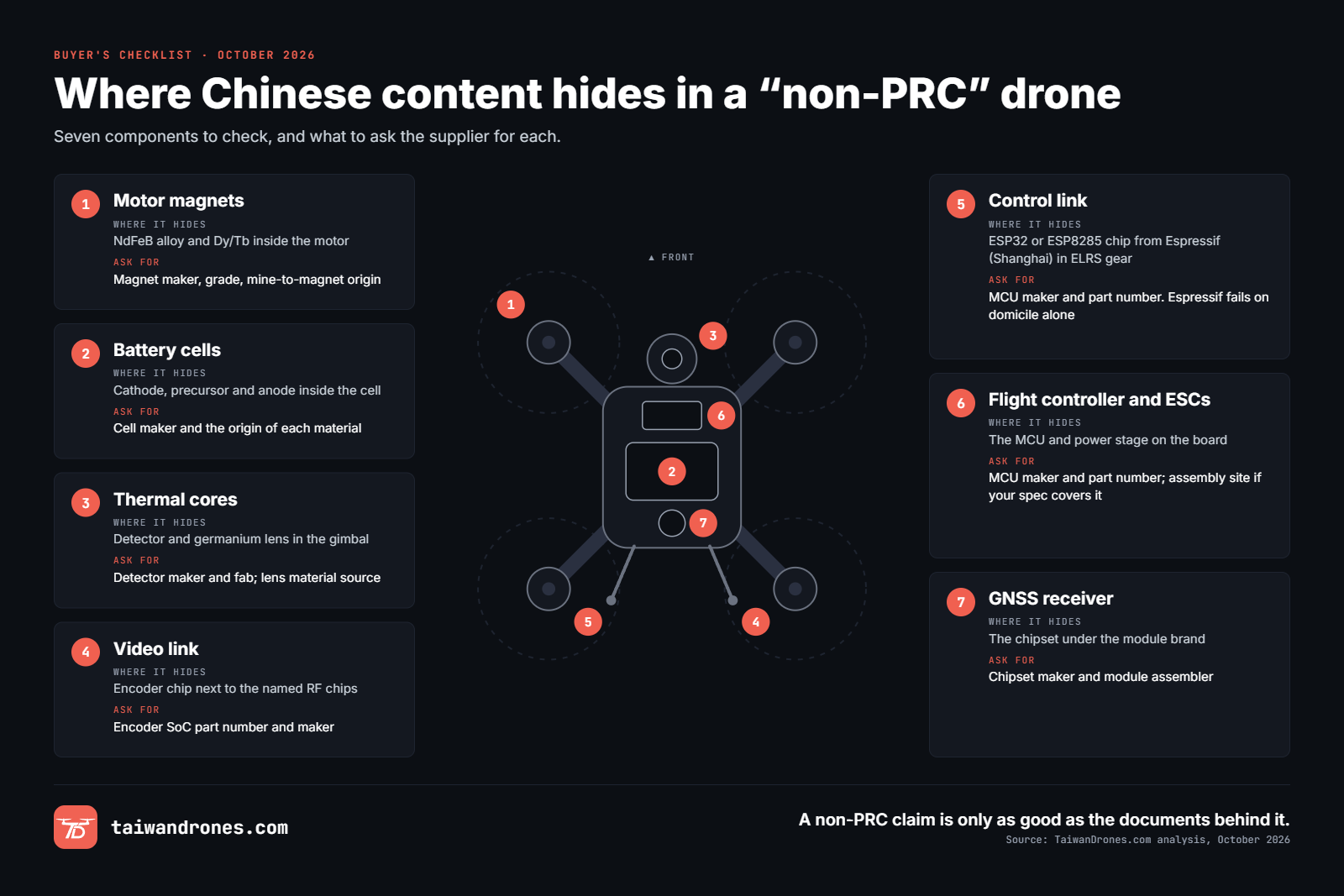
This article ranks seven components by how hard they are to source outside China, sets out what a supplier claiming a non-PRC supply chain should be able to document for each, and covers the rules and deadlines that apply. It applies the standard from our October piece on origin documents at the component level.
How we ranked them
We ranked components on three criteria:
- Dominance. China supplies most of the world's output, or controls an upstream step.
- Visibility. The Chinese content is inside a sub-assembly and does not appear on the finished module's datasheet.
- Alternatives. Non-PRC alternatives cost much more, are made in much smaller volumes, or are not available off the shelf.
Chinese parts listed on a datasheet are easy for buyers to find and replace. The components that rank highest are those that appear compliant on paper.
The seven components, ranked
Magnets and battery materials rank highest because the Chinese content is in raw materials, several steps upstream of the parts drone makers buy. The electronics lower on the list are easier to replace, but only if buyers ask for chip part numbers.
| Rank | Component | Where the PRC content hides | Non-PRC options | The gap |
|---|---|---|---|---|
| 1 | Motor magnets (NdFeB) | Inside the motor; origin of the alloy and heavy rare earths | Japanese, German and new US magnet makers | Volume, and raw materials still often Chinese |
| 2 | Battery cell materials | Cathode, precursor and anode inside non-Chinese cells | Non-Chinese material suppliers | Inputs cost 40–50% more (DSET) |
| 3 | Thermal imaging cores | Detector and lens inside the camera or gimbal | US, French, Israeli cores; European sensors | Capacity: far below demand |
| 4 | Digital video SoCs | Encoder chip inside the video transmitter | Analog links; non-PRC SoCs at higher cost | Few off-the-shelf digital links |
| 5 | MCUs in radio links and flight controllers | ESP32/ESP8285 in ELRS gear; AT32 in budget boards | STM32-class and other non-PRC MCUs | Price, STM32 lead times; part numbers rarely checked |
| 6 | ESCs | The MCU and power stage | NDAA-listed ESCs from US and allied makers | Few high-voltage options |
| 7 | GNSS receivers | Chipset under a module brand | Swiss and Belgian chipsets | End-use terms, not just origin |
1. Motor magnets
Nearly every brushless drone motor runs on neodymium-iron-boron magnets, and drones are now the fastest-growing source of rare-earth demand, according to S&P Global. A motor wound and assembled in Taiwan can contain magnets whose alloy, and the dysprosium or terbium added for heat resistance, came from China. When we looked at foreign requests to Taiwanese suppliers in September, motors with non-Chinese magnets were not available for new orders.
One way around that is consignment, and our own sourcing work has recently brought us requests on these terms. The buyer buys non-Chinese magnets directly from a magnet maker and ships them to the Taiwanese motor maker, which winds and assembles the motor around them. The origin question then sits with a supplier the buyer has qualified itself, and the magnet documentation stays in the buyer's hands. The buyer also takes on the work: matching grade, geometry and coating to the motor design, meeting the magnet maker's minimum order, and agreeing with the motor maker on incoming inspection, scrap allowance and who pays for a defective lot. The contract should require lot-level traceability, so each delivered motor can be tied to the consigned magnets inside it.
The leading non-Chinese magnet makers are Shin-Etsu, VAC and Proterial. A magnet finished in Japan or Europe can still contain Chinese material. Benchmark Mineral Intelligence notes that Proterial, Shin-Etsu and TDK all depend on Chinese rare-earth oxides, metals and magnets, and in January 2026 China tightened dual-use export controls on Japan to cover heavy rare earths and the magnets containing them. High-performance magnets outside China were also in short supply this year, according to Fastmarkets. Buyers need the origin of each stage, from mining to the finished magnet.
2. Battery cell materials
Taiwan has reduced its use of Chinese cells: the share of Taiwan-made drones using them fell from about 70% to 50% in a year, and at least one Taiwanese maker ships 5–7 million cells a month to Ukraine, according to DSET. The remaining dependence is upstream. China dominates cathode active materials, cathode precursors and anode active materials, which DSET puts at around 70% of a battery's cost. Non-Chinese alternatives cost 40–50% more.
A cell made in Taiwan can therefore be largely Chinese by value, and an inspection that checks only the cell's origin will not show this. Our review of E-CURRENT's bill of materials shows what documenting the layers below the cell looks like.
3. Thermal imaging cores
Ukrainian makers now design their own thermal cameras but still import the detectors and lenses, according to the AP. Europe makes about 600,000 thermal sensors a year against an estimated Ukrainian need of 4 million, an Odd Systems executive told the AP: "Without this 5%, there is no camera."
Non-PRC cores exist: Teledyne FLIR announced an NDAA-compliant 1280 × 1024 module in June 2026. The constraint is volume and price. Gimbal datasheets often describe the detector only by type and resolution, with no maker named. Buyers should ask for the maker.
Non-PRC cameras still depend on Chinese germanium for their lenses. Primary germanium metal capacity outside China is about 31 metric tons, according to S&P Global. China banned germanium exports to the US in December 2024; that ban is suspended until November 27, 2026, but the ban on exports to military end users stays in force. Chalcogenide glass lenses can replace germanium in some designs.
4. Digital video SoCs
Analog video links are simple enough to build from non-PRC parts, and NDAA-compliant analog transmitters are on the market. Digital HD links are harder because they need a video encoder chip. The open-source OpenIPC links run on SigmaStar's SSC338Q, from Xiamen, paired with a Realtek Wi-Fi chip. Artosyn's AR8030, from Shanghai, is becoming the common chip in new commercial FPV links.
As a result, many digital links pair Taiwanese or American RF chips with a Chinese encoder. Datasheets usually list the RF chips but not the encoder.
5. MCUs in radio links and flight controllers
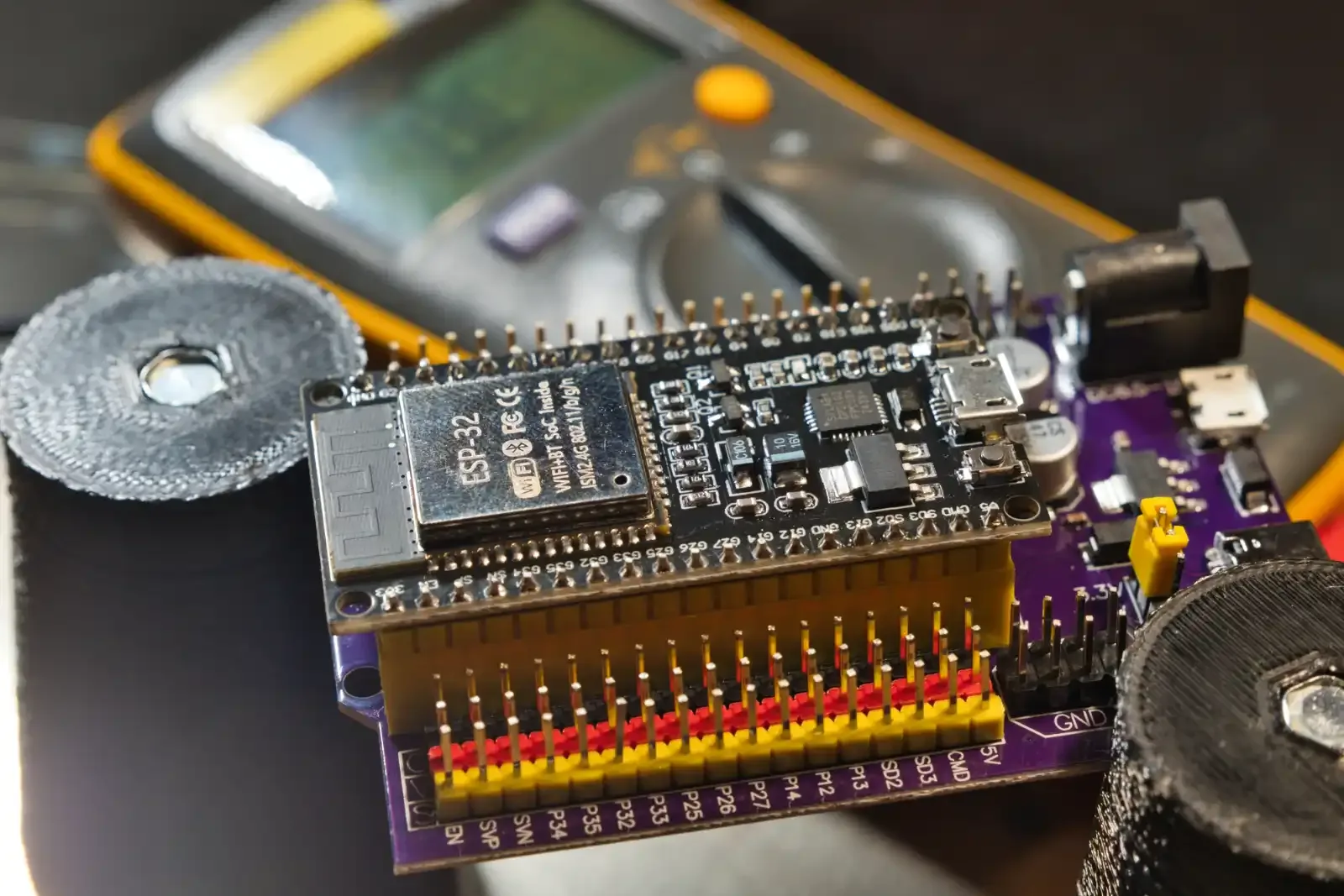
ExpressLRS, the open-source control-link standard, pairs Semtech radios with either an Espressif ESP32/ESP8285 or an STM32 processor. Espressif is a Shanghai company. Its chips are fabricated by TSMC in Taiwan, which does not change the designer’s domicile, and that is what Section 848 and most buyers look at. Many common ELRS transmitter modules use ESP32 as the main processor with an ESP8285 for Wi-Fi.
Flight controllers follow a similar path. The AT32F435 comes from ArteryTek, an MCU designer whose main operating company, Artery Technology (Chongqing), was set up there in 2016. The group is incorporated in the Cayman Islands, has been listed in Taipei since January 2026 and is a Faraday Technology subsidiary, with R&D and sales offices in Chongqing, Shenzhen, Suzhou, Shanghai and Taiwan. The chip is now supported by Betaflight, sold as a cheaper alternative to STM32 chips, and appears in boards from several brands. Most non-PRC rules look at where a chip's maker is domiciled and where the chip was made, so buyers should ask both. The MCU part number is printed on the chip, but buyers rarely ask for it.
STM32-based ELRS hardware is available, but ST raised lead times on several STM32 families to 30–52 weeks in mid-2026, and earlier STM32 shortages are part of what pushed builders toward ArteryTek's cheaper chips. ST also now makes some STM32 families in China, fabbed by Huahong and packaged in Shenzhen, for Chinese customers, starting with the STM32H7, a common flight-controller chip. Buyers should ask for the fab and assembly site as well as the part number.
6. ESCs
Electronic speed controllers carry their own MCU, and some low-cost AM32 ESCs now use the same AT32 processors as flight controllers, sometimes on the same all-in-one board. US and allied makers now offer NDAA-listed ESCs, including entries on the Blue UAS Framework. Off-the-shelf choice is limited for the high-voltage ESCs used on heavier platforms. ESC makers using STM32 chips face the same lead times as flight-controller makers.
7. GNSS receivers
Chinese chipset makers such as Unicore and Allystar supply GNSS and RTK modules sold under many brands. Non-PRC chipsets from u-blox (Switzerland) and Septentrio (Belgium) are widely available. However, u-blox's policy forbids use of its products in weapons, so a non-PRC chipset may still be unusable for some defense programs. A genuine u-blox chipset can also sit in a module built by a Chinese company, so the module maker matters as much as the chipset.
A non-PRC claim needs documents
Everything in the ranking above can be documented: a magnet's maker and grade, the sources of a cell's materials, a detector's fab, an encoder's part number, an MCU's maker, fab and assembly site. A supplier that claims a non-PRC supply chain should be able to hand those documents to a buyer and state clearly which parts are not non-PRC.
Start with the supplier's own datasheet. If a product's spec table lists an ESP32 or an ESP8285, the product contains a processor from a Shanghai company, whatever its marketing says. A claim, such as "NDAA-compliant", that fails against the supplier's own published specifications needs no further checking. The market already treats it this way: US drone parts retailer GetFPV lists a standard ELRS transmitter module built on an ESP32, an ESP8285 and a Semtech SX1280 radio as not NDAA compliant.
Compliance belongs to a product, not a company. "NDAA-compliant" is the seller's own assertion; no agency issues or audits it, as we wrote in August. A claim that covers a whole company or product range tells a buyer nothing about the module in front of them. Blue UAS listing works the same way: it is per product, and one listed product does not carry the label across an entire catalog or company. Where a supplier offers alternative bills of materials, such as an ESP32 build and a non-PRC build of the same module, the claim has to name the part number and revision it covers, and the buyer has to order that build.
Agree on definitions before delivery. A chip can be designed in one country, fabricated in a second and packaged in a third, and its markings may show only the last. Whether packaging counts depends on the buyer's rule. A supplier that lists fab and packaging sites in advance lets the buyer apply that rule before delivery rather than after.
Documents can be false. Executives of two Taiwanese drone suppliers have been detained in National Security Act investigations into allegedly false certificates of origin, as we reported this month. The allegations are unproven. They are the reason buyers who need supply to stay non-PRC write audit rights, lot traceability and change notification into their contracts, as set out in our October piece on origin documents.
Be specific about what is still Chinese. A supplier that says "everything except the magnets" gives a buyer something to act on. One that says "100% non-red" gives the buyer something to check, and a reason to doubt. Suppliers willing to put their sourcing up for scrutiny, as Carbon-Based Technology and E-CURRENT have in our coverage, make the check more efficient and faster.
The same standard applies to distributors, agents and partners who present a supplier as non-PRC. Their claims carry weight only if they hold the supplier's documents, have read them and demonstrate they understand the non-red labels they're using.
Rules and deadlines
US rules cover different components. Section 848 of the FY2020 NDAA bars the Pentagon from drones made in China or by a company domiciled there, and from drones using flight controllers, radios, data transmission devices, cameras or gimbals made by either, or Chinese ground control systems or operating software. It does not cover magnets or battery cells, which fall under separate rules.
| Date | What changes | Who it affects |
|---|---|---|
| In force since Apr 2025 | China's licensing on seven medium and heavy rare earths | Magnet buyers everywhere |
| In force since Dec 2025 | FCC adds all foreign-produced drones and critical components to its Covered List. The test is where a product was made, so Taiwanese parts are covered too. | Anyone selling new drones or critical components into the US |
| In force since Sep 3, 2026 | Section 232 tariffs of up to 100% on drones and components. Taiwanese goods qualify for a 15% cap only if the US importer certifies that substantially all critical components and technology come from the US or qualifying countries. Tariffs on a further list of components start February 9, 2027. | US importers of Taiwanese drones and parts |
| Nov 10, 2026 (legal text) / Jan 10, 2027 (political deal) | China's October 2025 package, including the 0.1% extraterritorial rule on rare-earth content and controls on high-density cells and graphite anodes, is suspended until one of these dates (analysis) | Magnet and battery supply chains outside China |
| Nov 27, 2026 | China's suspension of its germanium, gallium and antimony export ban to the US ends unless renewed; the ban on military end users stays either way | Thermal camera lenses |
| Jan 1, 2027 | DFARS 252.225-7052 extends to NdFeB and SmCo magnets mined, refined or separated in China, Russia, North Korea or Iran, not just melted or produced there | Every US defense contract carrying the clause |
| Jan 1, 2028 | FCC exemptions for Blue UAS-listed and Buy American (65% domestic content) equipment expire unless renewed | Foreign producers relying on Blue UAS listing |
The FCC rule matters most for Taiwanese suppliers selling into the US commercial market. A non-PRC Taiwanese component still needs a Blue UAS listing, Buy American status or a conditional approval to get new equipment authorization; our Blue UAS guide, linked above, covers the routes. Section 232 is the one US instrument where non-PRC content pays directly, and the importer's certification there rests on the supplier's documents.
The DFARS change goes furthest upstream. From January 1, 2027, a magnet's compliance depends on where its ore was mined and separated, so suppliers need documentation back to the mine.
EU rules work differently. EU defense funding under SAFE and EDIP rewards EU, EEA-EFTA and Ukrainian content and caps third-country content, Taiwan included, at 35%. Non-PRC origin gives a Taiwanese part no advantage under these rules. Ukraine has also been allowed to spend part of an EU-backed tranche on Chinese components where other suppliers cannot deliver, Focus Taiwan reported in July. For European buyers, the reason to use a Taiwanese part is security of supply rather than compliance.
India, by contrast, may require origin verification for defense buys under a draft framework for its Defence Acquisition Procedure 2026.
What this means for Taiwan
Taiwan is stronger in the electronics on this list than in the materials. It designs and fabs much of the world's semiconductors, and Taiwanese RF and Wi-Fi chips already sit inside many video links. Taiwanese firms are also building complete non-PRC subsystems: in August 2026 Elan Microelectronics showed Taiwan-made remote controllers, vision-based obstacle avoidance and anti-jamming communications, validated with Thunder Tiger.
Taiwan's battery makers rely on China for cathode and anode materials, and its motor makers buy magnets on a world market where most supply runs through China. Most of the industry outside China shares that dependence. DSET's battery report recommends holding six months of upstream inventory in case supply is cut off.
Most Taiwanese suppliers cannot claim zero Chinese content today. What they can offer is documentation: where the Chinese content is, which parts are non-PRC, and what replacing the rest would cost. As we argued in September, non-red is a capability that suppliers build part by part, and buyers facing the DFARS deadline, a Section 232 certification or an FCC application need the documents that show how far along a supplier is.
The buyer's checklist
Ask for part numbers, makers and documents, not country-of-origin declarations. Suppliers that have mapped their supply chains can answer these promptly.
| Component | Ask for | Answer that needs follow-up |
|---|---|---|
| Motor magnets | Magnet maker, grade, origin of the NdFeB alloy and of any dysprosium or terbium; mine-to-magnet documents for US defense work | "Imported magnets" with no maker named |
| Battery cells | Cell maker and factory; origin of cathode, precursor, anode and separator | A cell origin with no material origins |
| Thermal cores | Detector maker and fab; lens material, lens maker and germanium source | "VOx 640 × 512" with no maker named |
| Video links | Encoder SoC part number, image sensor, RF chip, firmware origin | RF chips named, encoder not mentioned |
| Control links | MCU maker and part number on both the air and ground units; fab and assembly site if your rule covers them | ESP32 or ESP8285 anywhere in the link |
| Flight controllers and ESCs | MCU maker and part number, fab and assembly site; MOSFET and gate-driver makers | A GD32 (GigaDevice, Beijing) or AT32 MCU, or no MCU maker named |
| GNSS | Chipset maker and module assembler; any end-use restrictions | A module brand with no chipset named |
| All of the above | Per-component origin sheet for the exact part number and BOM revision, with the remaining Chinese content stated | A company-wide "NDAA-compliant" or "non-red" claim, or one certificate covering a whole product line |
Some US makers already publish per-component origin sheets for each configuration of a drone, and they show how easily compliance slips. One maker's sheet for its Blue configuration notes that adding the optional FPV system takes the aircraft out of Blue compliance; its sheet for the standard configuration lists the FPV camera as Chinese-made. Buyers should ask for this level of detail.
What buyers can expect
Few suppliers in Taiwan, or anywhere outside China, can show zero Chinese content today, and buyers who demand it will find very few candidates. What buyers can expect is labels that are accurate and consistent with the supplier's own documents. A company that calls its whole range "NDAA-compliant" while its own spec sheet lists a Chinese processor has shown one of two things: it does not understand the rule it is citing, or it has not checked its own products against it. Either is reason enough to stop the conversation. A supplier that writes "non-PRC except the MCU, which is an ESP32" is giving the buyer useful information.
Beyond accurate labels, buyers can expect a supplier to know where its Chinese content is, put it in writing for the exact part they are buying, and keep that record current as parts and sources change. A document set describes one build at one point in time, so buyers who need supply to stay non-PRC also need audit rights and change notification in their contracts.
The dates in this article put a limit on how long that can wait. China's suspended controls could return as early as November 10, the DFARS magnet rule takes effect on January 1, 2027, and the FCC exemptions for listed equipment currently run only to January 1, 2028. Suppliers that can produce the documents now are the ones buyers will be able to qualify before those dates.
When buyers send us a sourcing request, we ask them to detail how far any "non-red" requirement goes, and then ask suppliers what they can document before we make an introduction.
Sourcing drones or components from Taiwan?
Tell us what you need — we match it to verified Taiwan-based manufacturers and make the introduction. There's no charge to submit a request.
Source these components from Taiwan →Could Taiwan's US Supplier Parks One Day Include Drone Makers?
Oct 19, 2026
Taiwan plans industrial parks in the US to help the smaller suppliers of its chi...
Non-Red Is a Requirement, Not a Label: Why TaiwanDrones.com Is Asking Suppliers for Documents Instead of Declarations
Oct 9, 2026
We planned to launch a China-Free verification program with our supplier directo...
What Taiwan Offers Drone Component Buyers Besides Non-Chinese Origin
Oct 5, 2026
Non-red gets a Taiwanese part considered, and competitors elsewhere can claim it...