
Taiwan Drones Weekly News Roundup: June 8 - 14, 2026

June 14, 2026
This week the U.S.-Taiwan drone relationship moved decisively in both directions at once. American Altius-600 loitering munitions struck maritime targets for the first time in Taiwanese live-fire drills, AeroVironment signed an MOU with Taiwanese company Ubiqconn to develop a common controller for the indigenous drone fleet, and Defense News published the clearest analyst case yet for the reverse flow: Taiwanese drones being pitched into U.S. military procurement. Add a four-drone donation to Palau by VP Hsiao Bi-khim, a TEDIBOA tech forum where President Lai got eyes on Jiin Ming's new fixed-wing UAV, and another Taiwanese chipmaker pivoting into drone vision, and the week reads as the supply chain getting more bidirectional, more diplomatic, and more crowded at the same time. Here's the week.
1. The US usually sells weapons to Taiwan — with drones, expect the reverse
Defense News — June 10, 2026 · Read article
Defense News pulled together the strongest analyst case yet for the role reversal at the heart of Taiwan's drone strategy: Taiwan positioning to sell drones to the U.S. military rather than just buy weapons from it. The piece quotes Lee Yi-ching of the Market Intelligence & Consulting Institute on Western buyers prioritizing supply-chain resilience, Jeremiah Gertler of AeroDynamic Advisory on the U.S. needing allied production to bridge a domestic capacity gap (legislators proposed expanding U.S. drone output to one million units a year in 2025), and Sean Su making the bluntest case: cost barely matters when Taiwanese drones are already dozens of times cheaper than competing platforms, and the absence of China in the supply chain is the real product. This seems to be a clear articulation of the strategic positioning Taiwan's officials have been pushing for months, now backed by real transactions.
2. Taiwanese forces deploy American-made attack drones against maritime targets
USNI News — June 10, 2026 · Read article
Taiwan's Anduril-supplied Altius-600 loitering munitions struck offshore targets along the west coast last week. It is the first time the Republic of China Army has used the system against maritime targets, and a clear signal of how the roughly 2,000 Altius-600s delivered in recent years fit into the anti-invasion concept. At least three towed flatbed launchers carrying four drones each were deployed, paired with Thunderbolt-2000 MLRS, M109 self-propelled guns, and anti-tank missiles, in a setup that explicitly addresses the gap between long-range anti-ship missiles and short-range artillery. Worth reading as the live-fire payoff of the June "Drone Exercise Month" announced in our May 25–31 roundup, and as crucial context for the planned activation of the Littoral Combat Command next month, a Marines-Navy-fast-attack-craft formation built to defeat maritime threats within 24 nautical miles, with drones explicitly named as a core capability.
3. AeroVironment, Ubiqconn team up on common drone control system for Taiwan
The Defense Post — June 15, 2026 · Read article
AeroVironment and Taiwanese ruggedized-hardware specialist Ubiqconn signed an MOU on June 11 to jointly develop a common drone control system for Taiwan's indigenous UAV program. AeroVironment is contributing its Kinesis mission-management software and command-and-control stack, and Ubiqconn is supplying the controller hardware and handling engagement with Taiwanese drone manufacturers to expand compatibility across locally developed platforms. AV's Justin McFarlin explained the goal: with Taipei planning to procure tens of thousands of indigenous drones, a unified controller reduces training burden, simplifies sustainment, and keeps the fleet interoperable across services. Worth reading because this is the "operating system" play: less glamorous than airframes, but arguably more strategic, since whoever sets the control standard shapes which manufacturers can plug in.
4. VP Hsiao visits Palau, donates Taiwan-made drones
Focus Taiwan — June 11, 2026 · Watch clip
Vice President Hsiao Bi-khim's June 6–10 trip to Palau included a ceremony in Koror with President Surangel Whipps Jr. where Taiwan donated four locally made multi-functional drones, framed as a boost to the Pacific ally's disaster response capabilities. The trip paired the drone handover with agricultural collaboration around local crop production and import substitution. Worth reading because it's the first concrete export-via-diplomacy moment for Taiwan's drone industry: democratic-supply-chain UAVs flowing not to a buyer or a procurement program, but as a state-to-state gift. Palau sits squarely in a Pacific theater where Beijing has been actively contesting Taipei's remaining allies, which makes "four drones for disaster response" both a humanitarian gesture and a strategic signal, and a template the Lai government can replicate with the other eleven.
5. Jiin Ming exhibits fixed-wing UAV at tech forum
Taipei Times — June 11, 2026 · Read article
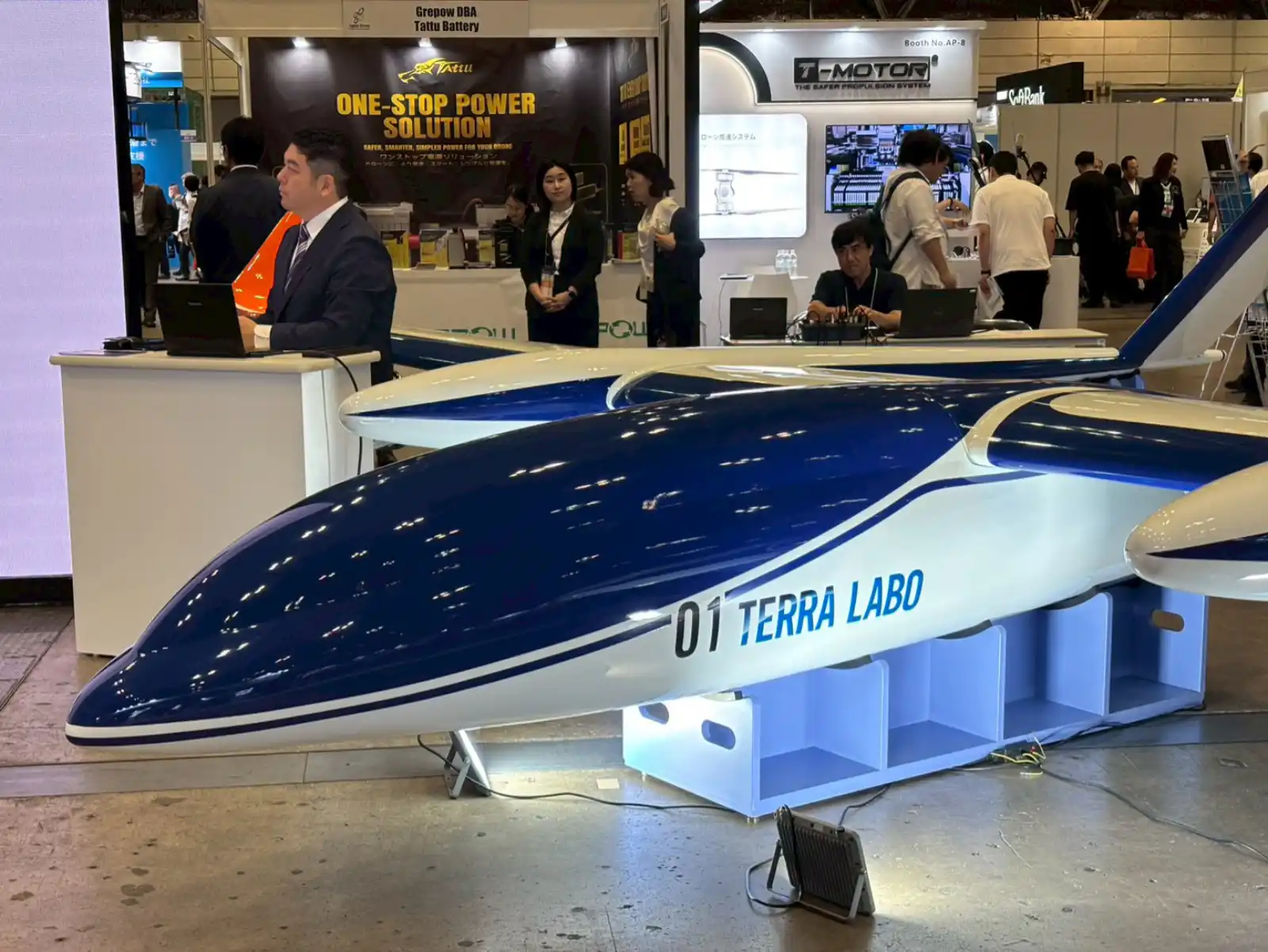
Jiin Ming Industry (錦明) showcased a new fixed-wing UAV alongside its digital video transmission module and anti-jamming tech at a TEDIBOA-organized tech forum in Taichung, with AIDC, Thunder Tiger, and other supply-chain players on hand and President Lai in attendance. Chairman Tsai Hsiang-feng's earlier April investor briefing offers useful context: Jiin Ming has been delivering multirotor "Viper" drones to the military at small scale for training since 2025, but hasn't seen major orders because the legislature blocked the NT$50 billion weapons procurement line, a concrete, firm-level illustration of how the budget cuts are landing. The company has booked Japanese orders and is now scouting Ukraine and the Middle East. Worth reading as both a TEDIBOA-momentum story and a useful reminder that the budget fight isn't abstract: real Taiwanese suppliers are pivoting toward overseas markets because domestic procurement is stuck.
6. Elan Microelectronics expands AI imaging into drone applications
Taiwan News — June 9, 2026 · Read article
Elan Microelectronics is repositioning eight-plus years of AI image-processing work — originally built for smart transportation, automotive surround-view, and visual recognition — into drone applications, with on-device processing for real-time object recognition, intelligent tracking, and 360-degree obstacle avoidance. The company is also building drone-side controller hardware tuned for outdoor field conditions: high-brightness displays, water resistance, glove-compatible operation. Chair Yeh I-hau pointed directly to non-China supply chain demand as the driver, and argued that the winners will be companies that can integrate AI vision, flight control, communications, and security into complete system-level offerings rather than selling components piecemeal. Worth reading as yet another Taiwanese chip firm pivoting in, and a sign of how the consolidation thesis (vertically integrated stack vs. discrete components) is starting to crystallize.
That's the week. Watch for the Littoral Combat Command activation next month, follow-on AeroVironment–Ubiqconn demonstrations, and whether the resubmitted drone budget makes any progress through the legislature.
Sourcing drones or components from Taiwan?
Tell us what you need — we match it to verified Taiwan-based manufacturers and make the introduction. There's no charge to submit a request.
Source these components from Taiwan →Taiwan Drones Weekly News Roundup: September 7 - 13, 2026
Sep 13, 2026
This week's clearest signal was not that Taiwan needs more drones. It was that b...
Taiwan Drones Weekly News Roundup: August 31 - September 6, 2026
Sep 6, 2026
This was the week Taiwan's drone advantage got priced by three different governm...
Taiwan Drones Weekly News Roundup: August 24 - 30, 2026
Aug 30, 2026
Taiwan's drone-funding fight finally produced a number this week: NT$240 billion...