
Taiwan Drones Weekly News Roundup: June 15 - 21, 2026

June 21, 2026
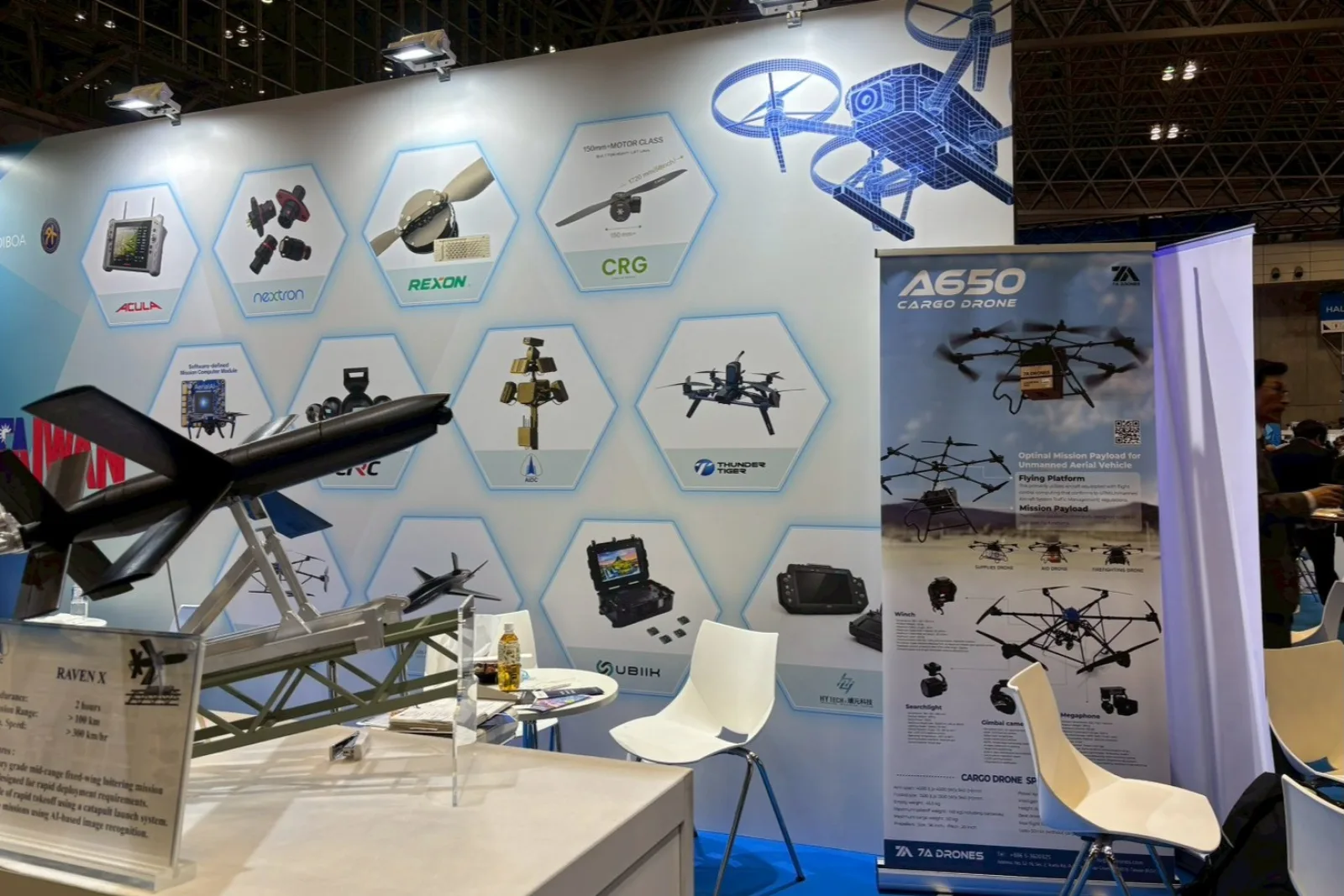
This was the week Taiwan's drone story ran in every direction at once: a new NT$210 billion procurement proposal landed before the legislature had finished arguing about the last one, Ukrainian firms showed up in Taichung hunting for components, and civilians in Taipei were learning to hover drones around traffic cones on a Saturday afternoon. The supply-chain pressures that have been building for months came into focus too, as Digitimes reported that foreign certification timelines are pushing Taiwanese manufacturers away from simple exports and toward joint ventures. The demand signal from the region has never been clearer; the domestic machinery for translating it into budgets and supply chains is still catching up. Here's the week.
1. Taiwan Tables NT$210 Billion Drone Budget — The Second One This Year
Plataforma Media — June 18, 2026 · Read article
The Executive Yuan proposed a new NT$210 billion (roughly US$6.65 billion) special budget on June 18 to fund phased acquisition of military drones through the end of 2031, covering surveillance UAVs, coastal attack drones, and small unmanned suicide boats. Executive Yuan spokesperson Michelle Lee framed the proposal around asymmetric warfare, while Premier Cho Jung-tai used the occasion to call for deeper integration into non-China global supply chains and expansion of domestic manufacturing capacity. The timing matters: this is the second special defense package tabled this year, coming just six weeks after parliament approved a NT$780 billion defense bill that explicitly excluded drones and other locally produced equipment. President Lai's declaration that his government "would not surrender" on defense self-sufficiency is now backed by a specific line item — one that will immediately face the same opposition coalition that cut the first package from NT$1.25 trillion down to NT$780 billion.
2. Opposition Wants Oversight Built In, Not Promised Later
Taipei Times — June 19, 2026 · Read article
The sharpest line in the legislative response came from TPP caucus whip Chen Ching-lung (陳清龍), who demanded no "opaque decisionmaking" and called for a clear oversight mechanism before the party would engage with the NT$210 billion proposal at all. That framing matters more than the familiar opposition-blocks-budget headline: special budgets in Taiwan are exempt from the deficit restrictions that apply to regular spending, which is precisely what gives the executive flexibility — and what gives the legislature its leverage to demand accountability in return. KMT legislator Lai Shyh-bao (賴士葆) made the structural argument explicit, warning that routing drone funding through a special statute weakens parliament's constitutional check on the executive. His alternative, a standard industry development act under the Ministry of Economic Affairs, is worth watching; it would put drone industrial policy on a different institutional footing than defense procurement. For suppliers and investors tracking when and how this money actually moves, the oversight provisions the executive is willing to write into the bill will determine how long the negotiation takes.
3. Ukrainian Drone Makers Came to Taichung Looking for Parts
Reuters — June 19, 2026 · Read article
In May, the Ukrainian drone association IRON brought roughly a dozen members to Taichung to meet with Taiwanese firms and find component suppliers, a gathering Reuters is reporting for the first time. UFORCE CEO Oleg Rogynskyy has been pitching Japanese officials and defense contractors on a parallel track, citing the Magura surface vessel's record of turning parts of the Black Sea into no-go zones for Russia's navy. The Taiwan piece of the story carries an additional wrinkle: Jiin Ming Industry's Elson Zhang told Reuters his company is in early-stage collaboration with a Ukrainian partner on a drone that may eventually be sold back to Taiwan, though he declined to name the partner. The broader picture Reuters assembles is of a structural shift rather than a sales trip: Ukrainian firms are trying to reduce dependence on Chinese components, Japan and Taiwan make many of the cameras and microelectronics they need, and the incentive to find alternative suppliers runs in both directions now that Beijing has placed some restrictions on drone-parts exports.
4. Certification Walls Are Pushing Taiwan's Drone Exporters toward Joint Ventures
Digitimes — June 18, 2026 · Read article
Taiwan's drone exports are gaining traction, but the regulatory path into foreign markets is long and getting longer. Industry sources told Digitimes that mid-tier certification in Southeast Asia takes at least six months; in the US, the timeline stretches to one or two years. The compliance burden covers not just the airframe but individual subsystems: tracking systems, infrared imaging equipment, batteries, and motors each face separate reviews. The response from Taiwan manufacturers has been to pivot toward joint ventures with local partners, allowing the local entity to apply for certification as a domestic company and enabling technology transfers that satisfy governments' push for supply-chain self-sufficiency. The underlying structural point is the one this audience will recognize: drones are now treated as defense and security technology in nearly every jurisdiction, which means the export-hardware model is gradually giving way to a build-local, partner-local model. The regulatory drag isn't slowing Taiwan's export momentum so much as redirecting where the value lands.
5. Taiwan's First Civil Defense Drone Pilot Course Is Sold Out through August
The Guardian — June 18, 2026 · Read article
Kuma Academy, the Taipei civil defense NGO, launched Taiwan's first civilian drone piloting course in May, and demand has outrun capacity: sessions are sold out through August, with roughly 75 people trained per month. Instructor Tao Han teaches participants battlefield applications of drones, but the student profile in the Guardian's reporting is notably broad: two teenagers, a 65-year-old retiree, and a mix of adults through their 60s, more than half of them women. Taiwan now has over 39,000 registered drones, and the Civil Aviation Administration lowered the minimum registration age to 14 in 2024; some Taipei high schools have started drone assembly summer camps. The quote that cuts through the human-interest framing belongs to Pan Chien-chin, a 48-year-old food company worker who attended the course: "We can't change the broader environment, so the only thing we can do is prepare ourselves as best we can." That sentiment is running directly parallel to the budget fight two items up: citizens building drone skills because domestic procurement is gridlocked is not a coincidence.
That's the week. Watch for the NT$210 billion budget's path through the legislature, whether the Jiin Ming–Ukraine collaboration surfaces more details, and how many Taiwanese manufacturers follow the joint-venture route into the US market ahead of that one-to-two-year certification clock.
Sourcing drones or components from Taiwan?
Tell us what you need — we match it to verified Taiwan-based manufacturers and make the introduction. There's no charge to submit a request.
Source these components from Taiwan →Taiwan Drones Weekly News Roundup: September 7 - 13, 2026
Sep 13, 2026
This week's clearest signal was not that Taiwan needs more drones. It was that b...
Taiwan Drones Weekly News Roundup: August 31 - September 6, 2026
Sep 6, 2026
This was the week Taiwan's drone advantage got priced by three different governm...
Taiwan Drones Weekly News Roundup: August 24 - 30, 2026
Aug 30, 2026
Taiwan's drone-funding fight finally produced a number this week: NT$240 billion...